Crossrail, London, United Kingdom


|
In October 2007 the UK Government secured a £16bn funding deal for Crossrail, giving the go-ahead to secure the construction of the project running between Paddington and Liverpool Street mainline stations. The route, agreed in principle in summer 2004, would take it through the centre of the city, with trains capable of carrying up to 1,100 people every two and a half minutes. Long-time supporter of the scheme, former London Mayor Ken Livingstone said: "Crossrail is not just a transport scheme; it is the key to the next 20 years of economic development of London." Government claims that Crossrail will underpin a £20bn boost to the UK economy. 
Typical current journey times from North Kent to Central London are around an hour. Crossrail will cut these by around a third. The journey to Heathrow, currently over one and a half hours, will be cut by up to a quarter. "Typical current journey times from North Kent to Central London are around an hour. Crossrail will cut these by around a third."
Crossrail has been promoted by Cross London Rail Links, a joint venture company formed by Transport for London (TfL) and the Strategic Rail Authority (SRA), the latter now defunct and their role assumed by the Department for Transport. As London's importance as an employer increases, Crossrail will make new developments in the City, Isle of Dogs/Canary Wharf and the Thames Gateway accessible from other areas, without imposing extra burden on the already strained Underground and urban road network. The projectCrossrail's brief is to provide the transport capability to cope with London's forecast population and economic growth. With Crossrail services taking over from many of those routed into the termini, capacity will be freed at existing termini such as Liverpool Street and Paddington. New opportunities for interchanges with TfL Underground and Overground services will further reduce the volumes currently concentrated at the termini, moreover the central London stations in business and retail areas will remove the need for many passengers to transfer onto other modes at all. The use of the route for freight trains had been envisaged, but this does not form part of the business case to build the line. The Freight on Rail partnership of rail freight operators, Rail Freight Group, Network Rail, the transport trade unions and Transport 2000 have expressed concern about the potential track restrictions that Crossrail could cause to the main lines at either end of the route which carry high levels of freight. In the core Central London section, there will be stations at Paddington, Bond Street, Tottenham Court Road, Farringdon, Moorgate / Liverpool Street and Whitechapel, all with interchanges for Underground and commuter 'heavy rail' stations. A major change to the plan was the decision not to run services through to the new station being built at Ebbsfleet, Kent, for High Speed 1, the Channel Tunnel Rail Link. The main difficulty involved guaranteeing service reliability along the congested North Kent Line. Instead, trains will terminate at Abbey Wood on its south eastern section. A new cross-platform interchange will be built at Abbey Wood to ensure a smooth connection for passengers wishing to travel to and from North Kent, with a maximum five-minute wait for a Crossrail train during peak hours. InfrastructureThe heart of the project is the construction of a new 16km (10 mile) tunnelled route across London, including the branch of the eastern end to Shenfield and Abbey Wood. Crossrail will, for the first time, allow existing suburban east-west rail services to run through central London. Portals for the main tunnels will be at Royal Oak to the west of Paddington and in the east at Custom House and Pudding Mill Lane. "Becoming Europe's largest civil engineering project, major works are due to begin in 2010, with the first service trains expected to run in 2017."
There were earlier intentions for other lines to be promoted under the Crossrail identity, but these have now all been shelved in favour of promoting only the route described here. For through running, the Great Western main line west of (Heathrow) Airport Junction would need electrification as far as Maidenhead, the proposed western limit of Crossrail operations. Many existing stations would need platform lengthening to accommodate the new trains. Crossrail will be a major engineering exercise needing a wide range of multi-disciplinary skills. Substantial pre-planning and design work has been carried out to demonstrate that the scheme is technically feasible, and can be built on time and on budget. Most of the spoil (earth removed from the tunnels) will be removed from four portal sites, keeping local disruption to a minimum. The project's twin 6m bores totalling 41km (25.5 miles) will be constructed with tunnel-boring machines designed for the ground conditions and ensuring that ground movement is minimised. Over 8,500 jobs are envisaged as being needed to create the infrastructure. Construction will incorporate the latest elements of proven best practice in order to minimise ground-borne noise and vibration. The extensive underground infrastructure and location of existing deep building foundations have determined the route alignment, which was safeguarded 12 years ago. Preliminary studies indicated that re-used railway land at Romford in east London could be the site of the system's depot, although Brentwood and existing maintenance sites at Ilford and North Pole (formerly Eurostar) have also been considered. Recent practice indicates the likelihood of a rolling stock build-and-maintain operation for a specified duration. Rolling stockThe Crossrail fleet will comprise purpose-built, energy-efficient, high-performance trains, possibly twin five-car dual voltage sets using overhead lines and third rail systems; their performance will be capable of delivering a train approximately every two minutes in the Central London area. Carriage design will facilitate rapid entry and exit, and interiors will be climate controlled. Crossrail will be accessible to mobility impaired passengers. Rolling stock commissioning is likely to be concentrated on the Great Eastern main line. The rolling stock procurement process is yet to commence. Signalling/communicationsThe signalling and communications strategy of Crossrail is still in the early stages of development, although the European Rail Traffic Management System (ERTMS) will be installed. Signalling will need compatibility with the traffic on lines being integrated into the scheme. The deep tunnel section will call for a high level of security, with the capability of emergency services access and for evacuation of large numbers. The future"London's winning bid for the 2012 Olympic Games did not include Crossrail as part of the transport provisions."
Hosting an Olympic Games was previously seen as impetus for Crossrail's earlier development. However, London's winning bid for the 2012 Olympic Games did not include Crossrail as part of the transport provisions. That role was by implication deemed adequately catered for by the Javelin/High Speed 1 service to the Olympic Park at Stratford, also by expansion of the Docklands Light railway, improvements to the Underground and creation of the Overground format. Nevertheless, Crossrail has now joined what appears to be a relative boom in spending on UK railway projects. Although the Crossrail go-ahead has been widely welcomed, aspects continue to generate controversy. As Crossrail is projected as a standalone operation, this precludes integration with long-distance UK services. More specifically, maintaining the Heathrow rail service as a spur rather than enabling long-distance through-services is felt to be missing a larger opportunity to encourage rail access as per the LGV eastern by-pass of Paris via Charles de Gaulle airport or the intentions for the Berlin Brandenburg International. In July 2008 the Arup company proposed a separate project related to new high-speed lines to fill the long-distance role at Heathrow. The decision to make Maidenhead the western terminus, as opposed to the important rail interchange of Reading just to the west, has attracted also widespread comment. In February 2008 the DfT announced an intention to safeguard land for potential Ebbsfleet and Reading extensions, albeit without making any commitment for the proposed structure to be amended. The municipal governing body of the City of London, the City of London Corporation, agreed to help meet an approximate £400m funding gap that was holding back the scheme before final approval was given in October 2007. Becoming the Crossrail Act 2008, Royal Assent was received in July 2008, with the Board being restructured shortly thereafter. Set to be Europe's largest civil engineering project, major works are due to begin in 2010, with the first service trains expected to run in 2017, effectively adding 10% to the capacity of London's public transport. The expectation is that Crossrail will become a wholly owned TfL subsidiary. |
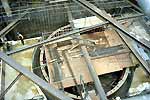  Expand Image Expand ImageOngoing construction work for the Crossrail project at Moor House. |
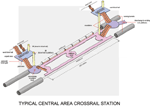 Expand Image Expand ImageThe layout of a typical Crossrail station in Central London. | |
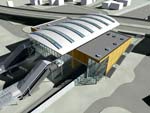 Expand Image Expand ImageThe remodelled exterior of Abbey Wood station. | |
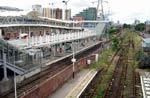 Expand Image Expand ImageCrossrail can reuse the abandoned North London Line alignment (seen right) at Custom House, offering interchange with the Docklands Light Railway. | |
 Expand Image Expand ImageThe future equivalent of this Shenfield-bound train will be part of a Crossrail service using a tunnel beneath central London. | |
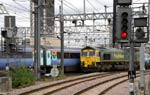 Expand Image Expand ImageFreight interests have expressed concern that Crossrail services will restrict freight services at busy locations such as Stratford on the Great Eastern main line. | |
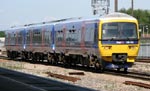 Expand Image Expand ImageWith new electrification east from Maidenhead, Thames Valley stopping services would be transformed as part of the Crossrail operation. | |
 Expand Image Expand ImageThe go-ahead for Crossrail was given in October 2007. | |
 Expand Image Expand ImageIn east London, Crossrail branches to the Great Eastern line (foreground) and Canary Wharf (left, background). | |
 Expand Image Expand ImageCrossrail's south-eastern arm will add rail capacity at Canary Wharf to that of the Jubilee Line and Docklands Light Railway. | |
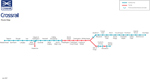 Expand Image Expand ImageThe modified Crossrail route. | |
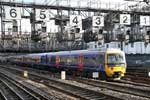 Expand Image Expand ImageThe western portals of the main tunnels beneath central London will be at Royal Oak near Paddington. |

Related links
Bids Invited for Four Crossrail Stations Work
Crossrail to Join Tunnel-Station Works to Save Money
Crossrail to Join Tunnel-Station Works to Save Money
Crossrail Hails New Transport Secretary's Rail Link Decision
Crossrail Budget to be Slashed
BBMV Wins Crossrail Tunnel Deal
Design Tender for Crossrail's North-East Section Invited
High Speed 1
Cross River Tram, London
The Crossrail Skills Crisis
Next Stop 2008
Firms Team Up to Bid for Crossrail Tunnelling Contracts
Crossrail Invites Bids for Thames Tunnel Contract