Matara-Kataragama Railway Line, Sri Lanka


|
The Matara-Kataragama Railway Line is a 114.5km-long Sri Lankan railway project. Currently under construction, the project will extend the coastal line from Matara to Kataragama. It is one of the pilot projects being built under the Mahinda Chinthnaya (which means Vision for the Future in Sri Lanka's Sinhala language), a multi-year policy programme launched by the Sri Lanka government with the aim of driving the nation's economic growth rate forward. The Matara-Kataragama rail line will add to the existing 1,450km of national rail network. Estimated at $366m, the project is owned and will be operated by the Sri Lankan Ministry of Transport. The project is scheduled to be completed by 2015. 
The new rail line aims to facilitate efficient and economic transport services in the region by promoting competition between rail and road transport. It will also benefit commuters travelling to remote areas of Matara while increasing the number of pilgrims visiting the sacred places in the Southern Province. The project is being built in collaboration with China. A memorandum of understanding (MoU) to construct the line was signed between the Sri Lankan Government and China in 2006. The Chinese International Trust and Investment Company (CITIC) Group is constructing the entire project. "The Matara-Kataragama rail line will add to the existing 1,450km of national rail network."
Project detailsThe project is being carried out in three stages. It involves the laying of double track in the entire route. However, only a single track will be constructed initially. Stage 1 consists of a 27km-long railway route from Matara to Beliatta. Construction works on this section began in April 2010 and it is expected to open by the end of 2010. The route will initially have four main stations at Kekanadura, Bambarenda, Wewurukannala and Beliatta. It will also have two sub-stations at Piladuwa and Weharahena. More stations will be added on this section in future depending on passenger demand. As of July 2010, around 1,411 land plots were acquired from residents for the construction of the railway line between Matara and Beliatta. The Railway Department had to pay LKR710m as compensation to the people from whom the land was acquired. Civil and path clearing works were also carried out. Stage II consists of a continuation of the railway track from Beliatta to Hambantota, which will be 48km-long. This line is scheduled to be complete by 2012. Stage III will involve construction of a 39.5km-long rail line from Hambantota to Kataragama. InfrastructureThe project will have all-new railway crossings developed over the main roads to avoid accidents. The Matara-Beliatta section will have 12 bridges. A new 170m-long bridge across the Nilwala Ganga situated a mile away from the Matara Railway Station was completed in August 2008 after a two year construction period. Constructed at a cost of LKR91m, it is the longest railway bridge seen by the country. Around 90% of the construction cost was borne by the CITIC. Stage I will also feature bridges at Walawe Ganga, Kirindi Oya and Kirama Oya which are supposed to be expensive and time consuming. The route will have a 600m-long tunnel. The travel time between Matara and Beliatta will be 20 minutes as the trains will travel at a speed of 120km/h. Sri Lankan railwaysRailways account for just 7% of the land transport in Sri Lanka with road transport accounting for 93%. Colombo, the capital city of Sri Lanka, connects to the main cities of Kandy, Galle, Matara, Anuradhapura, Gampaha, Negombo, Kurunegala, Avissawella, Kalutara, Polonnaruwa, Batticaloa, Trincomalee, Badulla, Gampola, Nawalapitiya, Matale, Vavuniya, Puttalam and Chilaw, located across nine provinces. "The Matara-Beliatta section will have 12 bridges."
The first rail line was opened in April 1867 between Colombo and Kandy. Most of the railways were developed only during British rule as distribution networks for the plantations that grew products such as tea, rubber and coconut. This resulted in railways focussing more on the plantation areas and less on the population and service centres. The lines to Jaffna, Kankesanturai and Mannar were destroyed by the LTTE group. Some of the narrow gauge lines from Nanu Oys to Nuwara Eliya, Avissawella to Yatiyantota and Avissawella to Ratnapura and Opanayaka have been dismantled as they incurred financial losses. |
  Expand Image Expand ImageCivil works being carried out for the sub-station at Weharahena. |
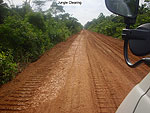 Expand Image Expand ImagePath being cleared for laying the tracks for Stage I. | |
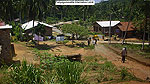 Expand Image Expand ImageAlternative land arranged for the people at Palliyaguruwattha. | |
 Expand Image Expand ImageAlternative land arranged for the people at Palliyaguruwattha. | |
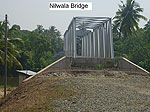 Expand Image Expand ImageConstruction of Niwala Bridge. |