




 |

|
|
 10.12.2023, 15:46
|
#1 (ссылка) |
|
Crow indian


Регистрация: 21.02.2009
Возраст: 41
Сообщений: 30,469
Поблагодарил: 398 раз(а)
Поблагодарили 6057 раз(а)
Фотоальбомы:
2624 фото
Записей в дневнике: 911
Репутация: 126141
|
Тема: Basics of vibration diagnostics of locomotive bearing unitsBasics of vibration diagnostics of locomotive bearing units M.Yu. GERASIMOV, Head of the Non-Destructive Testing Sector and technical diagnostics of the Locomotive Engineering Design Bureau - a branch of JSC Russian Railways The most important component in ensuring the safety of traction rolling stock is high-quality vibration diagnostics (VD) of rolling bearings, which is aimed at the timely detection of unacceptable operational defects that can cause a transport accident, including a crash, as well as an interruption in train traffic. The economic component of VD work in the locomotive industry is mainly associated with reducing the costs of unscheduled repairs and downtime of locomotives, as well as compensation for damage resulting from transport accidents. The development of diagnostic systems for traction rolling stock involves solving three main problems.
With this approach, there are three main problems that need to be solved:
In Fig. 1 shows corrosion defects and metal chipping on the working surfaces of bearing rings and rollers. When even small corrosion spots and shells form on the rolling surface, the durability of the bearing is significantly reduced. The root cause of the appearance of cavities on the working surfaces is various wear, dents, scuffs, surface damage, electrical burns or corrosion that occurs due to moisture entering the bearing housing, as well as a lack of lubrication, its quality or unfavorable lubrication conditions, leading to increased temperatures and excessive loads . In Fig. Figure 2 shows a clear example of the formation of cracks on the working surfaces of bearing rings and rollers. The main reason for the formation of this defect is the fit of the inner rings of the bearing on the shaft of the traction motor or the axle of the wheelset with increased radial clearance. In bearings with increased radial clearance, when exposed to light loads and rotation at an increased frequency, relative slippage (rotation) can occur and, as a result, wear of the rolling elements and cage with further jamming of the unit. Fatigue failures sooner or later lead to fracture of the bearing rings. This also applies to cases of contact corrosion. In Fig. Figure 3 shows the defects of extreme wear and rupture of the cage of rolling bearings. The cause of extreme wear of the bearing cage may be a violation of lubrication technology, since sliding friction between the cage and other bearing components cannot be eliminated; the cage is the bearing part that fails first if there is insufficient lubrication or poor quality lubrication. Cages are always made of materials that are softer than other bearing parts, for example, brass or polyamide, so they wear out more intensively. For bearings with the cage centered along the rolling elements, the size of the cage pockets increases due to wear. This leads to deviations from normal bearing kinematics. The forces generated by this phenomenon can destroy the separator in a short time. The use of bearings manufactured in accordance with GOST 520-2011 “Rolling bearings. General technical conditions", instead of bearings manufactured according to the technical conditions of VNIPP (TU VNIPP), in the wheel-motor, wheel-gear units of locomotives leads to an increase in the operating temperature of the bearings due to the lack of clearance between the ends of the rollers and the collars of the outer ring. 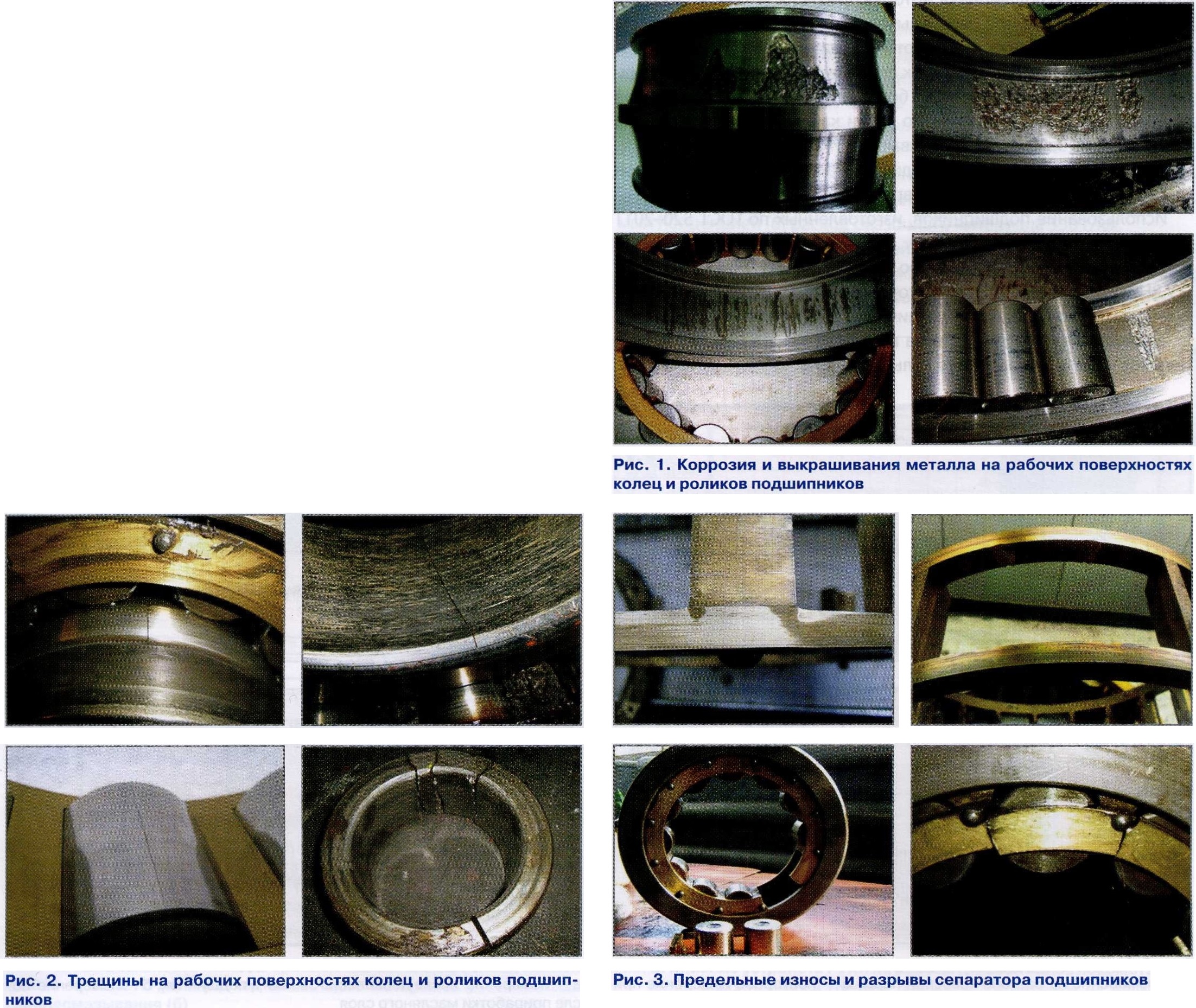 It should be noted that these specifications (TU VNIPP) are additions to the general machine-building GOST 520-2011 and contain special requirements for bearings of domestic manufacturers. These specifications for bearings significantly tighten the requirements of this GOST for the material, accuracy indicators, roughness, microstructure of the material of the parts of the mentioned elements, acceptance, control methods and manufacturer guarantees. With increased loads on the cage, due to increased friction forces of the rollers on the shoulder of the outer ring, the cage bridges wear out earlier than the calculated values, and accordingly, the cage is destroyed, followed by jamming of the bearing. In the absence of rated loads that act while the locomotive is moving, it is possible to detect a defect in a non-standard bearing when conducting vibration diagnostic tests only at the last stages of destruction. In Fig. 4 shows photographs of the pre-emergency state of the unit. Often, in the process of conducting VD, it is necessary to identify bearings in a pre-failure state, when the cage is almost destroyed, while other elements of the bearing are also damaged, and this makes it difficult to determine the actual cause of destruction. Based on practice, there are a number of main reasons for the failure of bearing units, i.e. preceding the pre-emergency state of the node, which are given above. In Fig. Figure 5 shows defects in the gearing (traction drive) of the locomotive and their consequences. These photographs show an example of weakening (compression) of a gear with the further possible prospect of jamming of the motor-anchor bearing. Cases of identified compactions, various chips and wear of the gear and gear are identified when a VD specialist issues recommendations when inspecting the unit, based on automatic diagnosis data or in the process of taking measurements when deviations occur in the normal operation of the gears. Modern diagnostic systems, subject to compliance with all the rules for carrying out measurements and diagnostics in automatic mode, with sufficiently high reliability, can determine the type of defect and the degree of its development, and make a forecast about the trouble-free service life. At the same time, components and mechanisms, in particular bearing units of wheel-motor and wheel-gear units, have design features that have a significant impact on the vibration pattern. And only a competent, trained specialist with sufficient work experience can correct the diagnosis with high reliability, taking into account the design features of the node being diagnosed and the measurement conditions. At the same time, to make a diagnosis, a specialist needs a mandatory set of vibration measurements, provided for by the technological instructions PKB TsT.25.0142, namely: & auto-spectrum of low-frequency vibration; & envelope spectrum, pre-selected by a wideband filter, of random high-frequency vibration; & RMS value and kurtosis value of an ultrasonic vibration signal (UHF), measured in a band with an upper limit frequency of at least 15 kHz. It is necessary to note a number of problems that VD specialists face when carrying out the required work. In Fig. 6 - 12 show the most common situations when diagnosing. In Fig. Figure 6 shows an example of high-frequency vibration spectra measured on the bearing shield of a motor armature bearing with a crack on the rolling body at an unstable rotation speed during acceleration of the wheelset and after stabilization of the speed. In a situation with an unstable rotation speed, the harmonic components of vibration from a bearing defect are blurred and have a shallower modulation depth; accordingly, the diagnostic program cannot make a correct diagnosis. In Fig. Figure 7 shows high-frequency vibration spectra measured on the bearing shield of a motor armature bearing with a cracked inner ring immediately after adding lubricant to the bearing and after running in the oil layer. This example illustrates how grease masks vibration from a bearing defect. In Fig. Figure 8 shows vibration spectra measured on the axle box housing at a negative bearing temperature and then after warming up the bearing during the running-in process. This example clearly shows how the increase in high-frequency vibration due to rupture of the oil film at a negative bearing temperature masks vibration from a supposed defect in the bearing cage. In Fig. Figure 9 shows vibration spectra measured on the axle box unit with serviceable bearings and insufficient gearbox rotation speed. A similar spectral pattern can occur with increased radial clearance of the axle bearing. In the spectrum of the vibration power envelope, a harmonic series is clearly visible at the frequency of rolling elements rolling along the outer ring. In this case, the vibration arose due to the impact of the rolling element (roller) on the outer ring when leaving the upper unloaded zone in the bearing at low rotation speed, when the wheel-motor unit was suspended on jacks. The diagnostic program does not take into account the design features of this axlebox and makes a diagnosis of “Sink on the outer ring”. The following example (see Fig. 9) shows a case with a real shell on the outer ring. A qualified specialist, analyzing vibration spectra and additional signs of defects with a high degree of reliability, must be able to distinguish vibration from a defect in a bearing with vibration of a different nature. This is the simplest and most common mistake when making a diagnosis. Statistics show that there are often cases of diagnosing a pre-emergency state of a node. Diagnosing this condition is not easy, since the geometry of the bearing is broken, the vibration is non-periodic, and it is almost impossible to distinguish such bearings by ear, since they still perform their function properly. This example is shown in Fig. 10. 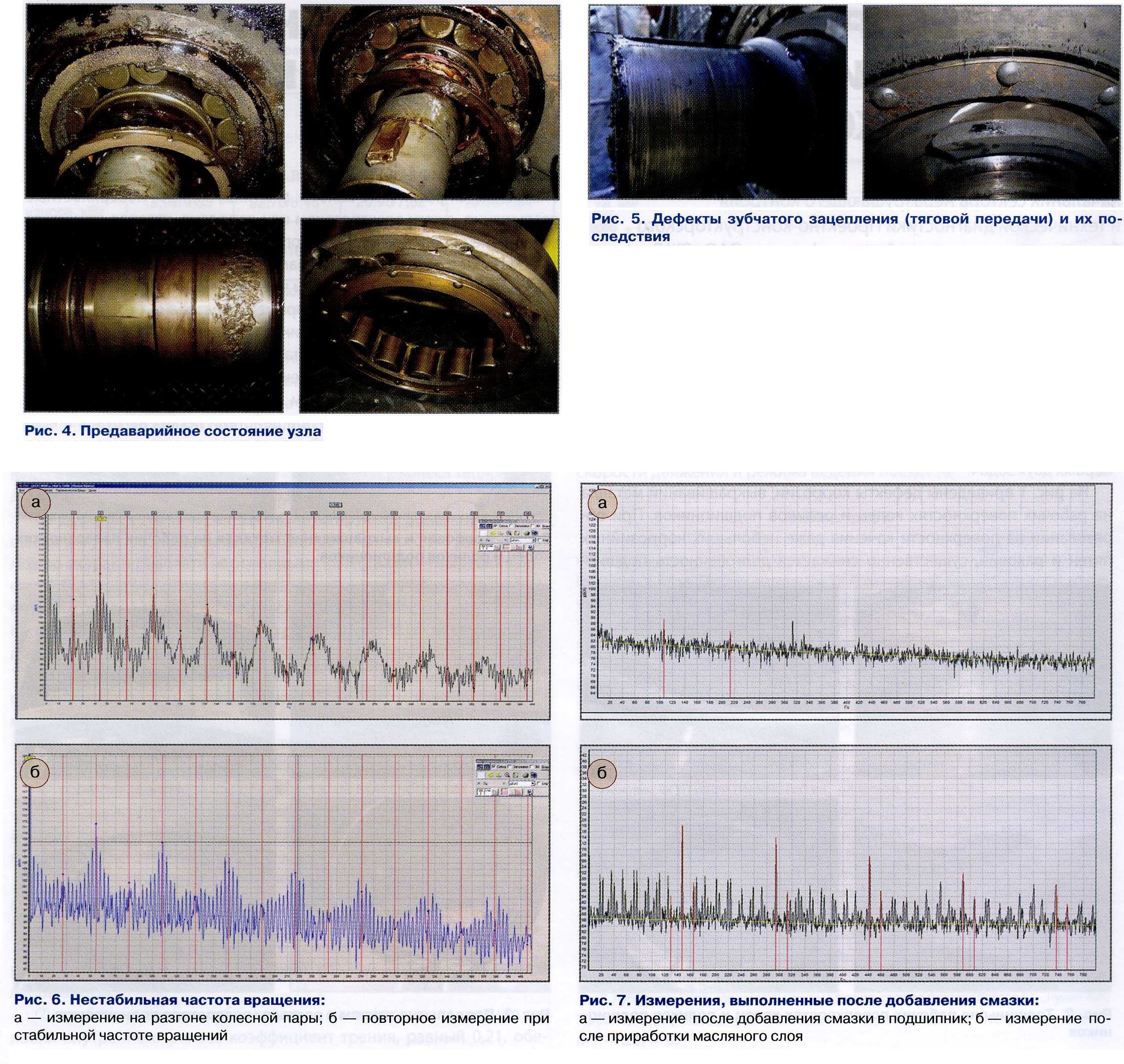 The diagnostic program identifies these bearings using monitoring measurements and exceeding monitoring thresholds. In this case, a specialist, analyzing the vibration of all control points of the wheel-motor, wheel-gear unit, must distinguish a bearing with broken geometry in a pre-emergency state from vibration (for example, a traction gear with uneven wear of the teeth or a suspended wheel-motor, wheel-gear unit on jacks with a misalignment) . The example shown in Fig. 11 shows how the vibration of the gear (traction gearbox) affects the spectral picture: exceeding monitoring thresholds in the auto vibration spectrum, an increase in the overall level of the high-frequency signal power spectrum, an increase in ultrasonic vibration. With such a spectral picture, it is the responsibility of the HP specialist to distinguish the pre-failure state of the bearing from the “normal” operation of the gearing, who must also correctly issue recommendations for adding lubricant to the bearing units, if necessary. It should be noted that timely recommendations for adding lubricant also contribute to the long-term forecast of the technical condition of rolling bearings. 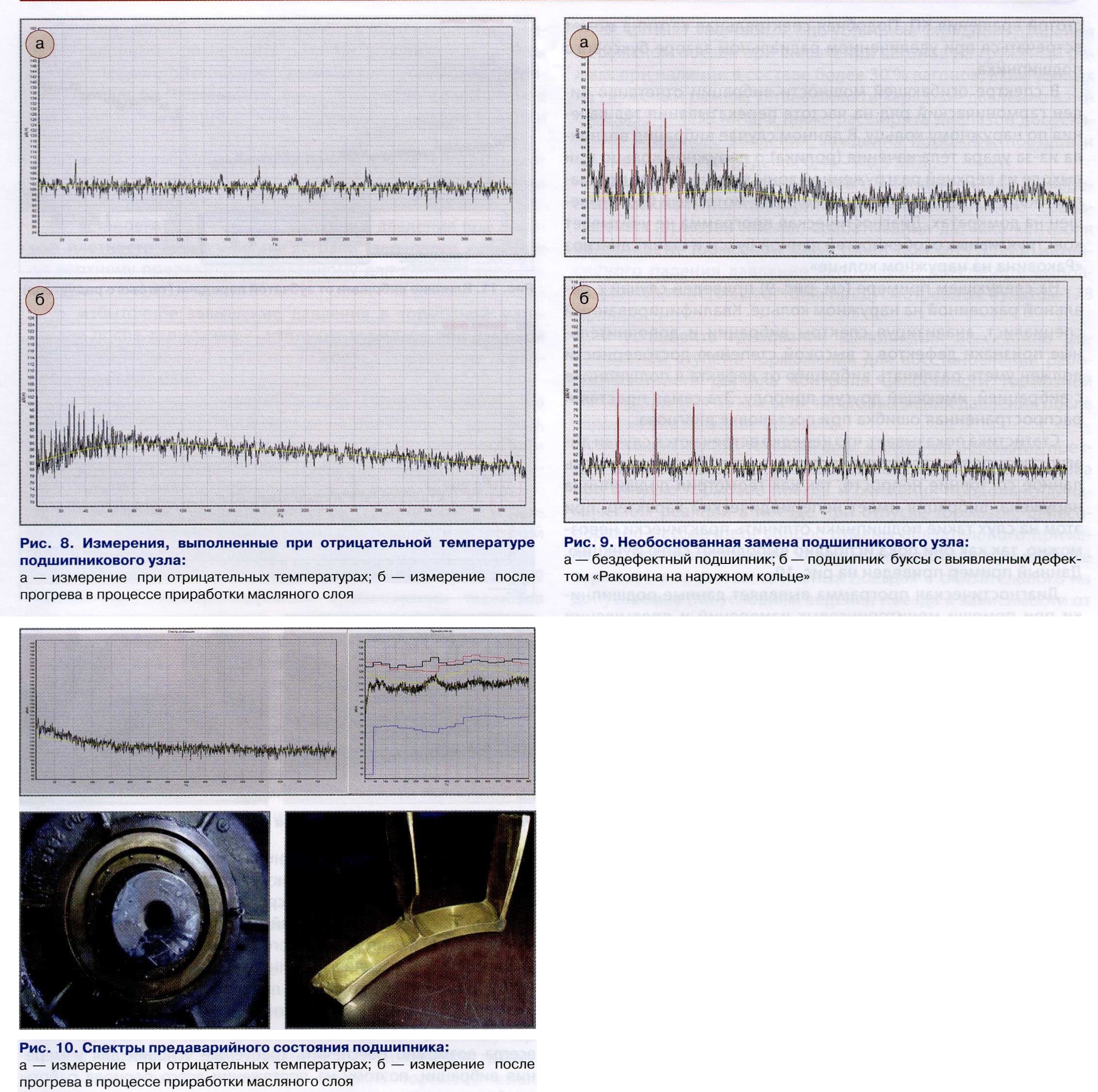 A cage defect is one of the fastest developing defects leading to bearing destruction, and what is most interesting is that it has practically no development history that would allow predicting the residual life of the unit. The vibration spectrum with a separator defect, as well as photos of the detected defects, are shown in Fig. 12. A cage defect is the most difficult defect from a VD point of view, since the cage is a lightweight brass or polyamide bearing part that does not bear large loads and, as a result, vibration from a cage defect has low power. In addition, the cage has the lowest rotation speed relative to all bearing elements, therefore, when the program automatically detects this type of defect, a specialist who has not been trained and does not have sufficient knowledge in the field of high pressure often ignores this type of defect. It cannot clearly identify the main and additional signs that the program signals automatically. Based on the above examples, it follows that for high-quality identification of defects during the HP process, in addition to improved diagnostic tools, a competent, qualified specialist is needed who, based on data from an automatic diagnosis, interpretation of vibration spectra, and the presence of additional signs, is able to establish the true condition of the bearing and issue based on the analysis, a definite diagnosis. When performing work on VD, it is also necessary to understand that it is not always possible to provide the required conditions for measuring vibration, therefore, throughout the entire period of work, it is necessary to look for new diagnostic signs of defects and diagnostic methods that do not depend on external measurement conditions. 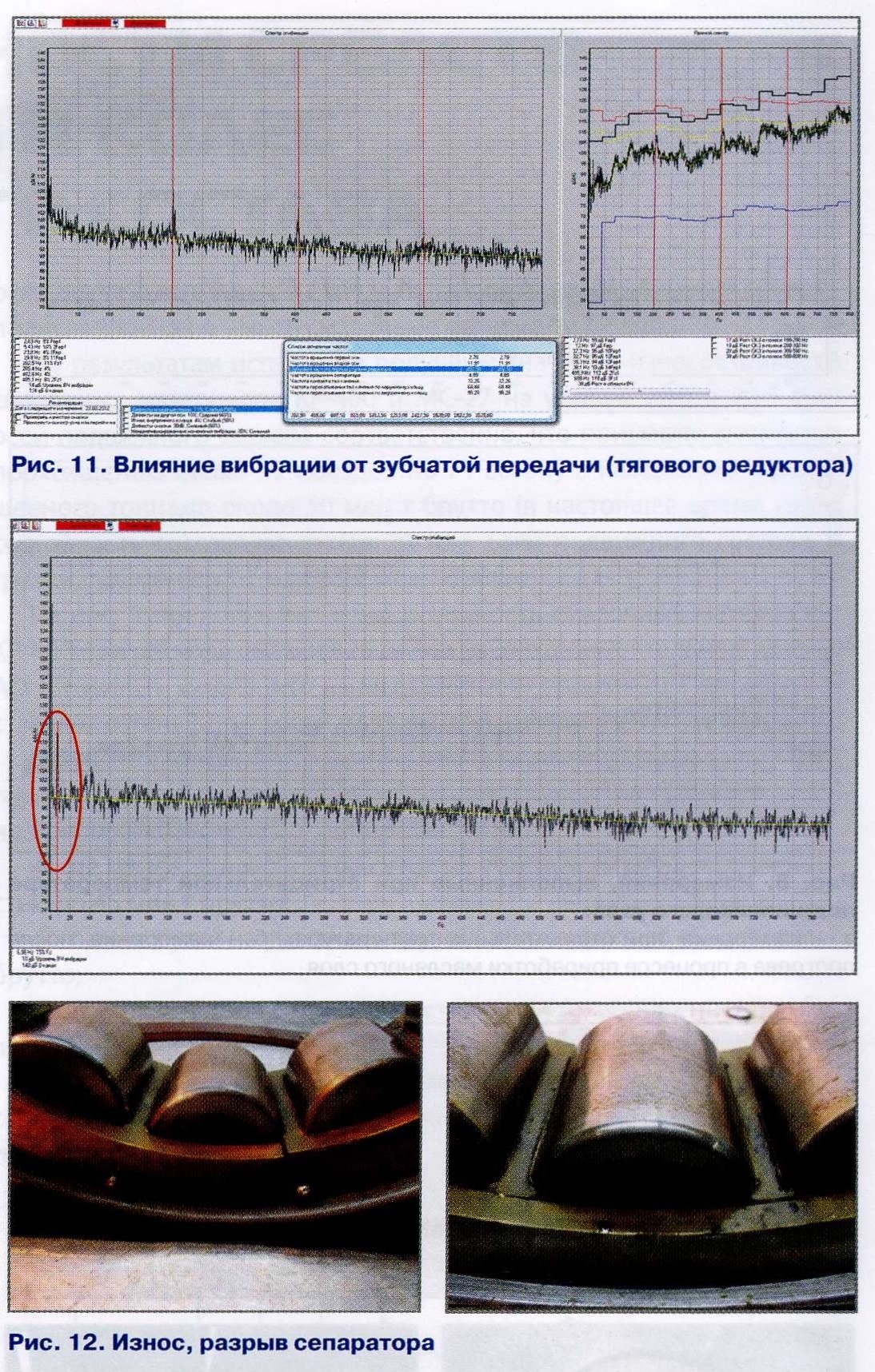 As a result of the work done, the developers of VD tools formulated unified approaches to configuring measurement points for all series of locomotives and the procedure for conducting vibration measurements. In addition, to increase the reliability of automatic diagnosis based on measurement materials, diagnostic program developers adjust diagnostic modules. In conclusion, it should be noted that in order to conduct effective and high-quality VD, only qualified and certified specialists should be involved. The measurement process and diagnostic equipment must comply with the requirements of the guidance document PKB TsT.06.0050 and technological instructions PKB TsT.25.0142 for vibration diagnostics of locomotive components. |

|
Цитировать 14 |
 Похожие темы
|
||||
| Тема | Автор | Раздел | Ответов | Последнее сообщение |
| = RW-Locomotive = Air supply system of diesel locomotive 2TE25KM | Admin | Article-RW | 0 | 10.12.2023 15:45 |
| = RW-Locomotive = Operational testing of the TEM23-0002 shunting locomotive | Admin | Article-RW | 0 | 10.12.2023 15:40 |
| = RW-Locomotive = More once about diesel locomotive TE3 | Admin | Article-RW | 0 | 10.12.2023 15:36 |
| = RW-Locomotive = "TMH- Electrotech " is mastering the production of new generators for the freight diesel locomotive ZTE30G | Admin | Article-RW | 0 | 10.12.2023 15:32 |
| Pryke John - Steam Locomotive Projects & Ideas (Идеи и проекты паровозов) | Admin | Тяговый подвижной состав | 0 | 19.01.2012 20:27 |
| Ответить в этой теме Перейти в раздел этой темы Translate to English |
| Здесь присутствуют: 1 (пользователей: 0 , гостей: 1) | |
|
|


 Почта
Почта


