Hong Kong West Rail Heavy Rail Line, China


|
West Rail is a massive, HK$57.7 billion project to build a stand-alone 30.5km rail line between Nam Cheong in West Kowloon and Tuen Mun, to try and tap into the growth potential of the western towns and cities of Hong Kong. While Hong Kong's total population was projected to grow from 6.2 million in 1996 to more than eight million by 2011, that of the North-West Territories was expected to rise from about 800,000 to 1.35 million - about 70%. The route connects several existing rail lines and will be run by the Kowloon-Canton Railway Corporation (KCRC). Opening in 2003, its ridership figure is around 340,000 passengers a day and ends the isolation from the rail network of the Tuen Mun/Shui Wai/Yuen Long conurbation. 
The route connects several existing light rail routes. It was drawn up, and will be run by the Kowloon-Canton Railway Corporation (KCRC). When it opens in 2003, West Rail is expected to carry around 340,000 passengers a day and will end the isolation from the rail network of the Tuen Mun/Shui Wai/Yuen Long conurbation. THE PROJECT The project's initial phase comprises the passenger line from Yen Chow Street to Tuen Mun, via seven intermediate stations, but a future extension for cross-border passenger and freight services will make the project more viable. Forty-five per cent of the project's cost is met from government equity, 39% in loans to KCRC, and the remaining 16% from KCRC funds. Service interval is three minute intervals, giving 20 trains per hour and capacity to carry 47,000 passengers/direction/hour. West Rail reduces journey times between Tuen Mun and urban Kowloon to 30 minutes, and is fully integrated with other public transport. The southern terminus at Nam Cheong will also be served by the MTR Tung Chung line, both served by an underground concourse. A pedestrian subway will provide an interchange with the MTR Tsuen Wan line at Mei Foo, while at the northern end of the line there will be interchange with KCRC’s existing light rail network at Tuen Mun, Siu Hong, Tin Shui Wai and Yuen Long. INFRASTRUCTURE Only 5.6km of the line is on the surface, with 13.4km on viaduct, and 11.5km in tunnel, including the 5.5km Tai Lam tunnel, Hong Kong's longest transport bore. The other major tunnel is at Kwai Tsing. The northern and the northwestern parts of the New Territories are the most flood-prone areas in Hong Kong. As a result, the West Rail alignment in this section will be primarily elevated on viaducts. From Kam Sheung Road Station to Tuen Mun Station, 13.4 km of the railway, representing 44% of the entire alignment, will run on viaduct, interspersed with six elevated stations. Viaduct assembly was competed in late-2001, and noise reduction measures are being implemented. KCRC identified ten sites with potential for commercial development, expected to include a mixture of residential, retail, office and hotel facilities. To maximise accessibility to West Rail, each station has interchange facilities between other modes, including light rail, buses, minibuses and taxis. For easy access all West Rail stations have escalators from the station concourse, with on-platform air conditioning provided for increased passenger comfort prior to boarding trains. Lifts and ramps are also provided. Tracklaying commenced in March 2002. ROLLING STOCK A massive new train order announced in October 1998 will benefit both West Rail and the companion East Rail system, running along either side of the territory. At HK$3.1 billion, the order is the largest order ever placed in Hong Kong. A total of 250 vehicles come from a Japanese consortium of Itochu, Kinki Sharyo and Kawasaki. West Rail will be served by 22 fully air conditioned seven-car trainsets running at speeds of up to 130km/h. Under rush-hour 'crush' conditions, each vehicle can carry 335 passengers, giving a total of 2,345 for each seven-car train. Each vehicle has five sets of doors on each side, and full-depth skirts for noise suppression. Regenerative braking gives a 25% energy saving. Trains will be maintained at the brand new purpose built Pat Heung depot next to Kam Sheung Road station. West Rail will run seven-car trains at an hourly frequency of 20 trains in each direction to meet the forecast daily patronage of 340,000 passengers. As patronage increases, West Rail will be able to operate up to nine cars per train at a maximum hourly frequency of 33 trains in each direction. West Rail's high-capacity cars accommodate a maximum of 335 persons per car. To enhance comfort, the interior of each train compartment is fully utilised. For example, the gangway will be air-conditioned and illuminated for the comfort of people standing. SIGNALLING/COMMUNICATIONS The contract for the design, manufacture, installation, testing and commissioning of a central train control system, worth Hong Kong $383 million, was awarded to Alcatel Canada Inc. This is expected to allow trains to run at headways as small as 105s. A new operations control centre at Kam Tin controls the integrated operation of all electronic systems, including trains, power systems, escalators and lifts. Trains have a passenger-to-driver communication system in each car for use in emergencies, and CCTV cameras. A digital passenger information panel, detailing the train's route, next stop, and available connections, is incorporated in each vehicle. Trains will be fitted with a passenger-to-driver communication system in each car for use in emergencies, and each car will also be fitted with CCTV. A digital passenger information panel, detailing the train's route, next stop, and available connections, is incorporated in each vehicle. At stations all signs will be in Chinese and English, with braille maps and tactile paths installed to aid the visually impaired. THE FUTURE West Rail is budgeted to be viable from the first day of operation. Depending upon the success of Phase One, further plans exist to expand the route, and connect it with the East Rail network at the northern end, and to build a new southern loop from the original West Rail terminus at Yen Chown Street, also linking the two networks. The trainsets are expected to be lengthened from seven to nine vehicles as demand increases, with train frequency increased from 20 an hour to 33. This will provide for up to 100,000 passenger journeys per hour in each direction. By 2011, the line is expected to carry 500,000 passengers a day. |
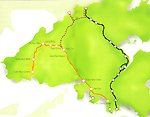  Expand Image Expand ImageThe West Rail route. |
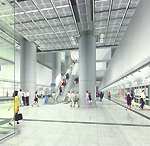 Expand Image Expand ImageStation concourses incorporate automated ticketing systems. | |
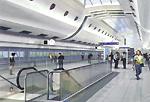 Expand Image Expand ImageSufficient lifts and escalators allow for ease of passenger handling. | |
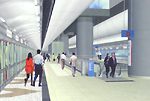 Expand Image Expand ImagePlatforms have straight boarding areas with minimum platform gap as well as platform screen doors. | |
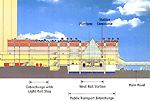 Expand Image Expand ImageCross section configuration of a typical West Rail station. | |
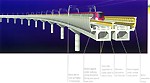 Expand Image Expand ImageWest Rail will be one of the quietest railways in the world. | |
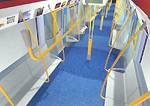 Expand Image Expand ImageThe interior of the trains are spacious and able to carry 335 passengers. | |
 Expand Image Expand ImageThe trains will be formed of 7 cars, due for delivery during 2001. | |
 Expand Image Expand Image11.5km of the new line will be in tunnel. | |
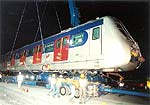 Expand Image Expand ImageThe first new train is delivered to the Hong Kong West Rail project. |

Related links
Leighton Wins $417m Rail Contract in HK