Dubai Metro, United Arab Emirates


|
Dubai inaugurated its metro network in September 2009, becoming the first urban metro network in the Gulf's Arab states. It is hoped that the system will ease the daily commute for thousands of the emirate's workers. With an economy increasingly based upon financial services, air transport, property development and tourism, Dubai has a rapidly growing population and severe traffic congestion problems. The population is forecast to increase by 6.4% annually, rising to three million by 2017. Tourist numbers are projected to reach 15 million in 2010. 
Dubai Municipality identified the need for a rail system to relieve growing motor traffic and support continuing urban development based on studies that began in 1997. Systra was awarded the preliminary engineering contract, and Dubai Rail Link (DURL), a consortium of four companies headed by Japan's Mitsubishi Heavy Industries (MHI), is leading the project to build the first two lines of the high-tech driverless rapid transit system. The other consortium members are the Japanese Obayashi and Kajima corporations, and Yapi Merkesi of Turkey. The metro will be fully integrated within the network operated by the Roads & Transport Authority (RTA), a body created in 2005. Routes will be organised around the backbone provided by the rail system. "The Red Line is the only route that has been completed so far. A second, the Green Line, is under construction, and three more are planned."
Around 1.74 million passengers used the metro in its first month, according to the statistics released by the RTA. The average number of passengers travelling on the Red Line has been estimated at 57,000 per day. The Red Line is the only route that has been completed so far. A second, the Green Line, is under construction and a further three are planned. The intention is for 320km of metro lines in place in Dubai by 2020. DURL officials are also in the process of negotiations with major local and international companies for acquiring brand naming rights – in other words, advertisement rights – for the 23 stations on Red and Green lines. Dubai metro projectGroundworks began in February 2006, centred on the 52.1km Red Line. About a third of the Red Line stations opened in September 2009. Station construction stalled temporarily due to payment disputes – worth $2-3bn – between DURL and its contractors, but resumed in February 2010. Seven more stations opened in April 2010, followed by another three in May 2010. The remainder are expected to be complete in October 2010. "Groundworks began in February 2006, centred on the Red Line."
In August 2006, a second contract worth $12bn was awarded to the MHI consortium for building the Green Line. The Green Line will run between Al-Qusais and Al-Jadaf, and will link strategic locations including Dubai Airport and Healthcare City. In June 2007, Serco (operator of the Docklands Light Railway in London) was named as preferred bidder for initial consultation and the system's operation and maintenance. The Green Line was initially planned to open in March 2010, which was subsequently pushed back to June 2010. Recent statements by the RTA now suggest that all works will be completed by August 2011. Infrastructure The 52.1km Red Line has 29 stations, four of which are underground. The line runs from Rashidiva to Jebel Ali and passes the American University of Dubai. It serves an estimated 32,000 passengers an hour. The 22.5km Green Line will have 18 stations. The route will be progressively extended to serve the Deira and Bur Dubai central areas and the souks up to the Burjuman and Wafi shopping centres. The routes run underground in the city centre: from the Sheikh Rashid/Sheikh Khalifa Bin Zayed intersection to the Salahuddin/Abu Bakr Al Siddique intersection on the Red Line, and from Garhoud to Oud Metha Road on the Green Line. "RTA is considering adding 268km of light rail lines that will serve as feeders to Dubai Metro."
Elsewhere, trains will run on elevated viaducts designed to enhance the urban architecture along the route. The tracks do not cross highways at any point, ensuring full mode segregation. Although taxi, bus and water taxi feeder services are being structured to encourage end-to-end use of public transport, the RTA is creating three park-and-ride sites, the largest of which will have 6,000 places. Underground works have been carried out without affecting buildings, and authorities claim that residents will not be disturbed by excavation work. A third-rail power supply was chosen to avoid the visual intrusion of overhead line equipment. All stations, elevated or underground, will feature platform screen doors for passenger safety and to facilitate air conditioning. RTA has introduced "feeder bus routes" to allow commuters to travel from major locations in and around stations. Drop-off zones and a bus and taxi layby have also been constructed outside of each station. To further reduce the area's reliance upon road transport, the authority is considering adding 268km of light rail lines that will serve as feeders to Dubai Metro. Rolling stockThe driverless, fully automated trains are fully air-conditioned and designed to meet Dubai's specific requirements. Unusual for metro operation, the trains offer standard "silver" class, a women and children-only section, plus a first-class "gold" section (a carriage for VIPs). The five-car sets are approximately 75m long, seating around 400 passengers but with standing room for many more. "Rolling stock is being supplied by Kinki Sharyo under a $456.2m contract for 385 cars."
Rolling stock is being supplied by Kinki Sharyo under a $456.2m contract for 385 cars, the first of which arrived from Japan in March 2008. As of April 2010, 51 trains had been put into service. This will gradually be increased to 106 trains. Storage and maintenance needs to take places under cover due to the heat and dust in Dubai. The main depot is at Rashidya, and has a capacity for 64 trains. Auxiliary depots are at Jabel Ali and Al Ghusais. The trains will have a maximum speed of 90km/hr, forming a round trip of two hours and 23 minutes for the Red Line and one hour and 23 minutes for the Green Line. Signalling and communicationsThe fully automated signalling and communication system is being supplied by Thales Rail Signalling Solutions. The automatic train control system will allow headways of between 90 seconds and two minutes. In 2005 MHI contracted Alcatel (now Alcatel-Lucent) to supply the driverless train control system and a communications system for on-train video surveillance, passenger information, public address and the integrated control centre. Trains will be Wi-Fi enabled. The system's control centre is at Rashidiya depot. The project's signalling system is moving block and fully automated with in-cab signalling. The future In full operation, Dubai metro is projected to carry approximately 1.2 million passengers on an average day, and 355 million passengers a year. Operating costs, including staff, maintenance and power, should be approximately AED570m a year. This is expected to be met through fares and additional revenues such as advertisement space and joint development. "Operating costs, including maintenance, staff and power, should be about AED570m a year."
In May 2007, the 49km Purple Line received approval, moving ahead of another future projection, the Blue Line. Parsons Brinckerhoff has been contracted for initial design work on the express eight-station line from Dubai International Airport to Al Maktoum International Airport along Al Khail Road. Construction began in March 2009, and the line is scheduled to open by 2012. However, Dubai airport has raised concerns as the line also has three check-in facilities which hampers passenger traffic. The 47km Blue Line, will link the current international airport with the new Dubai World Central International Airport which is being built at Jebel Ali, part of a 140km7#178; transport hub. Construction of this line will commence in 2012 and is expected to be complete by 2014. In April 2008, the RTA announced that the development of the Yellow Line, a light rail operation, would be carried out by a consortium including Serco and Alstom. |
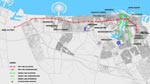  Expand Image Expand ImageDubai metro is one of the most advanced urban rail systems in the world and will be a catalyst for tourism, financial and economic growth. |
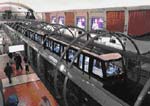 Expand Image Expand ImageAll stations will have platform doors to increase safety and allow a more comfortable, climate controlled environment for passengers. | |
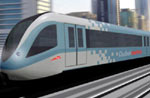 Expand Image Expand ImageArtist’s impression of a Dubai Metro train | |
 Expand Image Expand ImageThe trains have a three-class layout and sections of open floor space. |