Beijing-Shanghai High-Speed Line, China


|
The 1,464km Beijing-Shanghai main railway line is one of the most important in China, connecting two of the country's most prominent economic areas and forming the busiest railway route. However, China is currently upgrading the line to allow it to handle passenger traffic, as well as heavy freight traffic, which currently forms the only traffic on the route. The Shanghai Railway bureau is working towards increasing the power supply for the operation of passenger trains, but at the same time, the Chinese Ministry of Railways has a much bigger project in progress – the 1,318km Beijing-Shanghai high-speed line running parallel to the existing route. 
It will be solely dedicated to passenger train operation, and the Chinese Ministry of Railways promised a 2010 opening date, three years after the scheduled completion of the 115km Beijing-Tianjin high-speed line. The 115km Beijing–Tianjin high speed line has been in service since August 2008. The new Beijing-Shanghai line is being built to improve journey times and ease pressure on existing railway corridors between the two cities. Construction was expected to take five years. "The new Beijing-Shanghai line is being built to improve journey times and ease pressure on existing railway corridors between the two cities."
The projectThe Chinese Ministry of Railways' initial design work for the high-speed line was completed in June 1998. Feasibility studies for the new route were finally approved in March 2006, welcome news as the current line is the busiest in China and increasingly a bottleneck. More than a quarter of the country's population lives close to the line, which accounts for 10.2% of passenger transport and 7.2% of freight. The new high-speed line will be designed for 300km/h (186mph) operation and reduce the journey time between Beijing and Shanghai from 14 hours to just five. An estimated 220,000 passengers per day will use the trains. Despite China wishing to complete the line by 2010, engineers said that construction could take at least until the middle of the decade. The total cost of the new line is expected to be ¥100bn ($12bn). Foreign investment will be allowed. InfrastructureInitially, the Chinese Ministry of Railways was planning to build the high-speed line using only domestic technology. However, in May 2006, the Ministry opened an invitation to tender for contracts to the foreign market, with particular interest in the German and French high-speed railway technology. Alstom, Siemens and Japan-based Mitsubishi-Kawasaki are all said to be interested in tendering for parts of the project. The Beijing-Shanghai high-speed line will have 24 stations, including Tianjin, Jinan, Xuzhou, Bengbu and Nanjing. The alignment is designed for 350km/h operation, although the initial design top speed has been set at 300km/h (186mph). The Shanghai-Nanjing section of the current main line was chosen for early rebuilding to enable testing to take place, largely because it crosses the soft terrain of the Yangtse delta, presenting the engineers with their most difficult challenge. Two thirds of the new route is expected to be constructed on embankment, with the vast majority of the remaining third being laid on bridges. Two major river crossings, of the Yellow and Yangtse rivers will be needed. Rolling stockTests carried out in 1998 using a modified Shaoshan eight electric locomotive on the Beijing-Zhenzhou main line saw the formation reach 240km/h. These laid the foundations for development of a fixed-formation 200km/h electric multiple unit. "The rolling stock will feature an aluminium body and have specially engineered windscreen glass."
The prototype vehicle was completed at Zhuzhou locomotive works in 1999, for testing with six trailer cars of four different types, a driving trailer, one double-deck and two single-deck vehicles, providing a total of 438 seats. Lightweight construction techniques allowed the weight of the power car to be kept down to 84t, the first time a 21t axleload had been achieved on a four-bogied traction unit in China. Exact details of the trains for the new high-speed line have not been formulated, but with China's decision to allow foreign investment, French or German technology may play a significant role. What is known as that the rolling stock will feature an aluminium body and have specially engineered windscreen glass, similar to the strength used in airplane windscreens, to withstand impacts from birds. Signalling/communicationsThe existing Beijing-Shanghai corridor is 1,463km long, and equipped with automatic fixed-block signalling. The prototype high-speed train is fitted with an LKJ-93 automatic train protection system, used in conjunction with lineside equipment to monitor and record train speed. As the current fed to the motors can be varied steplessly, the driver is able to maintain constant speed automatically. New developments Construction of the Beijing-Shanghai high-speed railway began in January 2008. Work on the line is expected to be completed by 2013. The Ministry of Railways is contributing 78.9% of the estimated cost of ¥160bn and the rest is expected to come from other investors. "Work on the line is expected to be completed by 2013."
The civil engineering work on the 1,318km railway line is to cost around ¥83.7bn and is divided into six sub-contracts. In February 2008, the bidding results for civil construction works were announced. The tenders were awarded to six companies with a total bid price of ¥83.7bn. China Railway Construction Company took a major share of 40.3% or ¥33.74bn through its two subsidiaries. China Railway Group got the second-largest share of 26.2%. In March 2009, China's Ministry of Railways (MOR) entered into an agreement with state-owned vehicle producer CNR Corporation for the purchase of 100 high-speed China Railway High-speed (CRH) trains for ¥39.2bn. The new CRH trains are expected to travel between Beijing and Shanghai in 2011. The future The task force investigating strategies for development of the high-speed line was expected to complete its work during 2000, with construction works starting later in the year. While this has not happened, the Chinese Ministry of Railways is keen to push the Beijing-Shanghai high-speed project forward and is actively encouraging input from Europe and Japan. It is the template for of a future 12,000km high-speed railway network in China by the year 2020, an ambitious target. |
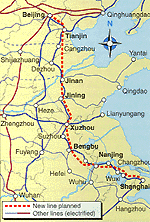  Expand Image Expand ImageA map showing the Bejing-Shanghai high speed route. |
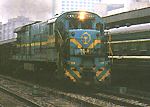 Expand Image Expand ImageConstruction of a dedicated high-speed Beijing-Shanghai line will alleviate conflicts with slower freight traffic. | |
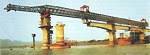 Expand Image Expand ImageA machine for assembling pre-stressed concrete bridge segments, developed by Chinese engineers, and expected to be used on the Beijing-Shanghai route. | |
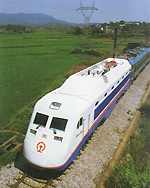 Expand Image Expand ImageThe prototype high-speed locomotive developed for Chinese Railways. | |
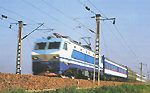 Expand Image Expand ImageThe rake of coaching stock assembled for high-speed testing shown during trials. | |
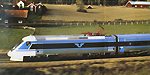 Expand Image Expand ImageSweden's X2000 train has been the model for some of the new Chinese high-speed train technology. | |
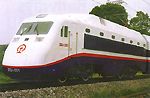 Expand Image Expand ImageChinese Railways' prototype high-speed train power car has undergone extensive tests. |