Gold Coast Rapid Transit System, Australia


|
The Gold Coast Rapid Transit system is a proposed 40km-long light rail system between Helensvale and Coolangatta in Gold Coast City, Australia. It is the first light rail and also the largest infrastructure project the city has seen. It was approved in 2000. The project will be constructed in three stages. Stage 1 will be a 13km-long light railroad between Griffith University Hospital and Broadbeach. It is currently in the early works phase, which is scheduled to be completed by the first quarter of 2011. It is expected to become operational by January 2014, while the construction is expected to be completed by the end of 2013. 
The estimated cost of Stage 1 is A$949m, which is being financed by three governments. The Queensland Government is contributing A$464m towards the project and the Australian Government is providing finance of up to A$365m with Gold Coast City Council committing A$120m. The project is called an 'operator franchise' as it is being carried out under the public-private partnership.В The city already has a population of 500,000, which is expected to grow at a rate of 3% a year. It is also estimated that, once the project becomes operational, it will help commute around 40,000 workers from the Southport, Surfers Paradise and Broadbeach areas covered by Stage 1. "The project was first proposed in 1996 by the Queensland Government and Gold Coast City Council."
In addition, around 20% of the total population of Gold Coast plus 50,000 to 60,000 overnight visitors will also be located within walking distance of the route. The project will result in 75,000 cars coming off the coastal strip and reducing green house gas emissions by 1.14m tons a year. The project will also boost economic conditions as it will provide 6,300 jobs and bring $1.2bn worth of benefits to the city during its course of construction. Background The project was first proposed in 1996 by the Queensland Government and Gold Coast City Council after recognising the need for a long-term solution to the growing population and increasing traffic congestion. After identifying that light rail was the best option due to passenger comfort, safety, reliability and value for money, feasibility studies were carried out in 2001. The project summary report was released in 2004 with consultation works carried between 2006 and 2008. Infrastructure and construction The early works contract for Stage 1, worth $33m, was awarded to Leighton Contractors in the second quarter of 2010. Stage 1 of Gold Coast Rapid Transit will have stations at Loders Creek, Queen Street West, Gold Coast Hospital Southport, Southport Central, Southport South, Queensland, Narrowneck (Paradise Waters), Surfers North (Cypress Avenue), Surfers Central (Cavil Avenue), Surfers Paradise, Surfers South (Clifford Street), Northcliffe, Broadbeach North (Cascade Gardens), Broadbeach, Broadbeach Central (Convention Centre) and Broadbeach South (Hooker Boulevard). The early works contract worth $33m for Stage 1 was awarded to Leighton Contractors Pty in the second quarter of 2010. Stage 1 will be delivered in two phases. Phase 1 consists of early and enabling works such as road widening, relocation of public utilities, reinstatement of driveways, fencing, car parks and construction of a station shell at the Gold Coast University Hospital. Preliminary works on the Griffith University Hospital station started in August 2010 and will be completed by early 2011. The station shell will have a floor, roof and walls to create the final fit-out for the future station. "Preliminary works on the Griffith University Hospital station started in August 2010."
It is also being constructed in two phases in order to integrate the construction of $1.76bn Griffith University Hospital. The station will be below ground level and will have open sides and two platforms that will provide entrance to the Griffith University Hospital. During Phase 2 the operator franchise will be selected, by early 2011. The winner will construct the stations, depots, bridges, supply vehicles and undertake all other operations to complete the project. The winner will also operate and maintain the system for 15 years. Rolling stock The Australian Government plans to use low floor rolling stock to operate on a standard gauge. It will use 750v DC overhead cabling to avoid usage of power by other rails on Gold Coast that uses narrow gauge. Future The other potential future stages are Stage 2 that will be heading north from Griffith University Hospital along the Olsen Avenue, to Harbour Town Shopping Centre to Helensvale Rail Station. It will be considered only after 2016 as the present road can accommodate medium traffic levels. Stage 3 will be heading in southern direction from Broadbeach to Burleigh Heads and Stage 4 further south from Burleigh Heads to Coolangatta. |
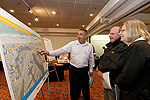  Expand Image Expand ImageSurfer's Paradise Community Information Session held between 31 August and 4 September 2010. |
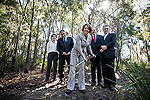 Expand Image Expand ImageSod turn event at Graffith University Hospital. | |
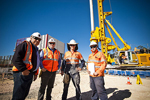 Expand Image Expand ImageGold Coast University Hospital Station shell construction. |