Ottawa Light Transit System, Canada


|
The Ottawa light transit system (OLTS) is a pilot light rail transit (LRT) project underway in the capital city of Canada. The OLTS, also known as the O-Train, is currently operating with a single line and is planned to have a new line by 2014. The OLTS is operated by Ottawa's OC Transpo under the name of Capital Railway. The first line of the OLTS began operations in October 2001. An extension project involving the construction of the second line is currently underway. Construction work is expected to begin in 2012 and expected to be completed by 2016 at the latest. 
Ottawa, Canada's capital, had a population of about 812,129 in 2006. Bus transit systems operated by OC Transpo form the major public transportation system in Ottawa. Other public transportation systems include regular buses travelling on fixed routes in mixed traffic, and door-to-door bus services for the disabled. The LRT system was chosen as it is flexible and provides a faster, more efficient, environmentally friendly transit system for Ottawa. Ottawa light transit system project background The Ottawa LRT project was initiated in August 1998, with the move made to develop and implement the project by the then administrative body. "The Canadian Government plans to increase public transit use to 30% by 2031."
During 1998-99, the environmental assessment study was conducted, and in September 1999 the project was approved by the city council. An agreement was made between the city council and Canadian Pacific Railway for the development of line 1. The extension of the system, which involved the construction of another line, dates back to July 2006. The execution of the expansion project was, however, delayed due to various controversies related to line routes. Ottawa's transportation master plan (TMP), which incorporates the development of the city's transit system by 2031, includes the plan to extend the Ottawa LRT. The expansion project came into significant focus again when the TMP was adopted by the city council in November 2008. In May 2009, the desirable corridor was selected and approved by the city council. The corridor was selected considering the set of rules developed for a grade-separated LRT system. The selected route connects Tunney's Pasture and Blair. Ottawa LRT project The first phase of the project involved the construction of line 1, including the building of railway stations and passing tracks as the fleet runs on the existing Canadian Pacific Railway track. The passing tracks were laid for operating trains in both directions. The construction of line 1 started in 2000 and opened to the public in 2001. The line cost $21m to construct. The extension project developed as part of the TMP involves building a new grade-separated rail transit system for Ottawa. It also involves the construction of the Downtown Ottawa Transit Tunnel (DOTT). The system should be capable of running on a track shared by roadways and grade separated track. It is an east-westbound line and its construction will be carried out on the pre-existing transitway. "The OLTS is considered to be Ottawa's largest ever light rail transit infrastructure."
OLTS is considered to be the city's largest ever transit infrastructure and is part of the government's plan to increase public transit use to 30% by 2031. The construction work on line 2 involves the construction of a light rail line, which includes a 3.2km-long downtown tunnel. Ottawa LRT will comprise two electric tracks powered by two AC motors each, a non-powered centre truck and a wide range of braking systems, including air, magnetic and dynamic systems. The estimated cost of extension project is around $2.1bn. Of this, $561m will be funded by the Ontario Government, with the remaining funded by federal and city governments. OLRT line routes The 8km-long line 1 connects Greenboro to Bayview Transitway, with downtown Ottawa towards its east. Greenboro is the line's south terminal. The two terminals are connected through the stations, Carling, Carleton and Confederations. The line connects five stations in different regions of the city. The 12.5km-long east-westbound extension line will connect the stations Tunney's Pasture and Blair in Ottawa. The line will be principally on the existing Transitway corridor. It will comprise 13 stations, four of which will be underground stations that serve downtown and the University of Ottawa campus in twin tunnels. The western terminal of the tunnels will have LeBreton station towards the west and will run through downtown core area until it turns south-east and reaches grade at a terminal south of Campus station. Rolling stock The existing light rail line utilises three Bombardier Talent diesel multiple unit (DMU) trains with three cars each. Built in Germany, they were later shipped to Canada in 2001. Each train has 135 seats and space for 150 standees. Of the entire fleet, two will be in service at any given time. "The Ontario Government will fund $561m, with the remaining provided by federal and city governments."
The locomotives integrated are Bombardier's BR643, powered by diesel. The front and rear cars of the fleet are powered while the car in the middle will be pulled along. The locomotives' emergency features include door release and fire extinguishers. The Bombardier Talent DMUs are being used for the first time in a North American transit system. Bombardier is also engaged in maintaining the fleet of the OLTS. Line 1 also operates other trains and serves Ottawa Central in facilitating freight service to the National Research Council. OLTS system signalling and communication The OLTS system makes use of an automatic block signal (ABS) system. The recently renovated systems are fixed at other locations to provide efficient signal communication to trains. The station platforms are equipped with CCTV cameras and patrolled by OC Transpo law enforcement officers. In addition, yellow emergency callboxes are integrated in the stations and used to contact the OC Transpo employee. Payphones with a free auto-dial button, connecting the commuters to the security, are also located in the station. Trains are fitted with intercoms to communicate with the train operator in case of emergency, such as passenger illness or a disturbance. |
  Expand Image Expand ImageView of Ottawa from McKenzie King Bridge. |
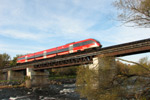 Expand Image Expand ImageThe O-Train over Rideau River. | |
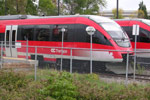 Expand Image Expand ImageThe existing light rail line utilises three Bombardier Talent DMU trains. | |
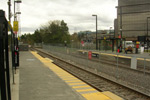 Expand Image Expand ImageLine 1 connects Greenboro to Bayview through Carling, Carleton and Confederation. | |
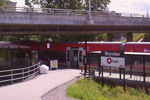 Expand Image Expand ImageBayview station, a terminal station of line 1. |