Waterloo Railway Terminus, United Kingdom


|
Waterloo Station (Waterloo) is a major railway terminus situated in central London and falls under the London Borough of Lambeth and Travelcard Zone 1. Also known as 'London Waterloo', it is used by 88m passengers a year making it the busiest railway station in Britain. It is owned by NetworkRail but managed by different operators. It is serviced by trains running to the counties of Surrey, Hampshire, Dorset, Devon, Berkshire, Wiltshire and the south-west of London. 
Waterloo has 19 platforms serviced mainly by local and suburban trains. Long-distance trains to destinations on the south coast such as Portsmouth, Southampton and Bournemouth also traverse the station. Waterloo Station historyThe original Waterloo station was built in 1848 by London & South Western Railway (L&SWR). It was built on an extension of the mainline from Nine Elms Railway station which was the London Terminus in 1830s. "The original Waterloo station was built in 1848 by London & South Western Railway."
The North station was opened in August 1860. Waterloo was connected to the South Eastern Railway in 1864. Subsequently South Eastern Railway opened Waterloo Junction (the present Waterloo East station) in 1869 to replace Blackfriars Road station. Over a period, the station grew in size with the addition of new platforms and came to be known as Central Station. An additional platform in North station and a new South station were opened in November 1885 and December 1878 respectively. The underground Waterloo and Bank (formerly known as City) stations were opened in August 1898. The terminus was rebuilt between 1900 and 1922. Waterloo was officially opened in March 1922. Nearly after 100 years, the terminus roof was refurbished in 2001-2003. Other major project witnessed by the station was the automatic ticket gate line project in June 2008. Location and layoutThe Waterloo terminus has many interchange stations, which include Waterloo East, Waterloo Underground and Waterloo International. Waterloo East is adjacent to London Waterloo and has four platforms. An elevated walkway across the Waterloo road connects it to the terminus. The eastern ends of the platforms are connected to Southwark Station on the London Underground Jubilee Line through a walkway situated near the main Waterloo Station. Waterloo East is managed by South Eastern, a train operating company in south-east England. The station does not have a separate building. The main Waterloo ticket office serves the passengers of Waterloo East. Waterloo Underground, also known as Waterloo tube station, is managed by London Underground. Waterloo International is on the western side of Waterloo. It has five Platforms numbered 20 to 24. Platform 20 belongs to the main station while the other four were new platforms constructed in 1994 to serve Eurostar international trains. The interchange station was closed down in 2007, after the Eurostar services were transferred to St. Pancras Railway Station upon the opening of a high-speed rail system. Design and constructionWaterloo terminus covers an area of 24.5 acres and is the largest station in Britain. With a slanting edge and furrow construction, the roof measures 520ft x 540ft with a maximum single span of 118ft. The office building was constructed using Portland stone in an Imperial Baroque style. It is known for its Victory Arch, which was built in the memory of London and South Western and Southern Railway men who fought in WWI and WWII. The Victory Arch carries statues that depict war and peace. These are placed below the statue of Britannia on the arch. The roof refurbishment project involved replacing 25,000 glass panes on the 28,000m² roof, constructing new steel support structures and walkways, creating new platform lighting, CCTV, voice alarm and power distribution systems. The £36.5m project was initiated by Railtrack and contracted to Morgan Sindall, AMEC and Lonsdale. A protection deck was constructed just below the roof to avoid disruption of regular station operations and most importantly to protect passengers and trains during the work. The new roof has as an asset life of 75 years with no major overhauling required in the first 25 years. The automatic ticket gate project was carried out to reduce the number of people travelling without tickets and to improve the aesthetic look of the station by providing a platform view from the concourse, a view which was concealed for years. "The Waterloo terminus has many interchange stations."
A total of 117 automatic gate lines were constructed at the entrance to mainline platforms and in the subway. The project also included installation of 118 cameras, refurbishment of the CCTV equipment room and the provision of electrical, mechanical and telecommunications services to the automated ticket gate line. The project was carried out by Bailey Rail, Murphy and AM Security Services. Platform 20 of the former Eurostar terminal was integrated with platform 19 of the main Waterloo Station for domestic passenger services in 2008. The £15m project was designed by YJLi in association with Bovis, Lehrer and McGovern. The project was manned by Charter Security. FacilitiesThe main concourse has many retail facilities and restaurants. The ticket office is also situated in the concourse opposite platforms 16 and 17 with additional ticket machines. The station has 130 automated ticket gates on the concourse and an additional 27 in the subway. A new super docking cycle stand was built outside the main station in December 2010. It has space for 124 bicycles. Cash machines and a bureau de change are near the South Bank entrances and Waterloo Bridge. A photo booth and lost property office are near exits 1 and 2. Other facilities include pay telephones, Wi-fi access, toilets and baby changing and a transport police office. FutureWith the growing number of passenger journeys, NetworkRail has decided to expand the concourse by building a 220m-long balcony on the first floor. The project aims to provide more retail space at the station. It is a part of Network Rail's programme to create 7,000m² of new retail space at stations. The proposal was revealed in November 2010. All the existing retail outlets and restaurants will be shifted to the balcony providing additional space in the main concourse for passengers. The project will make use of 1,900m² of existing office space on the first floor. Although work has not yet commenced, NetworkRail plans to complete the expansion before the 2012 Olympics. NetworkRail will consult with English Heritage and the London Borough of Lambeth before the plans are finalised. The new concourse has been designed by Robinson Kenning and Gallagher Architects (RKG) of London. |
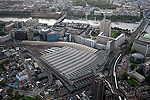  Expand Image Expand ImageWaterloo station aerial view. |
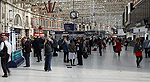 Expand Image Expand ImageWaterloo Station's main concourse. | |
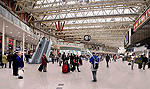 Expand Image Expand ImageArtist's impression of the proposed new balcony of the Waterloo station. |

Related links
Network Rail Reveals Station Upgrade Plans