Madrid Metro Extension, Spain


|
Spain's capital Madrid, home to over three million people, has one of the most extensive metro systems anywhere in the world. Since its first line opened in 1919, steady expansion has taken place. The late 1990s saw that growth accelerate considerably, with 56km of new lines opening, including 42 new stations in three-and-a-half years. This gave Madrid the third largest metro system in the world, after London (415km) and Moscow (269km). The 2007 target is 405km and 350 stations. Earlier lines, Lines 1–5 and 10, are built to a smaller profile with 1,445mm gauge track. Later tunnels from the 1970s and 1980s (Lines 6–9) can handle bigger trains. 
METRO EXTENSION PROJECTMadrid's regional autonomous government has drawn up several expansion schemes over the last decade, of which the latest is a €3.7m scheme to add 73km to the system by 2007 (31km of it light rail). The latest project, and perhaps highest profile, is the new underground extension of Line 8 to Barajas Airport. The €52m project to add a further 2.5km to the line was only given a nine month construction date, to be completed in November 2006. The first of the new wave of lines opened in December 1996, running from Lago to Plaza de Espana. Since then other openings, totalling 25.3km with the addition of 22 new stations, have seen extensions to Line 4, from Esperanza to Mar del Cristal, Line 7 between Avenida de America, and Line 10, from Fuencarral to Aluche. "The latest project is the new underground extension of Line 8 to Barajas Airport."
October 1998 saw further extensions to Line 7, from Gregorio Maranon to Canal, and the opening of a new interchange with Line 2. This former line has subsequently been extended to Valdezarza and again to Pitis, where the trains connect with RENFE suburban services. Line 11, from Plaza Eliptica to Pan Bendito, was added to the network in November 1998 and in the following month Line 9 was extended from Pavones to Puerta de Arganda. Line 4 saw further expansion to Parque de Santa Maria. April 1999 saw the system expand beyond the city limits for the first time with the extension of Line 9 by 18.3km to Arganda del Rey. The builder, a private-public consortium, has a 30-year operating concession. A major recent project is the new orbital Line 12, also known as Metrosur. Construction work was carried out between 1999 and 2003 on the 40.7km underground circular line with 27 stations connecting major suburban towns south of Madrid, including Alcorcón, Móstoles, Fuenlabrada, Getafe and Leganés. This line is connected to Line 10 at Casa de Campo and feeds into three RENFE CercanÃas lines into central Madrid (C3–C5). The entire circle line together with the remaining stretch of L-10 started operation on 11 April 2003. INFRASTRUCTUREMadrid's varied geological characteristics make tunnelling very difficult and the problems are exacerbated by underground water currents and pronounced slopes. Two-thirds of the new construction was in tunnel. Some was constructed using the cut-and-cover method and the remainder, because of the instability of the ground, had to be hand-excavated. All extensions are in twin-track tunnels. To increase capacity on Line 10 and use large profile rolling stock (2.8m wide and 110m long), the Batan-Alonso Martinez section of the original suburban line had to be widened and was closed from July 2000 until April 2001. Platforms at three underground stations were lengthened by 20m and in all stations the central platform was demolished. After a few months of disruption along the entire Line 10, this line was extended to Colonia JardÃn on October 2002. Metrosur is connected to the rest of Metro de Madrid by an extension to Line 10, from a new station called Casa de Campo (built between Batán and Campamento) to Puerta del Sur in Alcorcón on the MetroSur ring line. The Line 10 extension is 8.2km long and includes three intermediate stations, one of which, Cuatro Vientos, allows transfer to RENFE's busy C-5 suburban line. The largest new single extension will take Line 10 from Fuencarral to San Sebastián de los Reyes (north east of the city centre), which at Las Tablas will interchange with the extension of Line 4 from Parque de Santa MarÃa. Colonia JardÃn on the new extension to Line 10 will serve as the interchange for two light metro routes serving the south-western outskirts of Madrid. The third light rail feeder connects Móstoles on Line 12 (Metrosur) with Navalcarnero. ROLLING STOCKThe extended Line 9 to Arganda del Rey saw the inauguration of a new fleet of 37 two-car electric multiple units, designated Series 6000. Each unit is 36.2m long and has 104 seats with crush-loading capacity for a further 400 people. Capable of 110km/h, the trains are powered by three-phase traction motors and IGBT drives. Although they are fitted with automatic train protection (ATP) and automatic train operation (ATO), the trains are always driver-operated. 25 of the units were built by Adtranz-CAF and the remainder by Alstom. For the extended Line 10, twenty-seven 37 Series 7000 trains have been supplied by AnsaldoBreda in Italy. They comprise six cars, four of them motored, with 24 doors on each side and a seating capacity of 1,260 with 180 seats. Madrid Metro is strengthening its current trains as well as ordering complete new sets. The first line to benefit from longer trains will be Line 3 – 36 new sets will allow 90 second headways and increase peak time capacity to 22,560 passengers per hour. "Six new depots will be needed to accommodate the 700 new metro trainsets and 70 light rail vehicles."
A €450m order has been placed for 52 new Series 9000 trains for Line 6 and 7, carrying 490 passengers at up to 110km/h. They feature automatic train control to govern speeds and stop trains passing signals at danger, and video surveillance. To feed the additional capacity created by the extension of Line 8 to the Airport, 14 new cars have been ordered to strengthen Series 8000 trains. SIGNALLING/COMMUNICATIONSJuly 2000 saw the opening of a new control centre for the entire network, at Alto de Arenal. It unites the control of train services, stations, power supply and security previously handled from five separate locations. The centre has 180 staff arranged into five groups, controlling train operations, passenger information, station equipment, security and power supply. THE FUTURESix new depots will be needed to accommodate the 700 new metro trainsets and 70 light rail vehicles. The work is costing €356m, and existing depots centres at Cuatro Caminos and Laguna will be extended. The extension of Line 8 to Barajas Airport will greatly increase business. Older stations are being refurbished to the standards of those built post-1995, and 49 stations will be easier to access for those with reduced mobility. Studies continue to take place into the further extensions of the system to comply with a plan to cover the city's planned transport needs for 2010. Lines in tunnel and on the surface are required to serve the north and east of the city. |
  Expand Image Expand ImageThe impressive new Mar de Cristal station, under construction. |
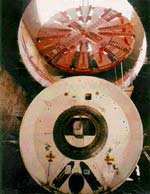 Expand Image Expand ImageOne of the boring machines that has driven the massive expansion of Madrid's metro network. | |
 Expand Image Expand ImageOne of the Series 6000 trains being built. | |
 Expand Image Expand ImageOne of the Series 6000 trains delivered from Adtranz-CAF during 1998-99. | |
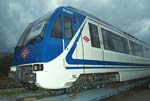 Expand Image Expand ImageAnother of the new trains. | |
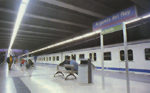 Expand Image Expand ImageArganda del Rey Station is modern, bright and spacious. | |
 Expand Image Expand ImageCab design is ergonomic, and the curved windscreen gives a good forward view. | |
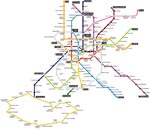 Expand Image Expand ImageMap of the Madrid Metro. |

Related links
UAE Plans Desert Railway