Las Vegas Monorail, USA


|
Bombardier Transportation signed a contract with the Las Vegas Monorail Company in 2000 to design and build a driverless, urban monorail transportation system east of the Las Vegas Boulevard ('the Strip') in the heart of the resort. The seven-station route formed an extension of the original 1.6km (one mile) monorail route that opened in 1993 between the MGM Grand and Bally’s hotels. In spite of the city's need for improved mobility there were no fixed guideways, automated monorails or light rail urban transit systems until this monorail, discounting the short free-access Mandalay Bay-Luxor-Excalibur and Monte Carlo-Bellagio inter-hotel systems on the west of the Strip. 
The first leg of the Las Vegas Monorail was by far the most scrutinised project in Nevada's history, with more than three years of public hearings and costly independent examinations. There was no tax money available to build the system, although the $65m project was finally given the go-ahead in September 2000. The project Driverless urban transit systems are expensive to build, and taxpayers usually do not want to raise their taxes to build them, especially in this setting where users are more likely to be visitors than residents. To overcome this problem Las Vegas resorts, led by Park Place Entertainment and MGM Mirage, raised finance without using any public funds. The sponsoring resorts invested a total of $30m, and the Las Vegas Monorail Team, led by Bombardier and Granite Construction, are investing an additional $18.5m. The rest of the required capital was financed by tax-exempt non-recourse revenue bonds tied to anticipated farebox and advertising revenue. Under a turnkey contract, the system was built by Bombardier with a maintenance and operation contract for five years, which may be extended by another two terms. Infrastructure Las Vegas Monorail links seven stations over 6.4km (4 miles) of elevated dual-monorail guideway, integrating the two existing stations and re-equipping the 1.6km guideway of the former MGM Grand-Bally's monorail line. Set behind the developments on the east side of the Strip, it provides a direct service between eight major resort properties and the Las Vegas convention centre. Five new stations were built for computability with the new line. All stations but the Sahara terminus have a centre-island platform layout, with platform-edge doors activated by the train. Consortium partner Granite's contract included the design and construction of the five new stations and three miles of dual-elevated guideway, integrating two existing stations along the route. The new alignment runs east of the Strip between the MGM Grand and the Sahara. The contract also included the reworking of the original line. Construction started in 2000 and was complete and ready for testing in late 2003, with opening to the public in July 2004. Prior to opening, in October 2003 Bombardier and Granite were awarded a further $336.6m contract to extend the monorail – by then retitled the 'Robert N Broadbent Las Vegas Monorail' – by 3.6km to Las Vegas' downtown gaming district. However, following difficulties and low ridership on the first 6.4km section, the Government withdrew its pledge of $170m from the project. Rolling stockBombardier Transportation's Transit Systems unit, based in Kingston, Ontario, Canada, was responsible for overall system design, the vehicles, systems engineering and integration, train control, communications and power supply systems, automatic fare collection, the operations and maintenance facility, also testing and commissioning. "The monorail was expected to carry 20 million passengers in its first year, but this target was never met."
The monorail fleet was built at the Bombardier facility in Kingston. The 36-car monorail fleet is operated in nine four-car trains, each car self-contained. Trains travel at up to 50mph, taking around 14 minutes from end to end. The air-conditioning is essential for the vehicles featuring a high proportion of the surface area being glazed and often operating in very high temperatures. Trains have level boarding and the complete system is compatible with disability access legislation. Many attractive features, including increased interior height and wider outside sliding doors have been incorporated into the fleet of nine four-car trains. Beneath the space-age styling of the monorail's strong, lightweight composite shells are standard transit components found on many other Bombardier transit vehicles. If future extensions are approved, up to 20 additional cars could be required to meet service demands. Signalling / communicationsBombardier is responsible for the electrical and mechanical systems of the fully automated line and the 36 M-VI monorail cars. This contract is valued at $200m. Bombardier will operate the system for an initial five years with an option for a further ten years. The five-year operations and maintenance contract assigned to Bombardier carries a value of $56m. The total capital cost of the project was valued at $354m. As a free-standing entity, ticketing relates specifically to the system which operates late hours befitting the location's attractions. Single-trip tickets, one- and three-day passes are available. Fares were increased significantly as part of the response to revenue shortfalls. The future Technical difficulties forced the closure of the system between September and December 2004, harming the system's credibility and ridership performance, and also playing a part in the Government withdrawing funding from the proposed extension. Lower than expected passenger numbers also contributed to this withdrawal. The monorail was expected to carry 20 million passengers in its first year, but this target was not met. By 2006, the system was carrying around 32,000 passengers per day, which equates to 11 million per year. 50,000 passengers was the projection at the 2004 opening. In 2006, planning began on a revision to a proposed extension to McCarren International Airport which is located unusually close to the downtown area. It is proposed to link major convention centres and the airport with the hotels that are served by the existing line. "In spite of rises with 7.9 million carried in 2007, patronage levels remain substantially below initial projections."
In spite of rises with 7.9 million carried in 2007, patronage levels remain substantially below initial projections. The operator has drawn upon reserves as revenues have failed to cover the amount needed to meet operating costs and to service debts. The implied desirability of new bonds that would be needed for the half-billion-dollar McCarran extension, expected to be completed by 2010, makes the project seem unlikely to advance in the foreseeable future. For the US at least, the mode appears to have a limited future in mass-transit applications with the commercial problems in Las Vegas and the cancellation of a multi-line Seattle scheme in 2005. Although affected by breakdown and incidents, the one-mile commercial Seattle Center Monorail using the Alweg system dating from the 1962 World Fair remains in use. |
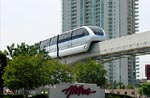  Expand Image Expand ImageSince mid-2004 monorail trains have been in passenger service over the 6.4km Las Vegas line. |
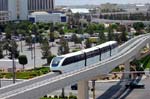 Expand Image Expand ImageThe Bombardier trains can reach up to 50mph on the elevated concrete sections. | |
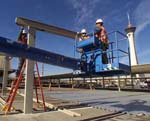 Expand Image Expand ImageBeginning demolition work at a Sahara hotel parking lot, the future site of the strip monorail maintenance facility. | |
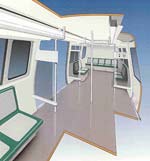 Expand Image Expand ImageArtist's impression of the interior of the monorail carriage. |

Related links
Public Railways in Private Hands