Lantau Line and Airport Railway, Hong Kong, China


|
Massive growth in Hong Kong's importance as a trade and business centre has brought many problems for the island's existing infrastructure. This in turn has slowed down the rate of potential growth at a time when the territory was keen to exploit its position as a force on the world trading scene. It was therefore seen as vital that the territory had modern transport facilities; the centrepiece of the development of these has been the new Chek Lap Kok international airport. 
A new 3.2km express magnetic-levitation line between Guangzhou and the Disney theme park at Sunny Bay on Lantau has a 2006 opening date. THE PROJECT The new 34km Airport Railway, opened in July 1998, is used by two distinct services. The Airport Express Line offers a fast passenger link between Chek Lap Kok and central Hong Kong. Journeys take 23 minutes, with intermediate stops at Kowloon and Tsing Yi, and are served by seven-car trains, offering an all-seated, business class-type service. The Lantau Line offers a more rapid transit orientated service, linking Lantau, West Kowloon and Hong Kong Central. This serves six stations: Hong Kong, Kowloon, Tai Kok Tsui, Lai King, Tsing Yi and Tung Chung. An interchange with the MTR (Mass Transit Railway light rail system) is provided at Lai King. The introduction of this service has brought two major benefits to the territory: traffic on the busy Nathan Road Corridor of the MTR has been eased, while journey times between Lai King and Hong Kong Central have been slashed from 23 minutes to just eight-and-a-half. INFRASTRUCTURE Hong Kong has five different rail systems: the heavily-used MTR network, the busy suburban Kowloon Canton Railway, the modern light transit (LRT) system, a traditional street tramway and the Peak funicular railway. Each operates independently but there is considerable interchange between them. Standard gauge lines are electrified at 1.5kV DC overhead, which gives total compatibility with the MTR system. Train speed, a maximum of 135km/h (80mph), is considerably better than the 80km/h (50mph) which is the norm on MTR. There are five intermediate stations on the two lines, some of which have separate, segregated platforms for Airport Express and Lantau Line services. 8km of the new line is in tunnel, including an immersed tube under Victoria Harbour, and a total of 6km (4 miles) is carried on elevated sections. This includes the spectacular Tsing Ma suspension bridge, one of the territory's biggest engineering projects of recent years. Among the world's longest suspension bridges, it has a central span of 1,377m, which is one of the longest single spans of any bridge in the world. With much of the line built on reclaimed land, the standard ballasted track can be shored up with additional material if required. However, tunnels, bridges and viaduct sections incorporate non-ballasted track on a concrete base, and in areas sensitive to noise pollution, floating slab track is used to cut noise and vibration. The high frequency of services along the Airport Railway and Lantau Lines places particularly heavy demands on the infrastructure. A British company is playing a prominent role in ensuring that the line is kept in as good a running order as possible. ROLLING STOCKThe contract for new trains to operate the services stipulated two distinct types of rolling stock for each service. However, the trains share a common aluminium-construction body design. They are built by joint partners Adtranz-CAF, the former supplying traction and control equipment and a cab simulator for training purposes, and the latter the car bodies, bogies, interior fittings, air conditioning and auxiliary equipment. The trains were assembled in Spain, where static testing was also carried out. Final acceptance took place in Hong Kong. The Airport Express Line is served by a fleet of 11 seven-car trains whose facilities include a baggage car to carry luggage checked in at Hong Kong Central or Kowloon stations. They also have two-plus-two upholstered seats - 64 to each car - carpets and luggage racks. Seat-back television screens provide up-to-date information on flights, MTR services and tourist information. The Lantau Line's fleet comprises 12 trains, also each of seven cars, seating a total of 336 passengers, and with standing room for 264 more in each car - important given the anticipated heavy use to which they were expected to be subjected. Driveless trains with advanced automatic train technology - the first in Hong Kong - are employed on the Disneyland line. Two four-car trains operate with a four-minute headway between the main line and the terminus at Sunny Bay. The target is to attract two million mainland tourists each year. SIGNALLING / COMMUNICATIONSSignalling comprises three fully-integrated system packages. Trains are supervised automatically from a main control centre, while their movements are controlled and constantly monitored by a transmission-based automatic train control system and computer-controlled interlocking. Stations are fitted with state-of-the-art communication and monitoring systems, including integrated passenger information displays (linked with those on the Airport Express trains), to provide up-to-the-minute travel information on which details of any disruption to services can be displayed. Train drivers have two-way communication with their main control centre in the event of emergencies. The contactless Octopus payment card is the heart of the public transport system. It can be used on all forms of public transport (except taxis) and increasingly other places such as convenience stores, restaurants, vending machines and car parks. THE FUTURE When fully operational, with the anticipated strengthening of the new trains, the Airport Express link and Lantau Line are expected to carry around 250,000 passengers a day. In order to cater for this anticipated growth, the trains are capable of being strengthened from seven to ten cars, boosting capacity by around 50%. The signalling system is capable of handling a greater service frequency than the initial eight-minute interval. Ultimately, this could be increased to one train every four-and-a-half minutes. |
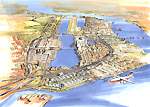  Expand Image Expand ImageArtist's impression showing the dramatic impact of the Airport Express and Lantau Line on the landscape. |
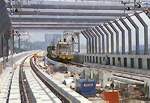 Expand Image Expand ImageTranslucent noise barriers have been installed in sensitive areas. | |
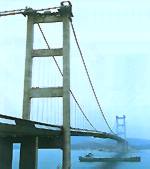 Expand Image Expand ImageThe spectacular Tsing Ma suspension bridge was an Anglo-Japanese construction project. |