California High-Speed Rail Network, USA


|
America has looked enviously on the development of high-speed rail routes elsewhere in the world, particularly Japan. The country has one the highest rates of private car ownership and some of the busiest roads in the world and it came to realise, perhaps late, that alternative forms of transport would be needed to cope with the continued demand for fast, efficient long- and short-distance journeys. In April 2009, the federal government, through the American Recovery and Reinvestment Act (2009), has committed to $8bn as initial investment and $1bn per year for next five years to develop high-speed rail projects across ten major corridors. 
The project The California high-speed train project is to be the first high-speed train system implemented in the US. After more than a decade, the project received the state voters approval in November 2008 through Proposition 1A for Safe, Reliable High-Speed Passenger Train Bond Act that authorises $9.95bn in bonds to establish a clean, efficient high-speed train service linking the Southern California, the Sacramento San Joaquin Valley, and the San Francisco Bay Area. The act also procures $950m to finance capital improvements to commuter and intercity rail and local transit lines to serve the high-speed train system. Construction efforts are anticipated to begin by 2011. An implementation plan approved in August 2005 estimates that it would take eight to eleven years. The 800-mile high-speed train system is estimated at $40bn. Federal government is to provide 25% to 33% of construction costs ($10–12bn). Another $4.5–$7bn will be generated through P3 funding (Public-Private Partnership). "The California high-speed train project is to be the first high-speed train system implemented in the US."
The California High Speed Rail Authority is the governing body overlooking the project. The commission's first objective is to develop a system connecting the San Francisco Bay area with Los Angeles, and then work on extensions to San Diego and Sacramento. The state government of one of the country's fastest-growing areas, California, decided in 1993 to establish an Intercity High-Speed Rail Commission to develop a framework for the implementation of a high-speed rail network in the state. The group focused on potential for inter-city travel; journeys of between l00 and 500 miles, at speeds of over 200mph (320km/h). Under the authority which created it, the commission's first objective was to develop a system connecting the San Francisco Bay area with Los Angeles, and then consider extensions to San Diego and Sacramento. The authority has carried out five evaluations which comprised a preliminary engineering study of the line between Los Angeles and Bakersfield, the corridor and environmental constraints, a ridership demand and market analysis study, modal cost comparisons and possible economic impact, and financing options. Three public inquiries have been held, and the findings handed over to the High Speed Rail Authority, which has the powers to implement the works needed for the project. The ability of the state's highway and airline network to continue to cope with future growth was questioned, and the Commission concluded that, while the extreme ends of the proposed route were well served, intermediate markets, such as the cities of Bakersfield and Fresno, enjoyed less frequent and less competitively priced public transport. Apart from cutting accident rates, the high-speed rail will reduce the congestion costs that approximate $20bn per year. The rail system is also projected to save $12.7m barrels of oil per year by 2030. The main project under planning is the San Francisco–Los Angeles high-speed line, which could connect the two cities in just 2 hours 30 minutes. Over the nearly 450-mile trip this express service is expected to average about 170mph, that will make it the second-fastest average speed run train in the world after the 174mph TGV-Est Paris to Champagne express. The forecast expects 117 million passengers annually by 2030, with a relatively low passenger cost per mile, with one-way fare of $55. After the completion of the authority's June 2000 Business Plan, it hired the consulting firms of national railroads from three countries – SNCF (French), DE Consult (German) and JARTS (Japan) – for peer review. Infrastructure Residents of the Los Angeles and San Francisco areas are also all too conscious of other possible major factors which affect existing modes of transport, but from which rail travel is less likely to suffer. The region is prone to dense fog, making travel on the already congested roads even more hazardous. The area is a well known earthquake zone, and the promoters of the scheme are keen to point out that it would offer an alternative means of transport in the event of such a natural disaster. "Consideration is already being given to how the new high speed line would fit in with other transport systems."
Supporters of the campaign to build the high-speed line have said that without it, California could need up to 3,000 miles of new highway, 60 new airline gates and five more runways as the population grows from 35 million to 48 million over the next quarter century. The new high-speed rail line would have trains capable of speeds up to 200mph. These would carry up to 115,000 passengers per day and serve up to 30 stations along a 700-mile route serving the population centres of San Francisco, Los Angeles, Sacramento and San Diego. Consideration is already being given to how the new high speed line would fit in with other transport systems. Most of the line is expected to be built alongside existing roads and railways and the two-track line will have 20 times the capacity of the neighbouring road, with 20 trains per hour in each direction. A ruling gradient of 3% is envisaged, which will allow for a comfortable high speed journey. At certain locations the high-speed line is expected to use viaducts and tunnels, in a similar manner to other high-speed rail projects around the globe. The electrically powered high-speed train system would draw electric power from overhead wires connected to the commercial power grid. In braking it would regenerate electricity back to the grid, thereby conserving power and reducing costs. Rolling stock Even though the final funding is not in place for the project, consideration has been given to the types of train that could be developed for the new high speed line. Technology is expected to be based on already proven high-speed trains from the likes of Japan, Germany and France. Each train will be up to 1,300ft long and capable of carrying 1,300 passengers. A variety of different cars will be included in the formation, such as quiet cars, play areas for younger families, café and bar cars and possibly even a conference facility. It is expected that 150 intercity trains will operate through the line each day. The high-speed train will reflect the design of the new Series 500 and 700 Shinkansen trains that operate with a maximum speed of about 187mph in Japan and French TGV and AGV (Automotrice Grande Vitesse). The steel-wheel-on-steel-rail technology has been preferred to maglev (magnetic levitation systems) technology. Signalling and communications High-speed train traffic control and communications systems are centrally regulated and managed during all hours of operation. These systems monitor and limit the train's speed, schedule, routing and headway. A sophisticated signalling and communication system is in the early planning stages. One proposal is to install intrusion alarms on the fencing, which would be linked to a central control system capable of detecting foreign objects on the tracks. In-cab signalling will be capable of automatically stopping trains if necessary. Line routes On 15 November 2007, the Authority issued a recommendation that the high-speed rail follow the Pacheco Pass route, rather than the Altamont route as the preferred high-speed train alignment between the Central Valley and the Bay Area. Similarly, the route via Palmdale is selected between the Central Valley and Los Angeles for the rail network. "The new high-speed rail line would have trains capable of speeds up to 200mph."
The future The High Speed Rail Authority has the job of directing the development and implementation of the system, including funding. It had been planned to gain the base funding by 2000, however, the project is in danger of stalling, as the $9.95bn bond may be removed from the public spending plan at the November 2006 ballot. If it remains in place, it will secure the start of works on the new line in 2007. Construction could take place in two phases over eight years. The first phase (five years) would build the San Francisco–Los Angeles section, while the San Diego–Sacramento line could then be completed partly using income from the first phase once it is operational. The new line is expected to divert over a third of the air trips travel and about 6% of auto-travellers. Once built, the system would not require operating subsidies and will generate over $1bn in annual profits. Comparatively, in Japan the Shinkansen has about 75% of the market in air transportation for a trip time about 2.5 hours. In Europe, high-speed rail occupies 50% of the traffic where rail trip times are 4.5 hours or fewer. If travel time is two hours or fewer, it occupies 90% of the market share. The high-speed rail line will create nearly 160,000 construction-related jobs to plan, design and build the system. An additional 450,000 permanent jobs are expected to be created by 2035. |
  Expand Image Expand ImageThe Route 99 corridor and extension alternatives. |
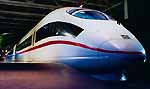 Expand Image Expand ImageThe latest variant of the Siemens high-speed train. | |
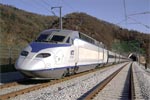 Expand Image Expand ImageAn Alstom TGV for Korea. | |
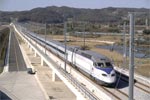 Expand Image Expand ImageViaducts will be incorporated into the new line to keep the gradient profile as flat as possible. | |
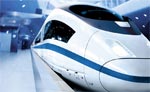 Expand Image Expand ImageA Siemens built Velaro high-speed train for service in Spain, on which the future trains of the California high-speed line may be partially based. |

Related links
California's Need for Speed
California Stakes Claim on High-Speed Budget
Americans Support High-Speed Rail
California's Metrolink Introduces New Safer Rail Cars
US State Commits Funds for High-Speed Rail Line
US State Commits Funds for High-Speed Rail Line
US High-Speed Rail Line Could Cost Extra $3bn