Budapest Border Railway Upgrade, Hungary


|
The MAV (Hungarian Railways) line through the north of the country from Budapest to Hegyeshalom on the main corridor to Vienna has been extensively upgraded, with 86km (53 miles) of the route made suitable for 160km/h operation. Full membership of the European Union from 2004 makes easy access to the country by rail even more important. THE PROJECTDespite this line being the main rail artery between the former Eastern bloc countries and central Europe, it has been blighted with long-term speed restrictions. At one point in the mid-1990s, there were more than 70 permanent or temporary restrictions along the route. 
On completion, the only permanent speed restrictions left in place along the line have been one of 80km/h (50mph) at Tatabanya and two of 100km/h (60mph) between Tata-Tovaroskert and Tata stations and at Gyor station. The main objective of the project was to cut journey times between Budapest and the Austrian capital Vienna from over 2¾ hours to around two hours by allowing 160km/h operation throughout. The funding for the work and new Z2-type rolling stock has been met by a loan agreed with a German Frankfurt-based bank. The loan was granted on condition that the improvements ensured that a two-hour journey time could be achieved between Budapest and Vienna and for this reason station reconstruction and track sections already modernised under previous programmes were not included in the scheme, but will be improved gradually as the amount of wear on the track dictates. INFRASTRUCTUREThe major works involved were the complete reconstruction of the line between Vertesszolos and Almasfuzio-Felso but the rest of the route saw mainly track and safety systems upgrading with the whole length of the route being grinded and reprofiled. This latter operation has brought about significant reductions in rail noise levels and in operating costs as well as extending the life expectancy of the rails. At the same time as the reprofiling work was carried out 490 new catenary masts were installed as replacements for worn out structures and 62km (40 miles) or wiring was renewed. The stations along the line have also been equipped with around 250 new turnouts to streamline the track layouts, while around 19,000m² of platform has been reconstructed in total. 44 level crossings along the route have required modifications, with the installation of new high-safety crossing gates and reconstruction of their pavements. Five main stations (Nagyszentjanos, Gyorszentivan, Otteveny, Kimle and Mosonmagyarovar) and the smaller stop at Level have also seen new underpasses constructed, while four stations and two more rural locations have been provided with new pedestrian bridges. Road bridges have been installed to allow main road 100 to cross the line near Tata station and near Vertesszolos. A new feature in this project was the first use in Hungary of temporary bridges capable of taking trains at 80km/h (50mph) while existing structures were being reconstructed. Several stations along the line have been provided with pedestrian footbridges for the first time, while near Tata a steel-reinforced concrete bridge was constructed in two separate sections which were then bolted together to give a higher load-bearing capacity than a single structure. The station building at Tata has been renovated to resemble an industrial building from the early 20th century. This itself houses new safety gear in its ground floor. The station at Hegyeshalom at the western end of the line has also been upgraded to make it appropriate for its role as a European border station. The location will also see the establishment of the new centralised commercial base for the line as well as the provision of a modern electronic weighbridge. SIGNALLING AND COMMUNICATIONSFibre-optic cables have been strung along the length of the route using the existing catenary masts which carry the telecommunications equipment needed for central traffic control and operations management systems. The line's traction supply has also had to be completely upgraded as part of the project. Several 120kV / 25kV transformer stations have been replaced to gas-insulated contact breakers, combined measuring switches and 25kV switching equipment. Electronic safety systems have been integrated in the project for the first time in Hungary with the existing block section signalling and level crossings along the route modified as necessary for the higher speeds. This work has included the provision of the first electronic traffic control room in Hungary, at Budapest-Keleti. The entire length of the route has been equipped with UIC 60-type sleepers, although the existing ballast was completely recycled and relaid as a water-insulating protective layer. ROLLING STOCKThe principal trains to be used on the upgraded line are the 70 UIC Type Z2 coaches delivered from Deutsche Waggonbau in 1995, on which some final assembly work was carried out at MAV's own workshops in Dunakeszi. These are complemented by 18 Class 1014 dual-voltage electric locomotives previously used by the neighbouring Osterreichische Bundesbahnen (Austrian Federal Railways), whose introduction eliminates time-consuming and costly traction changes at frontier points. THE FUTURETwo more enhancement projects are now planned: Budapest-Cegled-Szolnock-Loakoshaza (Romanian border) and Zalalovo-Zalaegerszeg-Boba (towards Slovenia). The Hungarian government will cover 50% of the cost. |
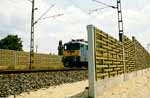  Expand Image Expand ImageMore than 15,000m² of noise protection walls have already been installed on this network. |
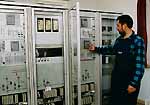 Expand Image Expand ImageNew electrical equipment replacing outdated systems. | |
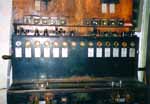 Expand Image Expand ImageThe old safety system equipment at Tata. | |
 Expand Image Expand ImageThe first electronic traffic control room in Hungary. | |
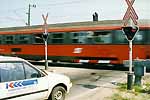 Expand Image Expand Image'Fly eye' high luminosity red optics are now standard new safety features in use. | |
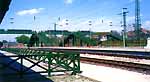 Expand Image Expand ImageThe reconstructed station building at Tata. |