Boston 'T' Metro Rail System Extension, USA


|
Commuter lines radiating from Boston's two downtown stations are being extended. The Massachusetts Bay Transportation Authority, or the 'T' as it is popularly known, continues to expand its boundaries with the support of the area government, which actively encourages the use of mass transit instead of automobiles. Today's MBTA (created in 1964) is the sixth largest system in the US, serving a population of 2.6 million in 78 cities and towns. It is a mix of eleven commuter rail routes, three rapid transit lines, five streetcar routes, four trolleybus routes, and 155 bus routes. The rolling stock fleet is 1,100 buses, 219 light rail vehicles, 12 PCCs, 50 trackless trolleys, 52 commuter rail locomotives, and 304 coaches. 
REVENUES Fare revenues from nearly 200 million annual riders however only account for 30% of receipts. The system receives a 70% annual operating subsidy from the Commonwealth (State) of Massachusetts, compared with 25% from local communities and only 4% from Washington. The rail system consists of three major divisions: the Green Lines (light rail); Red, Orange and Blue Lines (three separate heavy-rail lines sharing a common gauge but little else); and Purple Lines (commuter rail). EXPANSION Currently, 55 locomotives hauling 324 coaches operated for the "T" by Amtrak work on 425km of track on eleven routes, calling at 101 stations. In 1994, some trains on the Framingham line to the west were extended to Worcester. New stations and more services are being added. Services over 80 miles of old railway into the Old Colony area south and east of Boston are being restored to provide a critical economic and social link between the centre of population and the South Shore. Within weeks of the opening of the Southeast Expressway in 1959, passenger service on the historic Old Colony Railroad south of Boston shut down, after more than a century of service. It left 32 South Shore communities almost totally dependent on the automobile for transportation into Boston. But, in the 1990s, with no rail service, the automobile has created a haze of congestion and pollution. COLLABORATION The future of transportation in south-eastern Massachusetts requires collaboration between highways and mass transit. Fifteen new commuter rail stations, providing more than 8,000 car parking spaces, have been constructed on the first two branches opened in September 1997, one at Quincy Center and Braintree, six on the Middleboro/Lakeville line, and seven on the Plymouth/Kingston line. Other work includes rehabilitation of 51 railroad bridges, and a new bridge over the Neponset River. AMF in Montreal is re-engineering 25 former Canadian National locomotives to produce GP40PH-2 machines for MBTA services. TOURISTS The Ipswich line to the north is being revived on the 8.7 miles to Newburyport. (This service was withdrawn in 1976.) Since then, total commuter rail ridership on all lines into Boston has increased by approximately 60% to over twelve million passengers per year. The new service will provide alternative access to Boston for North Shore commuters, and enhance the tourist industry. Into the next century, there are plans for a new commuter service to Fall River and New Bedford. NEW TUNNEL Plans for the relocation of Boston's Central Artery motorway include provision for a two-track rail tunnel between the south and north rail networks, including a stop near Rowe's Wharf in central Boston. Amtrak trains bound for Portland will leave the present line near Back Bay station and turn to the east of the Central Artery, possibly with stops underneath South and North stations. There are also plans for MBTA regional commuter services radiating from the two stations to be linked. LIGHT RAIL The Green Lines comprise four routes, running generally to the west and south of the downtown area:
Plans also call for relocation of the Green Line immediately north of downtown from elevated structure to a continuation in subway under the Boston Garden and North Station, rising to join the Lechmere Viaduct near the Charles River bridge. The present Lechmere terminal will be moved across the street ready for an extension along the adjacent rail right-of-way to Somerville. The replacement vehicle chosen by MBTA for the elevated section relocated away from Washington Street is the trolleybus. A fifth line using LRT technology shuttles for 4km from the end of the Red Line branch at Ashmont to a transfer terminal at Mattapan. RAPID TRANSIT Three separate lines, one with two branches, form the rapid-transit system of the 'T'. Red Line, the most popular, operates from Alewife (north-west) to Ashmont and Braintree (south), and is the heaviest of the three divisions. It works from the third rail with vehicles from Bombardier Transportation and Pullman Standard. Recently-added have been extensions from Quincy-Braintree and Harvard-Alewife. The line runs from a modern terminal at Forest Hills along a new alignment containing "T" rapid transit and commuter trains, along with Amtrak Boston-New York services, to a new connection with a short section of original subway through downtown. Bombardier Transportation have recently supplied some 86 red line number three rapid-transit cars to Boston. The orange line then diverts into a new tunnel under South Station and rises to the surface under a motorway, sharing a right-of-way with commuter trains as far as Oak Grove. Extensions at either end are possible. Hawker-Siddeley cars are used. The blue line runs from Bowdoin on the outskirts of downtown northwards to Wonderland along the coast. Stock is shorter and narrower because the tunnel under Boston Harbour was originally built to tramcar profile, and other track was once a narrow-gauge passenger line. There are also plans for an extension north from Wonderland, and a connection with the red line near Charles River bridge. |
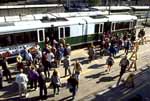  Expand Image Expand Image'T' services are particularly busy, exemplified by Fenway station. |
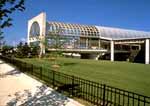 Expand Image Expand ImageThe futuristic exterior of Ruggles station. | |
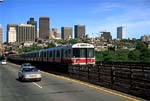 Expand Image Expand Image'T' suburban services are clearly segregated from local road traffic. | |
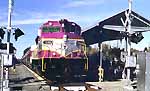 Expand Image Expand ImageThe $530m old colony restoration is a model of contemporary commuter rail technology. | |
 Expand Image Expand ImageHaverhill is a terminus of commuter rail lines from the city centre. | |
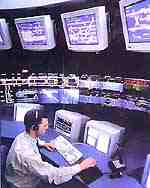 Expand Image Expand ImageThe 'T' System's new operational control centre. | |
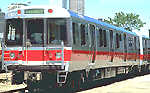 Expand Image Expand ImageBombardier Transportation red line number three rapid-transit car for Boston, United States. | |
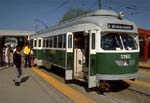 Expand Image Expand ImageClassic PCC trams are still in evidence, as seen at Mattapan Halt. |

Related links
MBTA to Buy New Locomotives