Ministry of Transport and Communications
Cairo
Tel: (+20 2) 355 55 66 Fax: (+20 2) 355 55 64
Key personnel
Minister: Soliman Metwali
Egyptian National Railways (ENR)
Station Building, Ramses Square, Cairo
Tel: (+20 2) 575 10 00/13 88 Fax: (+20 2) 574 00 00
Key personnel
Chairman: Eng Mahmoud Marei
Deputy Chairmen
Operation and Regions: Eng Mohamed Raafat Mostafa
Permanent Way and Signalling:
Eng Mohamed Talat Khattab
Technical and Engineering:
Eng Zakaria Abd El Hamid Youssef
Construction: Eng Nawal Taha Mahmoud
Financial: Bahgat Fayed
Administration: Mohammed Ezaat Badway
Gauge: 1,435 mm
Route length: 4,955 km
Electrification: 42 km at 1.5 kV DC
[топ]Organisation
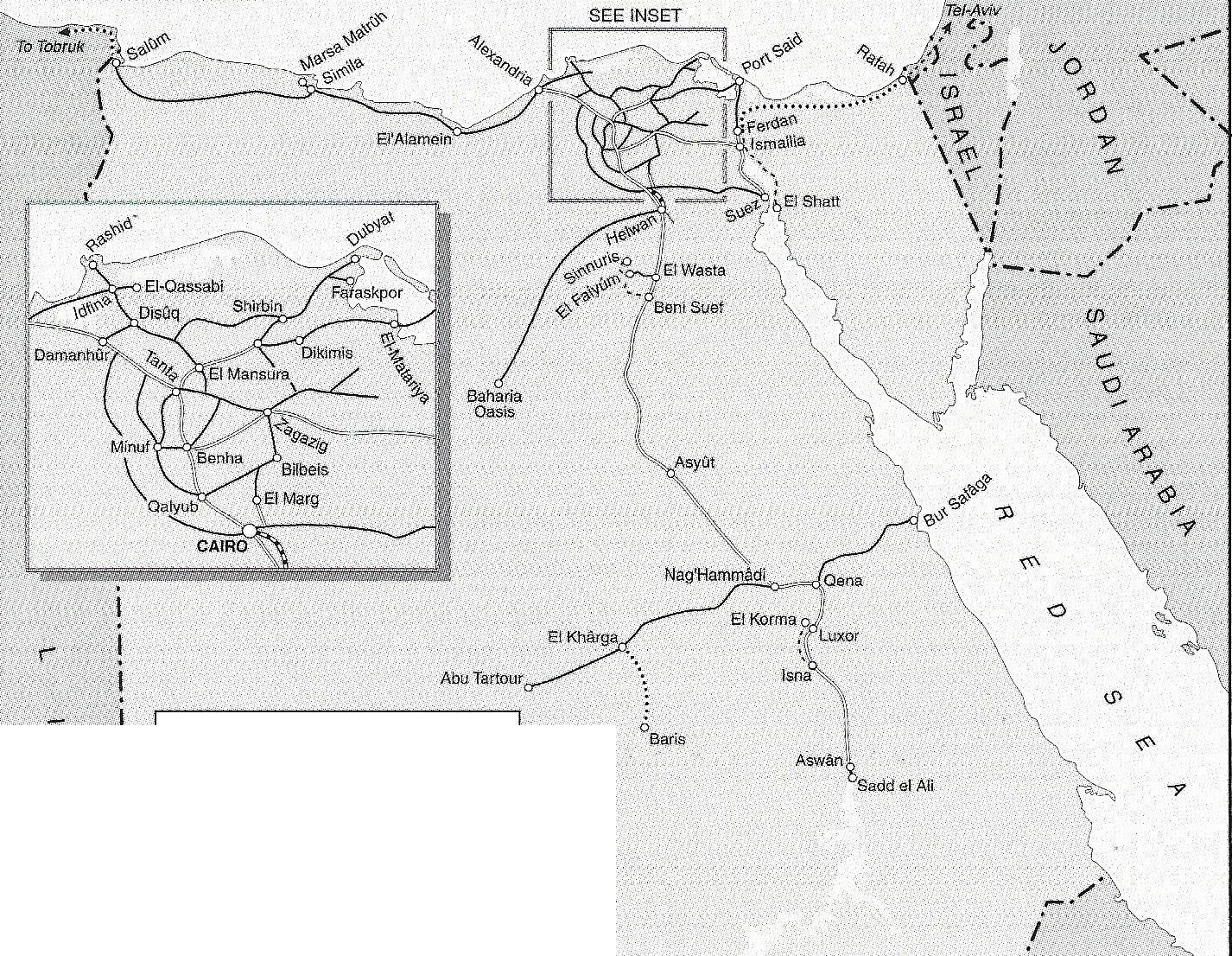
Egyptian National Railways extends from the Mediterranean up the Nile Valley, serving the Nile Delta, Cairo, Alexandria, Port Said, Ismailia, Suez and connecting at Sadd el Ali, its southernmost point, with the river steamers of Sudan Railways. From El Quantara, on the Port Said-lsmailia line, a branch runs east following the coast and connects with Israel Railways; it has been
disused for many years. A significant recent expansion of the network was the opening in 1996 of an west-east line in Upper Egypt, from Abu Tartour to the Red Sea port of Safaga.
[топ]Passenger operations
In modern times ENR has been primarily a passenger railway. Passenger traffic grew to some 462 million journeys by 1990 (compared with 313 million journeys in 1980) and jumped substantially thereafter to reach 775 million journeys in 1997 (60.62 billion passenger-km). This was due largely to the huge success of the cross-city tunnel linking Cairo’s two busiest commuter lines.
On main line services, ENR has expanded train lengths substantially, with the aid of 700 main line day cars and 605 suburban cars acquired since the mid-1970s. In 1992 and 1993 there was a slackening in passenger demand, as the tourist business felt the full force first of the Gulf War and later of terrorism within Egypt itself.
Three 10-car turbotrain sets built by ANF Industrie provide prime service over the 208 km between Cairo and Alexandria. It is hoped eventually to exploit this equipment’s 160 km/h capability to achieve a Cairo-Alexandria transit in 1 hour 30 minutes, with each of the trains completing three round trips daily. At present, however, they are confined to 140 km/h, and that only over certain sections. In the Cairo area speed cannot exceed 60 km/h for some 25 km distance.
Luxury air conditioned overnight trains using refurbished stock operate on the Cairo-Luxor-Aswan route. Infrastructure upgrading on this popular tourist route has included double-tracking and resignalling. Daytime services have benefited considerably from the track upgrading, permitting operation at 140 km/h of four trainsets supplied by ABB Henschel (now Adtranz) and Hyundai.
ENR long-term projections for passenger traffic volumes foresee growth of over 250 per cent in the 15 years from 1997 to 2012.
[топ]Freight operations
Freight too has advanced, though ENR has a market share of only around 12 per cent. In 1990, 8.6 million tonnes were hauled for 2,827 million tonne-km, but this had increased to 12 million tonnes (3,969 million tonne-km) by 1997. The main constituent is ore carried on the Baharia-Helwan line, with wheat and oil next in importance. Container traffic has also experienced substantial growth, sufficient to encourage ENR to commission studies into the establishment of intermodal terminals, or ‘dry ports’, in major towns and cities. The first of these is to be established in the Cairo area and will be managed independently of ENR.
Freight carryings were expected to receive a further boost of some 7 million tonnes annually with the recent opening of the long-planned line to tap phosphate deposits at Abu Tartour. The 235 km initial section of this export corridor, linking the Cairo-Aswan main line at Qena with the Red Sea port of Safaga, was opened in 1984, but construction of the western portion up to Abu Tartour was not started until much later. Work on this difficult project, which includes a crossing of the Nile at Nag’Hammadi, was completed in October 1996. A 46 km branch south from El Kharga to Baris is planned.
The infrastructure of a 70 km line from Port Said to the Nile Delta has been completed.
Another longstanding project is that for construction of a line into neighbouring Libya from ENR’s northwestern terminal at Salum, now revived as a joint venture between Egyptian and Libyan interests. Feasibility studies of the 130 km alignment have been made by ENR and in 1996 it was announced that Libya would build the line to Salum from Tobruk with technical assistance from Egypt. This would connect the ENR system to a proposed 1,800 km network in Libya.
A start has also been made on re-establishing the long-closed link across the Sinai peninsula to Rafah, close to the Gaza border, with award in 1996 of a contract to build a new rail/road swing bridge across the Suez Canal at El Ferdan. At 640 m, this will be the world’s longest swing bridge. It will be built by Consortium El Ferdan Bridge, led by Krupp Stahlbau of Hannover, and should be open in 2000. The line to Rafah will be built for 160 km/h running, and will be СТС-controlled. Completion was expected in 1999.
In 1998 ENR was also preparing preliminary studies into a 500 km line to Sudan, linking Aswan with the northern Sudanese town of Wadi Haifa. Other projects being studied or developed included: a new branch line to serve iron ore deposits near Aswan; a branch from the Cairo-Suez line to serve a proposed new port on the Gulf of Suez; and a branch from the planned Ismailia-Rafah to serve a new port east of Port Said.
[топ]Improvements to existing lines
A recent priority has been renovation of the 345 km line built shortly after the Second World War with Soviet aid from Helwan to Baharia, which is primarily an ore and coal carrier. Improvements included complete track renewal and protective measures to prevent service interruptions caused by drifting sand. CTO is managed from a control centre in Cairo.
A four-year programme to double-track the Cairo-Aswan Nile Valley line was completed in 1996.
Much of ENR’s track maintenance and renewal is undertaken by private-sector contractors, with both Franco-Egyptian and German-Egyptian joint venture companies active.
[топ]Traction and rolling stock
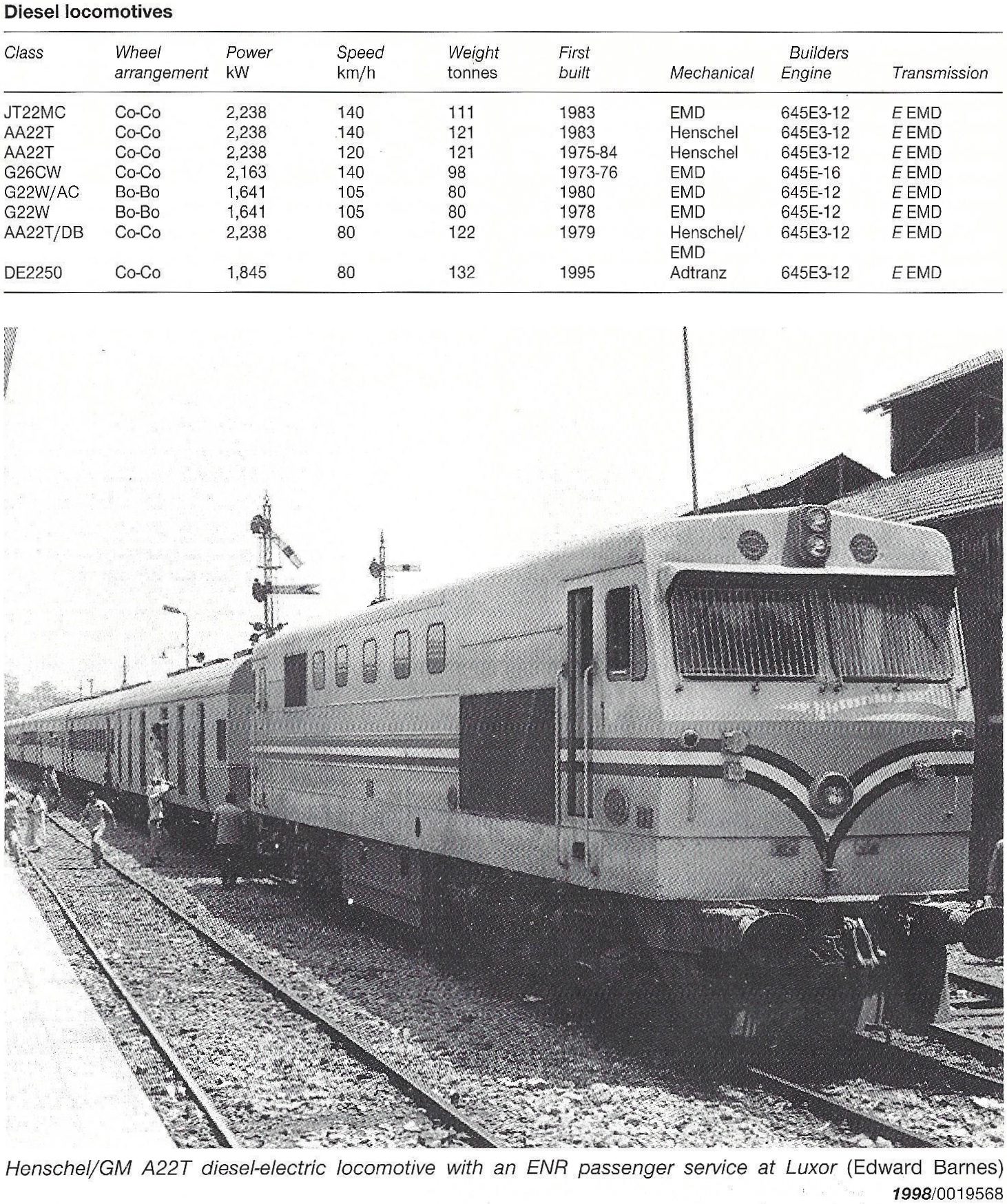
At the beginning of 1997, rolling stock totalled 833 diesel locomotives, three 10-car turbotrains, 45 multiple-units, 3,274 passenger cars, 38 diesel railcars and 11,673 freight wagons.
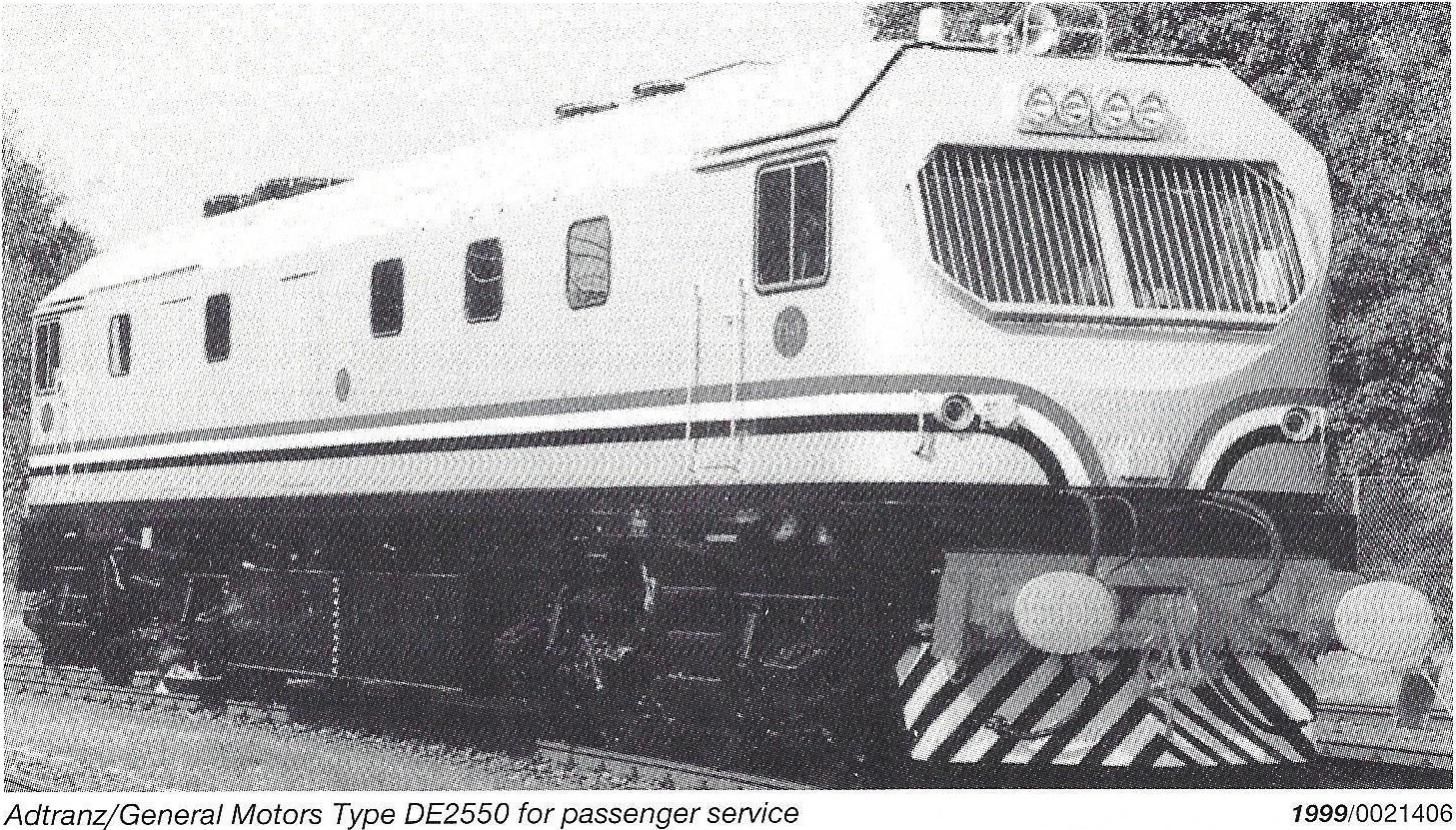
A fleet of 700 bottom-discharge wagons for the Abu Tartour phosphates traffic was delivered by local manufacturer Semaf. They are hauled by 45 DE2250 single-cab GM-powered diesel-electrics delivered during 1995-96 by Adtranz Germany. These Co-Cos are rated at 1,845 kW. A further 23 similar locomotives, but in a dualcab configuration, were ordered for more general duties in the Nile Delta area.
In 1997 a further 30 1,230 kW diesel-electric locomotives were on order from General Electric of the USA, ENR’s first machines from this manufacturer. Funding for the project was to be provided by the US Agency for International Development.
In December 1997 Bombardier Transportation signed a contract to undertake mid-life refurbishment of 80 ENR Turbotrain bogies. Semaf has received a contract to construct 100 non-air conditioned coaches, and has embarked on a refurbishment programme covering 100 second- and third-class vehicles.
Upgrading of the existing freight wagon fleet is being undertaken under a programme started at the beginning of 1998.
[топ]Electrification
The double-track suburban main line from Cairo to Helwan (42 km) is electrified at 1.5 kV DC, and forms Line 1 of the Cairo metro system.
Admin добавил 05.02.2026 в 13:20
Вы можете дополнить или изменить данную статью, нажав кнопку Редактор







 Похожие темы


 Почта
Почта


 Egypt railway