




 |

|
|
 05.01.2024, 10:11
|
#1 (ссылка) |
|
Crow indian


Регистрация: 21.02.2009
Возраст: 41
Сообщений: 30,470
Поблагодарил: 398 раз(а)
Поблагодарили 6063 раз(а)
Фотоальбомы:
2624 фото
Записей в дневнике: 912
Репутация: 126141
|
Тема: VLADIKAVKAZ CHILDREN'S RAILWAYVLADIKAVKAZ CHILDREN'S RAILWAY Vladikavkaz Children's Railway named after V.V. Tereshkova is located on the southern outskirts of Vladikavkaz, the capital of the Republic of North Ossetia-Alania. It is one of two children's railways on the North Caucasus Railway (after the Small North Caucasus Children's Railway in Rostov-on-Don). The Vladikavkaz Children's Railway has a ring configuration. The main station is the Eternal Flame station. 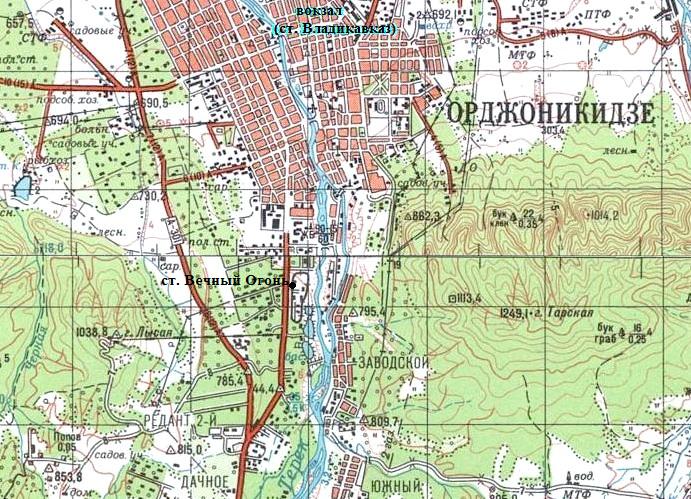 Vladikavkaz Children's Railway on a 1:100,000 scale topographic map published in 1988. Vladikavkaz Children's Railway on a 1:15,000 scale map (150 meters in 1 centimeter). The Ordzhonikidze Children's Railway (Vladikavkaz until 1931 and Vladikavkaz since 1990) was opened in 1968. It became the second children's railway on the North Caucasus Railway. The world's first female cosmonaut, V.V. Tereshkova, took part in the ceremony of laying the children's railway in 1966. The children's railway was named after V.V. Tereshkova. As of 2011, the Vladikavkaz Children's Railway is about 2,300 meters long. It has not changed since the opening. The line is a closed ring of elongated shape. It is located on the southern outskirts of the city, near the banks of the Terek River and the ring of the Vladikavkaz tram "Vodnaya Station". There is one station on the Vladikavkaz Children's Railway, which is named Eternal Flame. The name is due to the fact that it is located near the memorial complex. One stop remains: the Vodnaya Station (formerly Pionerskaya Station). Previously, there was also a Camp stop. Traction rolling stock is represented by diesel locomotives TU2-056 and TU7A-2991. Dmitry Ivanov's material (a brief description of the Vladikavkaz (Ordzhonikidze) children's railway, as of 1984-86). Ordzhonikidze Railway named after V. Tereshkova. The 1980s General information: Construction began in 1966. It was opened on May 2, 1968. It consists of a ring with a length (according to various sources) from 2200 m to 2370 m (probably 2200 m is only the length of the main track (ring), and 2370 m is the length of all tracks, together with access roads). The Children's Railway is located on the southern outskirts of the city of Ordzhonikidze (Vladikavkaz), near the Water Station, between the Tbilisi Highway (now Costa Avenue, the beginning of the Georgian Military Road) and the left bank of the Terek River. On the opposite side of the highway is the main station of the cable car to Bald Mountain. Rolling stock: TU2-056 diesel locomotive, 6 Pafawag passenger wagons (as of 2007, there may be 4 wagons left). The TU7A-2991 diesel locomotive was acquired in the late 1980s. In passenger traffic, a train consisting of a locomotive and four cars was used (sometimes there were fewer cars on the train for various reasons). The movement was carried out in a counterclockwise ring. The train made its 1st (zero) trip without passengers from the depot to Pionerskaya station. Stations and facilities: 1. Pionerskaya (now a Water Station). Without track development. Located in a curve. The platform and the ticket booth are located on the right side of the train. Passengers could purchase tickets and board the train only at this station. 2. The camp. The ghost station. The train passed the station without stopping. The station was dilapidated. The platform and pavilion are also on the right side of the train, similar in design to Pionerskaya, only on a straight section. I don't know if she's ever worked. 3. Eternal Flame. It is named after its location near the Obelisk in honor of the fighters for Soviet power in the North Caucasus. The only station with track development. The station itself has 2 tracks, 2 high passenger platforms — one on the right side of the train, the second between the tracks. The train stopped at the right platform. There was no boarding at this station, as there was no ticket office. There were 2 reserve wagons on the 2nd track. There is a depot in the same complex with the station. The depot has 2 tracks, accommodating 1 locomotive and 4 wagons. The depot also houses the administration of the Russian Railways and training classes for young railway workers. In the 1980s, there were no alarms or traffic lights on the road. Currently, according to unconfirmed reports, there is a semi-automatic lock (auto-locking is being designed), unified electrical centralization at the station, traffic lights, and train radio communications. There is a bridge across the bayou between Pionerskaya and Lagernaya. From the Camp to the Eternal Flame, the train goes along the embankment. There were 3 unguarded crossings. Also in the 1980s, a narrow-gauge steam locomotive (presumably Gr-329) stood at the back of Ordzhonikidze railway station, which, according to some reports, was intended for the railway, but never got on the road itself.  The Vladikavkaz Children's Railway was one of the main targets of this expedition. Due to the southern climate, the road's operating season is long — from early May to November 4. In May and in the autumn months, traffic is carried out only on Sundays. I arrived at the Vladikavkaz Children's Railway on Sunday, September 11. There was some excitement: would the road really work? There is no complete certainty about this. At first, the road seemed closed until spring: the tracks were rusty, and there seemed to be only security personnel. But I was assured that there would be movement. After a while, I visited the depot and training facilities, and inspected the TU2-056 diesel locomotive. Natalia Kelakhsayeva, the head of the children's railway, and other employees reacted exceptionally well to my work. Many historical photographs were provided for copying. I was shown railway models created by young railway workers and road staff. Reconstruction of the Vladikavkaz Children's Railway has been planned for a long time, but has not yet begun. One of the instructors assured me that many employees of the North Caucasus Railway had seen a narrow-gauge diesel locomotive loaded onto the platform, which was being delivered from Rostov towards Vladikavkaz. He was informed that the locomotive was already on its way to Ossetia, and everyone on the children's railway was waiting for it to be brought to them, but the locomotive did not arrive on the road. The instructor began to find out where the locomotive had gone, interviewed many railway workers, and found out that the locomotive had entered Alagir, from there to one of the mines in this part of North Ossetia (maybe Sadon or Buron). Theoretically, delivery to the construction site of the Zaramaga HPP is also possible. If this is true, then the information is sensational — narrow-gauge mine railways are almost never used and rolling stock of land-based narrow-gauge railways has not been used. Perhaps the only known exception is Oil Shale (http://infojd.ru/12/slantsy-ujd.html ). But the accuracy of the information needs to be checked. I'm taking a trip along the Vladikavkaz Children's railway, then I'm documenting it on foot. The traction rolling stock is the same here: diesel locomotives TU7A-2991 and TU2-056, both in working condition. The ticket price is 60 rubles. The train runs without a timetable. With a sufficient number of passengers, it is on the move almost all day, except for an hour-long lunch break. The road is maintained by young railway workers.  A train ticket. It was sold on September 11, 2011. One of the road workers turned out to be nervous, arranged a total check of documents and belongings, found fault with the absence of a stamp on military service in the passport (although it is not needed after 27 years) and arranged an exam on knowledge of the alarm Instructions — in order to make sure that I really am who I say I am. But this can be understood: the region is extremely turbulent. North Ossetia lives in extreme tension, and there is a reason for this — terrorist attacks and shootings, "liquidation of militants" happen here all the time, they are usually not even noticed in Moscow. It was even worse in the early 1990s, when the Ossetian-Ingush conflict was taking place. It was a big surprise for me to learn that even in the most difficult, hungry and paramilitary times — in the early 1990s, the Vladikavkaz Children's Railway continued to work and educated the younger generation of railway workers. While the children's railway, located, for example, in quite prosperous Chelyabinsk, was then closed... |

|
Цитировать 14 |
 Похожие темы
|
||||
| Тема | Автор | Раздел | Ответов | Последнее сообщение |
| ALMA ATA CHILDREN'S RAILWAY | Admin | Sergey Bolashenko's Travels | 0 | 08.02.2024 00:24 |
| THE "NEW" MALAYA OKTYABRSKAYA CHILDREN'S RAILWAY | Admin | Sergey Bolashenko's Travels | 0 | 09.01.2024 13:08 |
| indian railway | Legon | Общие вопросы железных дорог | 0 | 01.08.2017 12:50 |
| [Книга Путь и п/х] The Railway Track and Its Long Term Behaviour: A Handbook for a Railway Track of High Quality (Tzanakakis K.) | Admin | Библиотека | 0 | 20.04.2014 14:33 |
| Railway Signs | Admin | Wiki | 0 | 09.02.2012 14:49 |
| Ответить в этой теме Перейти в раздел этой темы Translate to English |
| Здесь присутствуют: 1 (пользователей: 0 , гостей: 1) | |
|
|


 Почта
Почта


