




 |

|
|
 09.01.2024, 13:08
|
#1 (ссылка) |
|
Crow indian


Регистрация: 21.02.2009
Возраст: 41
Сообщений: 30,466
Поблагодарил: 398 раз(а)
Поблагодарили 6054 раз(а)
Фотоальбомы:
2624 фото
Записей в дневнике: 911
Репутация: 126141
|
Тема: THE "NEW" MALAYA OKTYABRSKAYA CHILDREN'S RAILWAYTHE "NEW" MALAYA OKTYABRSKAYA CHILDREN'S RAILWAY The "new" Malaya Oktyabrskaya (Malaya Tsarskoye Selo) children's railway is located in the southern part of the city of St. Petersburg and the northern part of the city of Pushkin. It is the second longest children's railway in Russia and the only children's railway in the world connecting two cities. The main station of the children's railway (Tsarskoye Selo) is located in Pushkin. Therefore, it is more correct to consider the city of Pushkin (historical name Tsarskoye Selo) as the main location of the children's railway. Pushkin (Tsarskoye Selo) is part of the Saint Petersburg region, but it is nevertheless a separate city. Postal addresses: St. Petersburg, Pushkin street ... This railway has little relation to the "old" Malaya Oktyabrskaya Children's railway, located in Ozerki (the northern outskirts of St. Petersburg). The two roads have the same name and are partially located in the same city, although they are dozens of kilometers apart. But these are different railways with different historical destinies. Plans to build a children's railway on the southern outskirts of St. Petersburg were discussed for more than 20 years before they began to be implemented. A huge number of different construction options were considered. The most "grandiose" of them involved the construction of a children's railway with a length of more than 20 kilometers — from the center of St. Petersburg (near Vitebsk railway station) to the parks of Pushkin (Tsarskoye Selo). According to most variants, the starting point of the children's railway in St. Petersburg was the vicinity of the metro station and the Kupchino railway platform. From there, the children's railway was to be laid in a southerly direction and end in the city of Pushkin. The differences consisted in tracing the line on the Kupchino—Pushkin section and at the final destination — it was supposed to be located near one of the palace and park ensembles. The option that was considered the closest to implementation was that the children's railway would run mainly along the embankment of the Imperial Railway Line. An outstanding architectural monument, the Imperial Railway Station, was to be restored and become a children's railway station. The Imperial Branch Line was a railway that led to the northern part of Tsarskoye Selo. It ended at the Imperial Railway Station, and served to transport Russian monarchs and other top officials from the capital to country palaces. The railway ceased to be used as a result of the revolutionary events of 1917, and was dismantled in the 1920s. The building of the Imperial Railway Station, a valuable monument of history and architecture, is in an abandoned state as of 2008. In 2007, it was announced that the children's railway would be built using a different option, with almost no impact on the Imperial Railway Line. From the Kupchino platform to the vicinity of the Shushary station, the children's railway was supposed to run along the existing railway, then along the new route, significantly west of the existing railway. It was planned to build two overpasses over the St. Petersburg - Pushkin highway. Then the children's railway returned to the broad-gauge railway. It was decided to build the southern terminus at the 21 kilometer platform, away from the palace and park ensembles. However, this option (which has major drawbacks) was changed before the start of the project. Under the pretext of the economic crisis that began in the fall of 2008, it was decided to build the road along the most primitive and cheapest route — in the right-of-way of the existing railway. In fact, the children's railway along its entire length became an additional narrow-gauge track of the "big" railway. The implemented version is striking in its primitiveness in terms of tracing. The impression is that the task was set — leaving the children's railway long (almost 10 kilometers), to build it along the most unnecessary route. The task of saving a valuable monument, the Imperial Railway Station, was not solved. The decision also freed the road from the function of passenger transport for visitors to the sights of Tsarskoye Selo, removing the southern terminus from the palace and park ensembles. The task was handled "brilliantly"! Initially, it was planned that the stations of the children's railway would be called Presidential (in Kupchino), Oktyabrskaya (in Shushary), Gubernatorskaya (near the Locomotive Museum platform), Yunost (it was supposed to be located far from the broad—gauge railway), Imperatorskaya (near the 21 kilometer platform, and in the earliest version - at the former Imperial railway station). But even the original names of the stations were "given a red light." The number of separate points in the implemented version has been reduced to three. The northern terminus was opened under the name Molodezhnaya (the name is banal, "full of teeth"), the junction in Shushary — under the name Yuny (coincides with the name of the station of the Malaya Oktyabrskaya children's railway in Ozerki). Only the southern terminus opened under an atypical name — Tsarskoye Selo. 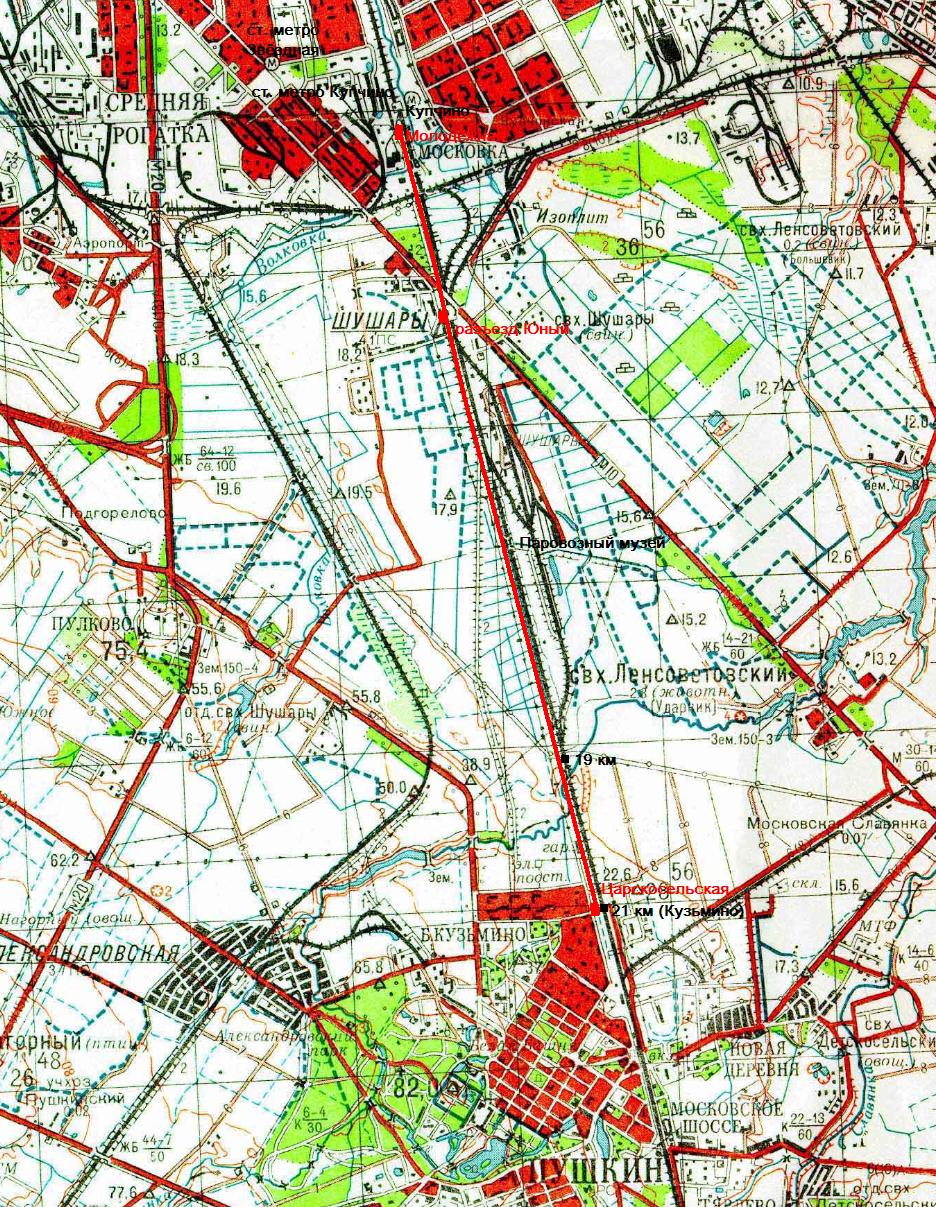 The "new" Malaya Oktyabrskaya Children's Railway on a 1:100,000 scale topographic map published in 197? year (indicated by the author). The main works on the construction of the children's railway were completed in 2009-2010. The grand opening of the children's railway took place on July 12, 2011. As of July 24, 2011, the children's railway had two locomotives.: TU10-001 (the first diesel locomotive of this series, built by the Kambarsky Machine-building Plant in 2010), TU2-167 (brought from the "old" Malaya Oktyabrskaya children's railway in Ozerki). The length of the main road is 9.8 km. It is the second longest children's railway in Russia (after the Svobodnenskaya Children's Railway with a length of 11.1 km). The main station is the Tsarskoye Selo station in the city of Pushkin. There is a locomotive and carriage depot on it, capable of accommodating the entire rolling stock of the children's railway. The depot has four tracks — more than on any other children's railway. The Yuny crossing is designed for crossing oncoming trains. Track development — two arrows. There is one island platform. There are no buildings at the junction. The building located near the junction does not belong to the children's railway, it is the ticket office of the Shushary station. The crossing area is fenced and locked after the end of the movement. Molodezhnaya Station is unusual in that it is a dead-end type station. Analogues include all stations in St. Petersburg except Ladozhsky, and all stations in Moscow except Kursky, Belorussky, and Savelovsky. This is the first such station on the children's railways of the Russian Federation. There is something similar only in Tbilisi and Yerevan. However, the case in Yerevan is still different — the Pionerskaya station of the Yerevan Children's Railway is the simplest dead end without track development. No shunting work is carried out there, the train goes in the opposite direction with the wagons going forward. At the Molodezhnaya station, shunting work is carried out as follows: the train arrives from Tsarskoye Selo at a dead end, settles onto a ranged track. Then the locomotive overtakes the main track and brings the train to a dead end with cars ahead. It should be noted that this is an extremely demanding operation. The slightest carelessness will lead to a collision with a dead-end prism (which quite often happens at dead-end broad-gauge railway stations). That is why, until recently, there were no dead-end stations on children's railways. It is envisaged that two trains should run along the children's railway, meeting at the Yuny junction. However, due to a malfunction of the TU2-167 diesel locomotive, one train was temporarily running in July 2011. The volume of traffic was three pairs per day, instead of the expected six pairs. The one-way fare was 100 rubles. In the author's personal opinion, in the current situation, when the "old" Malaya Oktyabrskaya children's railway continues to operate (as of summer 2011, according to official statements, it will be preserved), the opening of the new children's railway is certainly a positive event. Despite the huge drawback — the primitiveness of its route. If the "old" Malaya Oktyabrskaya children's railway is destroyed under the pretext that there is now a new road instead, the fact of the construction of a new children's railway can be considered a great evil. It remains to be hoped that this will not happen. On June 2, 2012, in honor of the 175th anniversary of the Russian Railways, the new (southern) section of the Malaya Oktyabrskaya Children's Railway was named the Malaya Tsarskoye Selo Railway. The broad gauge line along which the children's railway runs is the Tsarskoye Selo Railway, opened in 1837. The day of its opening is considered the founding day of the Russian Railways. In 2012, it was decided to deliver an operating steam locomotive to the road. In May 2013, the monument locomotive Kp4-447, which stood at the Bologovsky shpalopropitochny plant, was transported to St. Petersburg. Restoring a steam locomotive monument to working condition is an atypical and complex process. It took about a year. On May 29, 2014, the locomotive was brought to the Molodezhnaya station of the Malaya Tsarskoye Selo Children's Railway. The locomotive will be used to drive trains on holidays: Children's Day and the opening day of the road season (June 1), Railway Worker's Day (the first Sunday in August). The author's trip (2011) The children's Railway was first visited by the author on July 24, 2011. Due to the acute shortage of money, I travel from Moscow to St. Petersburg by electric train. Consumers, actively using the results of my work, do not purchase books. Departure at 11:20 from Leningradsky railway station to Tver. I walk from Tver station to the Proletarskaya platform and then to the Volga River bank. A little above the railway bridge, I swim in the Volga, having swum to the opposite shore and back. I'm going back to Proletarskaya. Then - Bologoe, Malaya Vishera. I traveled from Okulovka to Malaya Vishera in an electric train following the reserve. In Okulovka, where the electric train ceases to be a passenger train and turns into a rear one, I ask the assistant driver for permission to drive to Malaya Vishera (specifying what exactly is before it, and not further). Usually this electric train follows the reserve in the PM St. Petersburg-Moskovskoe. Interestingly, on this day, a disgusting group of young people tried to "get to St. Petersburg" for free. They look like punks with beer in their hands, swearing and dirty. Unfortunately, the traveling cashiers did not perform their duties and were unable to disembark these disgusting "humanoids." To my great joy, I noticed that in Okulovka these "animals" came out onto the platform, unaware that the electric train was actually moving on. At the last moment, they realized that the electric train would soon leave for St. Petersburg, and tried to jump into the closing doors. But it was too late! On the way from Okulovka to Malaya Vishera, the backup electric train made one stop — in Borovenka. Several people got out there. Besides me, there was only one railway worker and one passenger with a two-wheeled cart who turned out to be deaf and dumb. When departing from Malaya Vishera, there was no one in the electric train except the driver and the assistant — it is really impossible to go further, strictly with this. A difficult overnight stay in Malaya Vishera: the heat, which did not subside at night, made it difficult to use a sleeping bag. Sleeping without a sleeping bag in the open air was impossible due to the abundance of mosquitoes. I go to the familiar attic of one of the two-story barracks (it has more than once served as a place to spend the night in Malaya Vishera). But there was no complete protection from mosquitoes there either. I didn't get much sleep. At 6:58 a.m. — departure by electric train from Malaya Vishera to St. Petersburg. I walk from Moskovsky railway station to Vitebsk, and take an electric train to Kupchino. It took a while to find the station of the children's railway: it is located nearby, but the only road to it passes through the metro station, and there are no signs in the underpass under the railway tracks. When I found the station of the children's railway, it turned out that it was surrounded by a fence stretching for hundreds of meters. I didn't want to climb over the fence. I go back and enter through the subway station. The exit from the metro station to the children's railway is an inconspicuous small door. Previously, access to this door was allowed only to employees of the electric depot of the Kupchino metro. Now, beyond the metro depot entrance, the footpath continues further, to the station of the children's railway. Perhaps the first thing that catches your eye here is the total "landscaping" of the territory. I'm not the only one with this impression. Due to the long search, I missed the train leaving at 11:30. The weather was rainy, so there was concern that there might be no traffic today. But my fears turned out to be in vain: I was assured that the train would definitely leave. I buy a one-way ticket for 100 rubles. 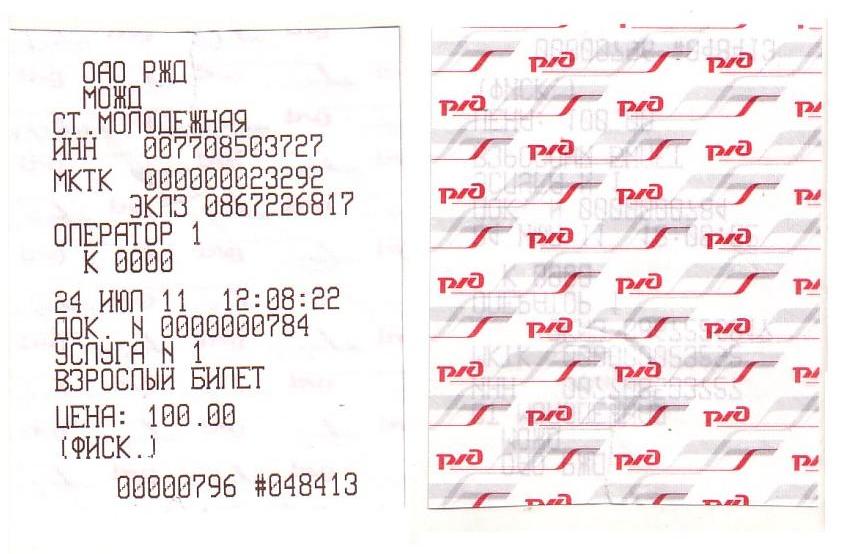 A ticket for the route Molodezhnaya — Tsarskoye Selo. The fact of the opening of a new children's railway while preserving the old one, like nothing else, pleases and improves the mood. As you know, the process of eliminating narrow-gauge railways has almost been completed in Russia. This is logical and natural: under the current conditions, almost all narrow-gauge railways are doomed to destruction, this is bound to happen, this process is irreversible. However, the best part of narrow—gauge railways is preserved and developing in Russia - children's railways! This is a great reason for joy. After all, one children's railway, in my opinion, is more valuable than several narrow-gauge railways of any other purpose. While waiting for the train, I take pictures of the railway from the overpass located south of Molodezhnaya. I hide my backpack among the bushes to the east of the broad gauge railway. I'm going back to Molodezhnaya station. I am traveling from Molodezhnaya to Tsarskoye Selo on a train departing at 13:40. The primitiveness of the route of the children's railway somewhat brightens up the fact of the historical significance of the main railway along which it runs. The section of the St. Petersburg-Vitebsk - Pavlovsk mainline railway (including the Kupchino section — 21 km, where the children's railway is laid) is the first railway in Russia, not counting the short track for a steam locomotive in Nizhny Tagil. Train traffic was opened here in 1837. The historical name of this railway is the Tsarskoye Selo Railway. Until 1897, it was isolated and had an unconventional track width of 1829 mm. The trip left a pleasant impression: the cars are new and comfortable, the train goes fast (by the standards of the children's railway). On the way, the young conductor read to the passengers quite a long material about the history of the Malaya Oktyabrskaya Children's Railway and the Tsarskoye Selo Railway. Back from Tsarskoye Selo to Molodezhnaya, the children's railway had to be walked to carry out photo documentation. Adult employees of the railways were not inclined to mutual understanding on the issue of walking outside the seats reserved for passengers. I decide not to go through the fenced—off area of the station - this will be stopped by numerous guards, who are even more unable to understand the essence of the work being done to study the railways. I walk around the city and get on the line north of the station. Soon I had to face the unexpected: in a remote place, in the middle of the fields, two women in the uniform of guards were on duty on the line. They were outraged by my appearance. I didn't follow the tracks in their line of sight. It was stated that one should not walk not only on the tracks, but also on the adjacent territory — although the Administrative Code of the Russian Federation prohibits walking on the tracks, but not on the adjacent territory! The guards rudely demanded to get off the railway (no explanations worked) and threatened with detention in case of disobedience. I continued walking towards Molodezhnaya. As it soon turned out, the guards still did not miss the opportunity to mess up. At the time of the passage of the train from Tsarskoye Selo to Molodezhnaya (the last one that day), I was standing on the 19 kilometer wide-gauge platform, photographing the train from above. When they noticed me, the train began to slow down and soon stopped. Two guards (this time men) got out of the first carriage and out of the cabin of the locomotive. They were ordered to go in search of me. These guards turned out to be a little more sober-minded, but insisted that one should not be near the children's railway. — So, it's not allowed near the children's railway, but on the mainline railway tracks, it turns out, is it possible?! — This does not concern us, we are responsible for the children's railway! The "wonderful" logic is that you can't walk along the tracks of the children's railway, where the last train has already passed for the next few days, and you can't get closer than 30 meters to them either, but along the tracks of the mainline railway, where trains rush by at high speed every few minutes — walk as much as you want! After a while, the guards set off on foot back to Tsarskoye Selo. After waiting for them to disappear from view, I continue to do the work on photo documentation. Of course, with a 99 percent probability, the new children's railway will always work. But still it is worth remembering that the new section of the old Malaya Oktyabrskaya children's railway (Ozernaya — Beregovaya), no less solemnly opened in 1999, managed to work for only a few months ... The photo documentation was carried out in accelerated walking mode, at a speed of about 7 km / h (the standard pedestrian speed is 5 km/ h). At 16:02 it was completed — I am approaching the southern mouth of the Molodezhnaya station. By land transport (tram No. 62 to Malaya Balkanskaya Street, then tram No. 49 to Slava Avenue, bus) I get to the Sorting platform. By electric train to Okulovka. It was a direct route from St. Petersburg to Okulovka with an hour-long parking along Malaya Vishera. We spent the night north of Okulovka station in an undeveloped area — almost in the same place where I spent the night in 1995 during my first Moscow—St. Petersburg—Moscow trip. Then — by electric trains to Bologoe, Tver and Moscow. In Tver, I am making a traditional visit to the narrow-gauge railway of the Tver Construction Materials Plant No.2. Photographs of the passing train were taken near the Konstantinovsky quarry. The author's campaign, 2017. The description is on the page http://infojd.ru/dop/poezdka2017spb.html . I limit myself to exploring the Molodezhnaya station. I am documenting a new TU10-025 diesel locomotive and a new TU7A-2886 diesel locomotive for this place. Today is an important holiday for the city, Navy Day. The locomotive was supposed to run, but it was not due to technical problems. |

|
Цитировать 14 |
 Похожие темы
|
||||
| Тема | Автор | Раздел | Ответов | Последнее сообщение |
| Accident at the Samolukovo - Nasva siding of the Oktyabrskaya Railway on January 18, 2026 | Admin | Russian railways accidents | 0 | 18.01.2026 10:56 |
| ALMA ATA CHILDREN'S RAILWAY | Admin | Sergey Bolashenko's Travels | 0 | 08.02.2024 00:24 |
| Cars Derail on the Stroganovo-Mshinskaya Section of the Oktyabrskaya Railway on September 14, 2025 | Admin | Russian railways accidents | 0 | 14.04.2023 11:39 |
| indian railway | Legon | Общие вопросы железных дорог | 0 | 01.08.2017 12:50 |
| [Книга Путь и п/х] The Railway Track and Its Long Term Behaviour: A Handbook for a Railway Track of High Quality (Tzanakakis K.) | Admin | Библиотека | 0 | 20.04.2014 14:33 |
| Ответить в этой теме Перейти в раздел этой темы Translate to English |
| Здесь присутствуют: 1 (пользователей: 0 , гостей: 1) | |
|
|


 Почта
Почта


