Sonoma-Marin Rail Transit Project, California, USA


|
The Sonoma-Marin Area Rail Transit District (SMART) is constructing a 70-mile passenger rail road along the existing Northwestern Pacific Railroad (NWP) right-of-way (ROW) in the North Bay corridor of California. The NWP is owned by the North Coast Railroad Authority (NCRA). The project also includes the construction of a bicycle / pedestrian path parallel to the railway line. The rail line and bicycle / pedestrian path will pass through two counties in North Bay, California – Cloverdale in the north of Sonoma County, and Larkspur in Marin County. 
The Sonoma-Marin rail transit project aims to provide multi-modal and fuel efficient alternatives to reduce traffic congestion on Highway 101, the only north-south transportation facility in North Bay. Around 80% of the commercial, educational and residential facilities in North Bay are located on this corridor. The project is expected to reduce car trips on the highway by 1.3 million and offset greenhouse gases by 124,000lb a day. "The project is expected to reduce car trips on the highway by 1.3 million."
The project's feasibility studies and environmental impact certification were completed in 2006 with the assistance of Louis T. Klauder and Associates Engineering Services (LTK). The supplemental environmental impact report (EIR) was certified in 2008. The contracts for the design and engineering of the 14 train stations valued at $11.3m were approved in December 2009. The main contractor is Winzler & Kelly. The SMART project is estimated to cost $590m, which includes $499m for the rail line and $91m for the bicycle / pedestrian path. The annual operating cost will be $19m. The project will be financed through local sales tax revenues, regional bridge toll funding, and state and federal funds. Sales Tax Measure Q, which is a 0.25% increase in sales tax, will fund 60% of the project. Measure Q was approved by 69.6% of the voters in Marin and Sonoma counties during the elections on 4 November 2008. The construction of the project is expected to commence in 2011 with train service scheduled to begin in 2014. Sonoma-Marin rail transit project details The project is expected to provide a seamless transportation network of buses, ferries, bike paths and side-walks connected to a centralised rail line. "The project aims to provide multi-modal and fuel efficient alternatives to reduce traffic congestion on Highway 101."
The project includes the re-laying of the tracks, the construction of a maintenance facility on either of the two stops (Cloverdale or Windsor), the reconstruction of two tunnels, 59 bridges and the operation of 14 stations – nine in Sonoma County and five in Marin County. Stations in Sonoma County are Cloverdale, Healdsburg, Windsor, Santa Rosa, Santa Rosa Railroad Square, Corona Road (Petaluma) and Downtown Petaluma. Marin County stations include Novato North, Novato South, Marin Civic Center, Downtown San Rafael and Larkspur. Two rounds of public workshops were conducted in February and April 2010 to take public opinion on the design and amenities required at the stations. The aim was to cater to all the needs of different communities living along the corridor. The commuter service trains will operate at a 30-minute interval in the peak hours (morning and evening) during week days, making 14 round trips and a 30-second wait at each station. According to environmental studies on the SMART project, around 5,300 passengers per day will utilise the commuter service, while the bicycle / pedestrian service will attract another 7,000 to 10,000 people per day. There will be a provision for boarding bicycles on the train. Rail transit infrastructure Stations along the corridor will be designed to accommodate existing feeder buses and shuttle services, along with park and ride facilities in a few selected suburban stations. In order to further reduce congestions in Santa Rosa, Pataluma and San Rafael cities in the downtown areas of the North Bay, stations at these places are being designed with no park and ride facilities. The bicycle-pedestrian pathway will have 54 miles of Class I pathway and 17 miles of Class II pathway improvements. The Class I pathway is a separate and exclusive path for bicycles and pedestrians with minimised cross flow. Class II is a small lane for one-way travel. "Around 5,300 passengers per day will utilise the commuter service."
There are two existing tunnels in the project corridor – Puerto Suello Hill Tunnel at San Rafael and Cal Park Hill Tunnel between San Rafael and Larkspur. These tunnels will be rebuilt to a 1,000ft length with adequate lighting, ventilation and water lines for fire protection. Most of the 59 bridges are timber open deck or timber ballast decks. These will be replaced with concrete decks. Sonoma-Marin area rail transit rolling stock The Sonoma-Marin area rail transit will use heavy diesel multiple unit (DMU) vehicles in this route. DMUs have engines installed under the passenger compartment, which eliminates the need for large locomotives. SMART is planned to operate with a fleet of 14 DMUs and serve six trains in this corridor. Proposals were invited in April 2010 for the manufacture of the train. The contracts are expected to be awarded by the end of 2010, with fleet delivery scheduled in 2014. SMART will be operating one, two or three car-set DMUs. With a proposed speed of 79mph, they are expected to maintain an average speed of 46mph. These sets will have a dual cab facility that will allow the trains to run in reverse direction as well as avoid the need for turnarounds. Heavy DMUs measure 85ft long, 10ft wide and 15ft high, and have a seating capacity for 150 passengers. Sonoma-Marin rail transit signalling and communications Signalling is based on the automatic block signalling concept that allows the train to operate at a speed of 80mph. A block signal has a combination of track switches that are interconnected to avoid conflicting train movements. The automatic signals ensure the safe movement of trains travelling in the same direction. |
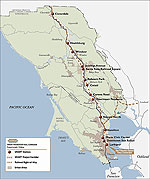  Expand Image Expand ImageThe Sonoma-Marin rail link will connect Cloverdale in Sonoma County with Larkspur in Marin County. |
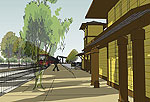 Expand Image Expand ImageThe proposed design of Windsor rail station. | |
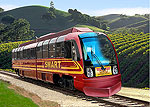 Expand Image Expand ImageA commuter train that will be operating on the new rail line. |