Lagos Rail Mass Transit System, Nigeria


|
Nigeria's capital city Lagos is constructing a light rail system under a public private partnership (PPP). The project is sponsored by the Lagos State Government (LSG) and will be developed by Lagos Metropolitan Area Transport Authority (LAMATA) on behalf of LSG. LAMATA has proposed seven lines in the network: Red, Blue, Green, Yellow, Purple, Brown and Orange. The project will begin with the simultaneous construction of the Red and Blue Lines. 
China Civil Engineering Construction Company (CCECC) has been appointed as the contractor for the construction of the first line (Blue). Detailed design and surveying for the entire project have been completed, and the project is expected to be completed by 2011. Lagos rail mass transit system funding The first two lines of the urban rail project are estimated to cost $1.4bn. The Red line will be 30km long, and will run between Marina and Agbado. The Blue line will be 27km long, connecting Okokomaiko to Marina. "LAMATA has proposed seven lines in the Lagos network."
The Blue line will cost $1.2bn and will be funded entirely by the Lagos State Government (LSG). The 30km-long Red line will use the existing Nigeria Railway Corporation corridor. The Lagos State Government is currently in negotiations with investors that have shown interest in constructing and running the project for a concessionary period. It is envisaged that the new lines will be contracted to separate companies comprising two contracts each. One will be a design build contract for the associated rail infrastructure and stations, and the other will be a concession contract. The design build contract for the Blue line has been awarded to CCECC. The concession contracts and the design build contract for the Red line are yet to be awarded. The design build contract will include the basic design and construction of the rail infrastructure. The concession contract will be for the operation and maintenance of the lines for a 40-year period. The scope of work for the concessionaire will also include design and construction of the infrastructure associated with operation and maintenance of the lines. The transaction adviser for the Red line is Dar Al-Handasah. CPCS Transcom is the transaction adviser for the Blue line. The two transaction advisers have conducted feasibility studies and conceptual design work for their respective lines. Red Line: Marina to Iddo The Red line begins as a double line at Marina and runs through Ebute Ero ending at Iddo. It then runs northwards via a reverse curve to reach Ebute Metta. The line runs straight to Yaba, Mushin and Oshodi before reaching Ikeja. At the Ikeja station, the Red line is linked to the line from the international and domestic airport terminal. From Ikeja, a single line will run to the airport terminals. The Red line moves as a double line further northwards from Ikeja to pass through Agege, Iju and finally reaches Agbado. "CCECC won the construction contract for the Blue line. "
The passenger railway service run by Nigerian Railway Corporation (NRC) from the north will terminate at the Agbado interchange. Passengers travelling to Marina using NRC services will change train at Agbado and continue their journey on the Red line. Some of the Red line section from Agbado will run on NRC corridor tracks. The Blue line starts at Marina station and runs along Ebute Ero and Iddo stations – same as the Red line. From Iddo, the Blue line running on an elevated platform moves along the National Theatre station and makes a descent at Iganmu to join the expanded Lagos-Badagry Expressway, an expansion conceived to ease link between Nigeria and neighbouring West African states, Alaba, Mile 2, Festac, Alakija, Trade Fair station, Volkswagen station, LASU and finally reaches the Okokomaiko station where it ends. One of the two bridges being built for the Blue line is at Mile 2. Island-style platforms The Red and Blue lines will have 13 stations each. Three stations in the south end of the Red line will be shared with the Blue line. The two lines will therefore comprise 23 stations in total. The stations will have island-style platforms and commuter payment systems. Public address and electronic information screens will be installed in each station. The Ebute Ero station will also have an escalator. A number of rail crossings with elevated road structures will be built along the lines. A total of 35 pedestrian bridges will be constructed over the Nigerian Railway Corridor. Cable ducts and walkways, in addition to drainage system with two walls will be built along different sections of the lines. Between Marina and Iddo stations, a combined 5km viaduct rail over road and cable stay bridge will be built, linking the Red and Blue lines. Other infrastructure to be built as part of the project include stations; signalling, control and communications (SC&C) systems; supervisory control and data acquisition (SCADA) systems; depot and workshop facilities; an operations control centre and a training facility for train drivers. "The Blue line will be 27km long, connecting Okokomaiko to Marina."
Rolling stock The Red line is anticipated to operate with 12-car trains between 2010 and 2015. More cars will be added according to demand. The maximum number of cars will, however, be limited to 16 a train. The 16-car trains will be 352m long and the 12-car trains will be 264m long. The cars will accommodate 300 passengers each. Signalling and communications The light rail system will employ the latest train authorisation systems, automatic train protection (ATP) and in-cab signalling in all of its lines. The wayside equipment will be minimised so that the drivers will not exceed the authorised movement limits. The ATP will help to maintain the speed restrictions set on the lines. To ensure that the signalling is available even during power cuts, a backup power system will be fitted. |
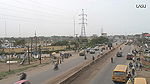  Expand Image Expand ImageLagos today. |
 Expand Image Expand ImageAn artist's image of Lagos with the new rail system. | |
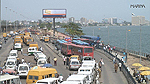 Expand Image Expand ImageLagos marina at present. | |
 Expand Image Expand ImageAn artist's image of the new Marina station. | |
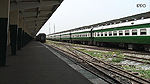 Expand Image Expand ImageIddo station now. | |
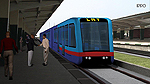 Expand Image Expand ImageAn image of the planned Iddo station. | |
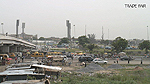 Expand Image Expand ImageThe Trade Fair today. | |
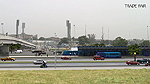 Expand Image Expand ImageAn artist's image of the Trade Fair with the new rail system. |