Delhi Metro, India


|
Stifling road traffic congestion in Delhi, population approximately 16 million, had become an economic liability. With more motor vehicles than Mumbai, Calcutta and Chennai combined, overcrowding and pollution was threatening the capital's ability to reach its potential in the rapidly expanding Indian economy. Calcutta/Kolkata opened India's first metro (16.5km) in 1984, but the project did not inspire confidence in the Indian Government to promote further schemes. 
Delhi Metro Rail Corporation (DMRC) was established by the Government of India and the Government of Delhi in March 1995 to build a new metro system in the capital. The project is being carried out in phases - Phase I has been completed and cost INR105.7bn ($2.3m). Phase II is underway. In February 2009, the Delhi Metro project became the first railway project in the world to be registered for carbon credits by the United Nations. DMRC saved 112,500MW of power by using regenerative brakes in the trains, and reduced carbon emissions by 900,004t between 2004 and 2007. It is estimated that more than 100,000t of carbon dioxide will be offset each year once Phase II becomes completely operational. DMRC has been eligible to claim 400,000 carbon credits for a ten-year period commencing from 2007. Any money received from the sale of carbon credits will be used to offset any additional investment and operational costs of the project. The project After more than 40 years of studies into a rail-based mass transit system, DMRC began construction on 1 October 1998. Funding has principally come from a Japanese loan and Indian public funds, the latter in the form of equity. By November 2006, all three lines in Phase I were operational, three years ahead of schedule. The lines in this phase covered 65km, 13km of which is underground. "All three lines in Phase I were operational by November 2006, three years early."
Delhi Metro was designed to be integrated with other public transport and DMRC signed an agreement with bus operator Delhi Transport Corporation (DTC) to integrate management and through-ticketing. However, limited take-up has led DMRC itself to supply around 200 buses of a quality consistent with Metro operations to work feeder routes to stations. Selected private bus operators will pay back DMRC over five years. There are 18 designated parking sites at Metro stations to further encourage use of the system. In March 2010, DMRC partnered with Google India (through Google Transit) to provide train schedule and route information to mobile devices with Google Maps. This free service will allow the commuters to get the latest service information and plan their journeys. Routes Line 1 runs between Dilshad Garden and Rithala. It covers 25.01km, serves 21 stations and has a rolling stock of 21 trains. The first section of Line 1, from Shahdara to Tis-Hazari, opened in December 2002. A Phase II extension from Inderlok to Rithala opened in March 2004 and the Shahdara-Dilshad Garden section became fully operational in June 2008. Line 2 runs between Jahangirpuri and Central Secretariat. It covers 17.36km, serves 15 stations and has a rolling stock of 21 trains. The first section, running between Vishwa-vidyalaya and Kashmere Gate, opened in December 2004. Extensions opened between Kashmere Gate and Central Secretariat in July 2005, and between Vishwa-vidyalaya and Jahangirpuri in February 2009. "Lines 2 and 3 pass through the city centre and business district at Connaught Place, served by Rajiv Chowk station."
Line 3 runs between Dwarka Sector 9 and Noida City Centre. It covers 47.3km, serves 42 stations and has a rolling stock of 30 trains. The first section of the line opened in December 2005 and ran from Barakhamba to Dwarka. Subsequent sections opened between Dwarka and Dwarka Subcity in March 2006; Barakhamba and Indraprastha in November 2006; Indraprastha and Yamuna Bank in May 2009; and Yamuna Bank and Noida City Centre in November 2009. Lines 2 and 3 pass through the city centre and business district at Connaught Place, served by Rajiv Chowk station. Line 4, which opened in January 2010, runs between Yamuna Bank and Anand Vihar. It covers 6.25km long and serves five stations. Line 5 runs between Inderlok and Mundka, and is the first standard gauge railway line in India. It covers 15.15km and serves 14 stations. The line opened in April 2010, and is expected to benefit 100,000 commuters residing in west Delhi. Infrastructure Line 2 is underground for its entire 11km length. All-but-one of its 15 stations have been built nearly 13m below ground using by cut-and-cover methods; Chawri Bazar, which lies some 20m down, needed tunnelling to be built. All stations have escalators, elevators and tactile tiles to guide the visually impaired from station entrances to trains. Many of the stations are equipped for rainwater collection as part of their environmental policy. One of the more challenging construction projects was Mandi House station on Line 3, managed by British company Mott Macdonald. As the station is located under a busy thoroughfare, much of the station had to be built top-down, with the diaphragm wall panels built from ground level to form the permanent walls of the station. Eight further extensions to the network are planned; these are expected to be complete by the end of 2010. These include extensions between:
DMRC will also be providing subway facilities in all the underground metro stations as part of Phase II. Bicycle rental is also available at the Vishwa-vidyalaya, Pragati Maidan, Patel Chowk and Indraprastha metro stations. Rolling stock The first wave of rolling stock was manufactured by a consortium comprising Hyundai Rotem, Mitsubishi Corporation and Mitsubishi Electric Corporation. Initial sets were built by ROTEM in South Korea, with later examples completed in India by public sector undertaking Bharat Earth Movers Limited (BEML). BEML is also responsible for the manufacturing coaches under technology transfer agreement. The manufacturing is under progress. The air-conditioned trains consist of four 3.2m-wide, stainless steel, lightweight, although eight is possible. The trains have automatic doors, secondary air suspension and brakes controlled by microprocessor. "Delhi Metro has a fleet of 280 coaches, which DMRC runs as 70 trains every day."
Delhi Metro has a fleet of 280 coaches, which DMRC runs as 70 trains every day. Each train can accommodate about 1,500 people, 240 seated. Maximum speed is 80km/h (50mph), with a 20-second dwell time at stations. Train depots are located at Khyber Pass, Najafgarh, Shastri Park and Yamuna Bank. In March 2008 Bombardier Transportation announced an €87m ($137m) contract for 84 MOVIA metro cars, a follow-on to an order for 340 placed in July 2007. The new vehicles are to be deployed as part of the Phase II expansion. DMRC received the first MOVIA metro car from Germany in February 2009. The first 36 vehicles will be manufactured in Goerlitz, Germany, and the remaining 388 cars will be built at Bombardier's Indian manufacturing facility in Savli, South Gujarat. Signalling and communications The trains use centralised automatic train control (CATC) comprising automatic train operation (ATO), automatic train protection (ATP) and automatic train signalling (ATS) systems. Intercoms are provided for emergency communication between the passengers and the driver in each coach, and on-train announcements are in Hindi and English. There are also route maps and LCD display systems in every coach. Fare collection is through contactless, stored-value smartcards. The metro has its own police force, and a training school at Shastri Park is run in association with Hong Kong MTR for operational and maintenance staff. Security is supported by about 1,200 CCTV cameras at stations. In October 2007 DMRC awarded Bombardier Transportation a $43m contract for the design, manufacture, supply, installation and testing of signalling equipment. The CITYFLO 350 system will be installed on 37km of two of new line sections of the Phase II expansion. The electronic interlocking, operation and automation control systems for the third line were supplied by Siemens Transportation Systems. The future Although the system operated at below projected passenger levels in 2007, partly ascribed to train capacity proving lower than anticipated, it has achieved an operating profit. About 850,000 people used the Metro in 2008. It carries 5% of the city's commuters, and the project is not only meeting its aims in terms of attracting former road users and reducing road casualties, but it is stimulating economic development near to stations. Low-cost cycle hire and a secure parking trial has been launched to further reduce road use. Development of the Phase II lines is well underway, and will add around 121km to the network. A 2010 completion is anticipated, in time for Delhi's hosting of the Commonwealth Games. Phase III and IV extensions, which will expand the network to 413.8km, are scheduled to open in 2015 and 2020 respectively. "Phase III and IV extensions will expand the network to 413.8km."
In addition to the expansions planned in these four phases, a new line is being constructed to link Noida Sector 62 and Greater Noida. It will cross the Indraprastha- Noida Sector 32 line. The Ghaziabad Development Authority also has plans for a fith phase, which could extend the Vaishali line to Mehrauli via Indirapuram (Ghaziabad). A welcome part of the system for overseas visitors is the 19.5km extension to Indira Gandhi International Airport. Journey times to the centre are cut to 16 minutes from the present one hour by road. The 135km/h (84mph) link will be extended as the airport adds new terminal facilities. The first construction contracts, covering 7.5km of line, were awarded to Alpine-Samsung-HCC and Afcons in October 2007. Delhi Metro is thought to have inspired greater support for mass transit systems; India has many projects now in the planning stage. |
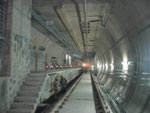  Expand Image Expand ImageA large percentage of the Delhi Metro is underground because of space constraints. |
 Expand Image Expand ImageMost of the four-car trains were constructed in Korea. | |
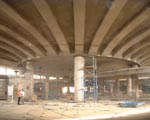 Expand Image Expand ImageStations have been designed by a variety of world companies, including Mott Macdonald. | |
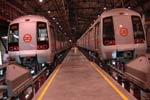 Expand Image Expand ImagePurpose-built maintenance facilities ensure high fleet availability. | |
 Expand Image Expand ImageInformation systems are in Hindi and English, and a tactile yellow line on platforms marks the safety limit. | |
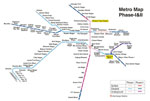 Expand Image Expand ImageDelhi Metro map, phases 1 and 2. | |
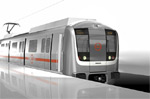 Expand Image Expand ImageTo be assembled in India, new Bombardier units represent a change of rolling stock supplier for the Phase 2 development. |