Bergen Light Rail System, Norway


|
The city of Bergen in Norway is building a light rail system between the centre of the city and Bergen Airport at Flesland. The project includes about 10km of tracks with 15 intermediate stops. The total cost of the project is €225m. The first phase of the project, which includes construction of the first line from Starvhusgaten in the city centre to Nesttun, started in January 2008. Work on the line is expected to be completed by 2010. The line will carry 26,000 passengers per day. 
The remaining portion of the light rail system to Flesland is expected to be completed by 2015. Bergen is the second largest city in Norway and has a population of about 250,000. Most of the city's population is concentrated in the valleys that spread outwards from the city centre. The new light rail system is expected to enhance the efficiency of the transportation system in Bergen and provide an alternative to car travel. It is also expected to promote regional development. Project Due to Bergen's relatively small size, the government previously focused on encouraging private automobile transport rather than developing a public transport system. Over the years traffic volumes increased dramatically, leading to traffic jams and accidents. "The project will serve about 25% of the city's population, with existing buses providing feeder services."
The increase in the number of car users also raised environmental concerns. The light rail system was proposed to address these issues. A light rail system was proposed in 2000 and approved in 2002. The project is being financed by Bergen Municipality, Hordaland County Council and the state and citizens of Bergen through tolls. Norconsult, a Norway-based consulting engineering company, was awarded the contract for design, construction procurement strategy, technical specifications for infrastructure and tender documents. The project will serve about 25% of the city's population, with the existing bus services providing feeder services. Major stations on the light rail system will include parking facilities to encourage a park and ride system. The light rail system will be operated from 2010 to 2017 by Fjord1 Partner, a joint venture between transport company Fjord1 Nordvestlandske and French transport group Keolis. The average operating speed of of the system will be about 25km/h to 30km/h. There will be an express service during peak hours and a faster service between major stations and terminals. Trains will operate on 5min headways in each direction during peak traffic periods and 10min headways during off-peak periods. Infrastructure The initial portion of the 10km railway section will feature four tunnels with a total length of 2.5km. The tunnels will not have stations due to the high costs involved. "There will be an express service during peak hours and a faster service between major stations and terminals."
During the first phase of the system, 15 stations will be built. Another five will be built during the second phase. The stations will be located at street level and feature public display systems and ticketing facilities. The station platforms will be 40m to 45m long and provide step-free access to trams. The platforms will be accessible by wheelchairs and strollers. The contract for designing the stations was awarded in June 2006 to a group consisting of Cubus, Fuggi Baggi Design, clothing designer T Michael and Kontragroup of Copenhagen. The contract includes landscape architecture, design of stations and interiors of trams, industrial design and branding. The project will feature an integrated smart-card ticketing system with a one-ticket ride for all transport services. A real-time information system will be installed at all stations. The system will provide information about travel time, arrival time of incoming trains and the station. Rolling stock In May 2007 the city of Bergen and Stadler Pankow, a Swiss rail passenger cars manufacturer, signed a contract for the supply of 12 low-floor light-rail vehicles with an option for another 20. Ten vehicles will be supplied for the first phase of the project. Stadler is supplying Variobahn, a modularly built tramway system, for the project. The bi-directional vehicles will be able to travel at 70km/h. They will be 32m long and 2.65m wide. They will be able to carry 220 passengers and capable of being extended to 42m to carry more than 300 passengers. They will feature ergonomically designed driver cabins at either end. The gauges will be 1,435mm but will be capable of being operated on 1,000mm. Each vehicle will have four exterior double-wing sliding doors on either side, three of which will be 1,350mm wide and one of which will be 800mm wide. The exterior body of the vehicles will be made from stainless steel and will be built with bounding technology, which ensures exteriors can be changed easily after accidents. Signalling and communications "A link between the primary regional hospital and the city centre is also being considered."
In September 2008 Thales was awarded the contract to supply telecommunications, traffic priority and traffic control and supervision systems for the project. Thales will provide rail signalling, video surveillance and information systems for the first phase. Thales will partner with a Scandinavian company YIT and Hanning and Kahl of Germany to deliver the project. YIT will provide telecommunications infrastructure and on-site commissioning, while Hanning and Kahl will supply signalling equipment. Thales will partner with BelAir Networks to install onboard and trackside Wi-Fi infrastructure. The Wi-Fi network will include 40 BelAir100 nodes along the entire length of the tram network. It will also include 24 BelAir20M mobile access points, which will be fitted in the first 12 train cars. The BelAir20M mobile access points will be fitted on the roof or inside walls of the train cars. They will provide 802.11n/b/g Wi-Fi access for smartphones such as iPhones, laptops and Wi-Fi enabled devices. Future Bergen is drawing up plans for future extension of the light railway system. It may be extended to Fyllingsdalen and Loddefjord in the west and Sandviken/Åsane in the north. A link between the primary regional hospital and the city centre is also being considered. |
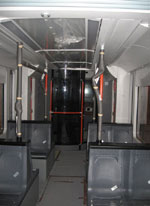  Expand Image Expand ImageThe total cost of the project is €225m. |
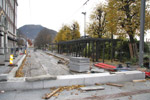 Expand Image Expand ImageThe project is being financed by Bergen Municipality, Hordaland County Council and the state and citizens of Bergen through tolls. | |
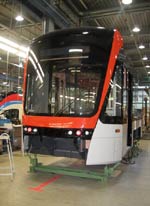 Expand Image Expand ImageThe average operating speed of of the system will be about 25km/h to 30km/h. | |
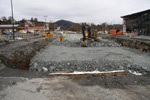 Expand Image Expand ImageThe project will feature an integrated smart-card ticketing system with a one-ticket ride for all transport services. | |
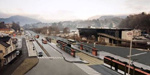 Expand Image Expand ImageTrains will operate on 5min headways in each direction during peak traffic periods and 10min headways during off-peak periods. | |
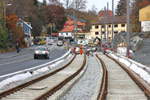 Expand Image Expand ImageThe initial portion of the 10km railway section will feature four tunnels with a total length of 2.5km. | |
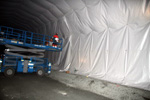 Expand Image Expand ImageMajor stations on the light rail system will include parking facilities to encourage a park and ride system. | |
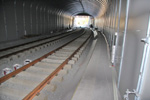 Expand Image Expand ImageA light rail system was proposed in 2000 and approved in 2002. |