Athens Metro Light Rail System, Greece


|
Athens Metro is formed of an enlarged and upgraded suburban rail route and two much newer lines. In 1869, a metropolitan railway was built to link Athens and Piraeus, the country's largest port, south-west of the capital. It was later electrified and extended north-east to Kifissia. It was to become designated the Metro Line 1, colour-coded green. 
Construction for the new metro lines, one of Greece's largest modern civil engineering projects, began in 1991. It was promoted as a response to intense traffic congestion and related pollution that were becoming an unwelcome part of the city's identity. Metro Lines 2 (red) and 3 (blue) opened in January 2000. The project In an effort to solve its traffic problems, the Greek government turned to the EU for financial help. In 1991, a turnkey contract for the construction was awarded to the Olympic Metro Consortium, a group of 23 German, French and Greek companies. The contract allows the consortium partners to recoup their investment during the term of their operating licence. The metro and other public transport modes, notably a new tram system, also benefitted greatly from Athens hosting the Olympic Games in 2004. "Line 1 runs from Piraeus to Kifissia via Athens, and conveys 450,000 passengers a day."
Lines and routes Line 1 (Green) is owned and operated by Athens-Piraeus Electric Railways. It runs 25.6km from Piraeus to Kifissia via Athens, and conveys 450,000 passengers a day. Line 2 runs 10.9km from Peristeri to Vouliagmenis Avenue. As of May 2010, work to extend the line northwards to Anthoupoli and southwards to Elliniko was underway. These extensions are expected to be operational by the end of 2010. Line 3 runs 16.4km between Egaleo and Athens International Airport. Between Doukissis Plakentias and the airport, the metro shares track with OSE services. Lines 2 and 3 are operated by Attiko Metro Operations Company and carry 650,000 passengers daily. Infrastructure All lines are standard gauge and use a third rail power supply. Line 1 stations were upgraded or completely rebuilt in time for the 2004 Olympics, with Eirini station the main public transport link to the main Olympic complex. "The sensitive nature of much of Athens' historic city meant that Lines 2 and 3 were built underground."
Nearby Neratziotissa is the interchange for the suburban railway into Larissa, the main OSE station, and the airport. End-to-end timing is 51 minutes, with headways varying according to demand, from two-and-a-half to 15 minutes. The sensitive nature of much of Athens' historic city meant that Lines 2 and 3 were built underground. Tunnel boring machines were used for much of the construction. The excavation work unearthed many archaeological treasures: some are showcased in the stations, while others have become attractions in their own right. All platforms are 110m long. A maintenance depot for new rolling stock is located at Sepolia (Line 2); a second at Eleonas (Line 3) is due to be completed by the end of 2010. The three lines interconnect at the centrally located stations of Monastiraki, Omonoia and Syntagma, the latter also being the city centre tram terminus. There are extensive bus services, with all modes and interchanges shown on maps of the co-ordinating Athens Urban Transport Organisation. Rolling stock Initial stock were relatively basic and followed an older styling in comparison to most equivalent vehicles elsewhere. New three-car trains were specified with high-density interiors, capable of accommodating over 1,000 passengers under crush-loading conditions. Dual voltage ROTEM-supplied stock with greater luggage space is used for services on the section to the airport, where it runs under 25kV wires with the suburban railway. Rolling stock has been acquired in several batches, sourced variously from France, East Germany, Germany and Korea. Seventeen air-conditioned EMU-6 trains purchased from Hanwa-Rotem are the latest addition to the rolling stock. Signalling and communications The trains are all fitted with an automatic control system, which controls headways between them, as well as the speed of each individual train. "The trains are all fitted with an automatic control system."
Ticketing systems and stations access are also fully automated. A coloured light system governs train movement along track sections, including in all the tunnels. Passenger information is provided on trains and station platforms. The future The Metro Development Study (MDS) brings together planning in respect of metro lines under construction with future developments of all transport modes in the Attica region. Other rail modes in the area are OSE Hellenic Railways, the suburban railway and trams. MDS coverage relating to metro developments includes:
Some developments initially envisaged as branches are likely to be replaced by Line 4 (orange), a 20.9km, 20 station route. Construction of this line would cost €2.1bn. Line 4 would be U-shaped and would serve Galatsi and Maroussi. It will connect the central section to Panepistimio (intersecting Line 2), Kolonaki, Evangelismos (intersecting Line 3), Pangrati/Kaissariani, Ano Ilissia, Zografou, Goudi and Katehaki (intersecting Line 3). |
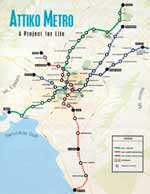  Expand Image Expand ImageMap of the Athens metro. |
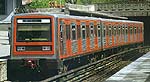 Expand Image Expand ImageA five-car train built in the 1980s for use on the Athens-Piraeus route. | |
 Expand Image Expand ImageA train pulls into a crowded underground station. | |
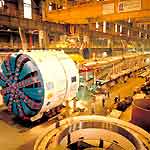 Expand Image Expand ImageOne of the machines used to bore the extensive tunnels on the Athens Metro. | |
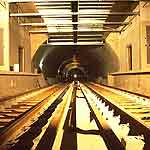 Expand Image Expand ImageAthens metro tunnel. | |
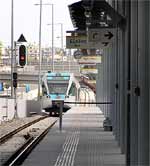 Expand Image Expand ImageNeratziotissa is an interchange between Metro Line 1 and the suburban railway for the airport and Athens’ main heavy rail station. | |
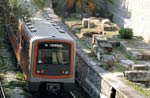 Expand Image Expand ImageA Line 1 train in central Athens near Thiseio station. | |
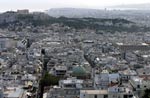 Expand Image Expand ImagePublic transport has helped unclog congestion on the densely packed streets of Athens and adjoining Piraeus. | |
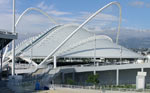 Expand Image Expand ImageThe Athens Olympic main complex is served by Eirini station on Line 1. |