Ankara-Istanbul High-Speed Train Project, Turkey


|
Turkish Railways (TCDD) is constructing the country's first high-speed railway line, which will connect the capital city of Ankara with largest population centre of Istanbul, and serve more than 17 million people. 12 million journeys per year are made between the two cities, stretching the mix of road and conventional rail lines to their limits. Many towns along the corridor are suffering from acute congestion and pollution. 
TCDD embarked on the high-speed project to ease this problem, and journey times will be greatly shortened as a result. It is also hoped that more of the 48 million tonnes of freight carried by road each year can be transferred to rail, way beyond the present disappointing 3% modal share. The projectTCDD has divided the Ankara-Istanbul high-speed train project into two phases. The first involves the construction of a 251km (157 mile) section of fast line between Sincan and Inonu at a cost of $747m. The project's first phase is being developed sectionally. Construction of a 206km section connecting Esenkent and Eskisehir was initiated in September 1999. Construction of the section began in December 2003 following foundations made in June 2003. Construction of the line was completed and first test run took place in April 2007. Construction of the 30km-long section connecting Eskisehir and Inonu was initiated in April 2008 and is estimated to be completed by 2010. Construction of the section of line connecting Sincan to Esenkent began in April 2008. The infrastructure works on this 15km section were completed and provisional acceptance of work was accomplished in October 2008. "TCDD has divided the Ankara-Istanbul high speed train project into two phases."
As of 2009, construction of the section connecting Ankara to Sincan is underway. However, the Ankara-Eskisehir section, opened in March 2009, uses the existing track between Ankara and Sincan. The second phase covers much more complex terrain, and will be undertaken in two sections. The first is 158km (98.75 miles) long between Inonu and Kosekoy including more than 60 bridges and viaducts. This section is expected to be completed in 2010. Completing the second phase is a 56km (35 mile) section between Kosekoy and Gebze. In total, the second phase will cost $2.27bn. The entire route is 533km (333 miles) long, 44km shorter than the existing alignment. InfrastructureThe Ankara-Istanbul project is one of the biggest to be implemented by Turkey's Ministry of Transportation. The main aim is for shorter journey times along with a fast, secure and safe way to travel away from roads. Major improvements are needed from the current route to allow trains to operate at speeds of up to 250km/h (156mph). These improvements can only be brought about by a completely new high speed line. The original 576km alignment between Ankara and Istanbul is single track apart from a 198km double section. This has been a major drawback to the improvement of services, and the new line is being built with double track throughout its length. Another drawback of the current rail route is its many tight curves, which have slowed train times. These will not feature on the new electrified line. Construction on the first phase of the route began in 2004 and was completed in October 2008. A consortium led by Spanish company Obrascon-Huarte-Lain and Alsim-Alarako carried out the construction work involved in the first phase. The second phase is a greater engineering challenge, primarily because it involves building 33 bridges and viaducts and boring 39 tunnels. The contract for the Inonu-Kozekoy section was let to the CRCC-CMC-CENGIZ INS.-IC ICTAS INS consortium in 2005. The entire line will bring a massive reduction in end-to-end journey times, down from 6hr 30min. Rolling stockHT65000 six-car trains manufactured by CAF, Spain are used on the first high-speed rail line operated by TCDD. In comparison to other national orders, TCDD's order of just ten is small. They have a maximum speed of 250km/h (156mph), and each six-car train has space for 419 passengers. It features air-conditioning, video surveillance, television and music broadcasting equipment, disabled access and vacuum toilets. A computer-controlled diagnostic train control and monitoring system is being installed. The new trains have been bought with a foreign loan to be repaid over 22 years. They are operating on the first phase of the route between Ankara and Eskisehir, with a journey time of 60 minutes. In the future, they will be used on the full length of the high-speed line as well as on the Ankara-Konya high-speed line, which is also under construction. Signalling and communicationsFrench company Alcatel won the contract to equip the new route with signalling and communications equipment to the value of $80m. It is being fitted with ETCS Level 1 automatic train control to ensure total safety, including bi-directional running on selected double-track sections. "When complete, the Ankara-Istanbul journey time will be reduced from 6hr 30min to just 3hr."
Alcatel is also designing, installing and integrating 24 LookTrac electronic interlocking systems for safe train routing together with two NetTrac central traffic control systems, signals, track circuits, and electro-hydraulic point machines. Communications systems include fibre optic and copper cable networks plus a digital transmission and telephone system. The futureThe Ankara-Istanbul fast line is likely to be just the first of a series of such high-speed projects in Turkey, and contracts have already been awarded for the Ankara-Konya high-speed train project. When complete, the Ankara-Istanbul journey time will be reduced from 6hr 30min to just 3hr. TCDD is also expecting that when the full 533km route is opened for public trains in 2010, rail transport can increase its share in the passenger transport market along the corridor from 10% to 78%. |
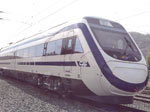  Expand Image Expand ImageCAF was contracted to construct ten new high-speed trains for the Ankara-Istanbul project with a maximum speed of 250km/h. |
 Expand Image Expand ImageThe new trains feature air-conditioning, like all other modern high-speed sets. | |
 Expand Image Expand ImageWhile other high-speed railways operate at 300km/h, including in Germany, the trains can also run on conventional lines. The Turkish high-speed line will have a maximum operational speed of 250km/h. | |
 Expand Image Expand ImageOverhead electric wires will supply 25kV AC power to the new trains between Istanbul and Ankara. |

Related links
Consortium Wins Danish High-Speed Rail Line Design Work