Ministry of Pubiic Works & Communications
1184 Avenida 6 de Diciembre у Wilson, Quito
Tel: (+593 2) 24 26 66
Key personnel
Minister: P J Lopez T
Under-Secretary: G Uzcategui P
State Railways of Ecuador (ENFE)
Empresa Nacional de los Ferrocarriles del Estado PO Box 159, Calle Bolivar 443, Quito
Tel: (+593 2) 21 61 80
Key personnel
Director General: Mario Arias Salazar
Traffic Manager: Vicente Cevallos Cazar
Directors
Administration: S Gudino C
Finance: G Vintimilla
Technical: M Herrera R
Motive Power Superintendent: E Benavides
Transport and Telecommunications Engineer: W Idrovo Permanent Way Engineer: Marco Redroban A Managers
Quito-San Lorenzo Division: G Gallo Sibambe-Cuenca Division: M Montalvo
Gauge: 1,067 mm
Route length: 965.5 km
[топ]Political background
In September 1999, Ecuador’s National Modernisation Council (CONAM) presented proposals for privatising the national rail network. CONAM expected to sell three lines for the following prices: Quito—Guayaquil for US$97 million; Ibarra—San Lorenzo for US$10 million; and Ibarra—Cajas for US$1.5 million. A technical and economic study was to have been drawn up by CONAM but was still not available in April 2000. The change from the sucre to the US dollar as national currency is reported to have caused economic difficulties which would have an impact on the proposed privatisation.
[топ]Organisation
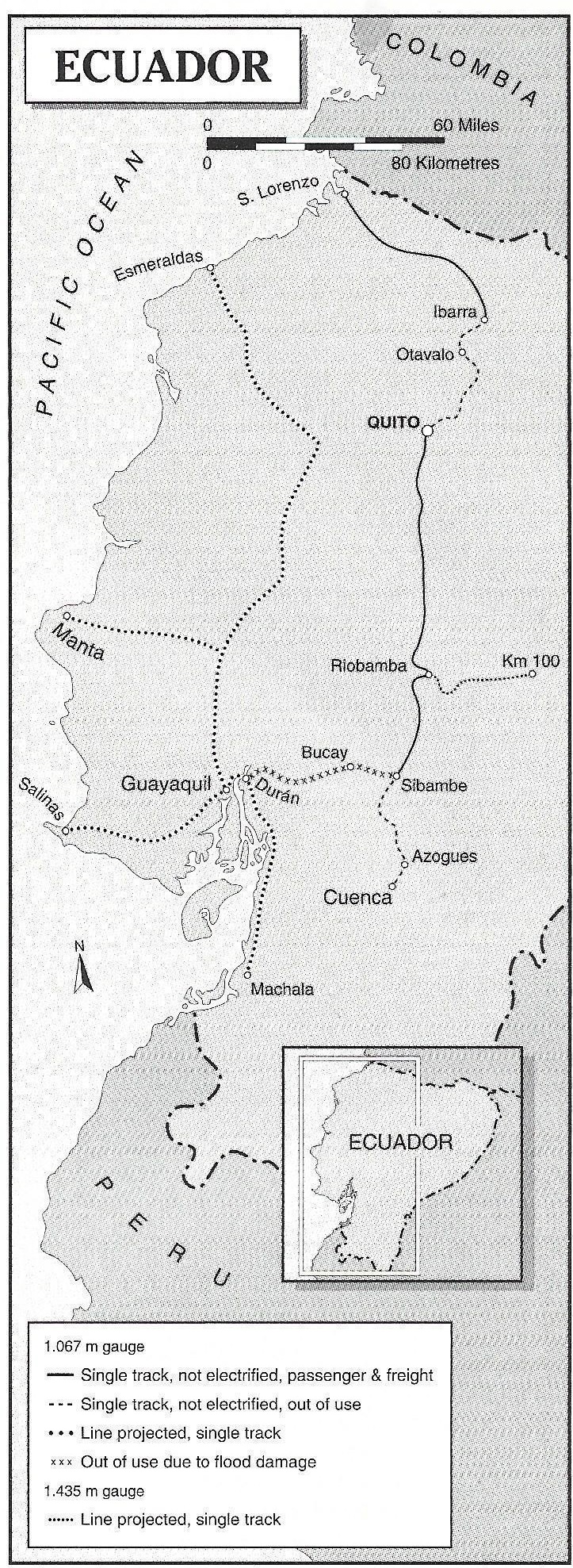
ENFE is composed of three divisions. The main line (the 446.7 km Guayaquil—Quito Division) connects Duran, located on the opposite bank of the river from Ecuador’s main port of Guayaquil, with Quito, which lies at some 2,800 m altitude in the the Andes. From Duran the line runs across low-lying plains for 87 km to Bucay, at the foot of the western slopes of the Andes. Over the next 79 km the line climbs 2,940 m at an average grade over the whole section of 3.7 per cent (1 in 27). The line strikes many sharp curves, and several stretches are laid on a grade of 5.5 per cent (1 in 18), including a double zigzag which was required to negotiate a particularly awkward mountain outcrop known as the Nariz del Diablo (Devil’s Nose). Once the summit of this section is reached at Palmira, 3,238 m in altitude and 166 km from Duran, the line remains in the high Sierra, never falling below 2,500 m, and rising to 3,609 m at the overall summit of Urbina, 264 km from Duran.
After severe floods in 1992 and 1994 the line was completely relocated and rebuilt near Tixan (from Alausi down to the Nariz del Diablo to avoid future breaches). In 1992 floods and high waters of the Rio Chanchan destroyed many bridges on the Sibambe—Huigra—Bucay section, and they have mostly been replaced by new steel structures. Floods during the El Nino weather phenomenon washed away several parts of the lowland line between Duran and Bucay and also some stretches between Bucay and Huigra, making any use of the lower sections of this line impossible. Some repairs have been carried out by ENFE near Huigra. In 1999, ENFE estimated the cost of rebuilding the Duran—Bucay—Sibambe line at US$1 million, with work expected to be completed by October 2000.
In late 1999, a weekly round trip by a mixed train between Quito and Riobamba was introduced, in addition to the three times-weekly railbus between Riobamba and Sibambe and the Sunday Quito—Cotopaxi excursion train.
The 373.4 km Quito—San Lorenzo Division runs northwest from Quito to the coastal town of San Lorenzo, near the border with Colombia. The Quito—Ibarra section of this Division has been out of regular service since the mid-1980s, and subsequently a short section was made inoperable when a parallel road was widened. In the early 1990s a railcar service was introduced between Ibarra and Otavalo to convey tourists to the Otavalo Indian market, but rolling stock problems have since led to its withdrawal. The Ibarra—San Lorenzo section has also suffered from landslides after heavy rainfall and has been repaired on several occasions. The most vulnerable section is around Carchi.
Until 1997 the railway had an effective monopoly in both passenger and freight transport in this part of the country, but the construction of a road on a generally parallel route has had a severe impact on traffic. Heavy rains in early 1999 again disrupted traffic and by May 1999 no signs of reconstruction had been reported.
ENFE’s Sibambe-Cuenca Division links Sibambe, 131 km from Duran on the main line, with Cuenca, an important provincial capital in the southern part of the country. On its northernmost section, near Sibambe, the line has been blocked on several occasions due to landslides and in the mid-1990s only sporadic traffic was operated on the southernmost part of the line between Azogues and Cuenca. However, in 1996 the line was closed completely near Cuenca when the track was covered in asphalt as part of a road improvement scheme.
In December 1999, 517 km of line were reported to be open for services.
Late in 1999, staff members were reduced to fewer than 400.
Passenger and freight operations
Passenger traffic has fallen from some 1.5 million passenger journeys in 1993 to around 110,000 in 1998. Freight traffic fell from 37,000 tonnes to 5,000 tonnes over the same period.
The principal ambition of ENFE has been to build a new north-south axis connecting the oil port of Esmeraldas, in the north of the country on the Pacific coast, with Machala, the inland centre of banana plantations south of Guayaquil. It would not entail difficult civil engineering. There would be a case for up to three branches to the line, one to serve a major economic development area based on prawn farms at Manta.
ENFE has also undertaken studies to improve rail access to Guayaquil. Both transhipment by either lorry or river barge and a new rail barge were considered. In 1996 US oil company Occidental Exploration & Production commissioned a feasibility study for a new 100 km 1,435 mm gauge route to bring freight and passengers to oilfields under development in the Amazon basin. This would have 300 tonne freight trains running at 50 km/h.
[топ]Improvements to existing lines
In April 1994, the ENFE board approved a Su212 billion investment programme which included track improvements and resleepering on the San Lorenzo-Ibarra and Riobamba—Duran sections of the system, as well as station modernisation.
[топ]Traction and rolling stock
The nine new Bo-Bo-Bo locomotives ordered from GEC Alsthom in 1991 with French aid began trials in Ecuador in August 1992. Designated Class 2400, each machine cost US$3.3 million; they are powered by SEMT Pielstick Type 12 PA4 V200 VG engines with a UIC rating of 1,780 kW.
ENFE’s other motive power comprises a mix of Alco DL535B Co-Cos and GEC Alsthom 960 hp B-B-Bs, steam locomotives and a handful of diesel railcars. Much of the fleet is unserviceable and many items of equipment are marooned by severed rail connections.
In December 1999 the fleet stood at:
Locomotives and rolling stock: 13 diesel-electric (4 reported serviceable), 9 steam (none serviceable); 15 railcars (4 serviceable); 50 passenger coaches (less than half serviceable); 120 freight wagons (fewer than 100 serviceable).
Type of coupler in standard use: Automatic
Type of brake in standard use: Air
Rails: 35, 30, 27.5 and 22.5 kg/m
Sleepers: Wood, 2,000 x 200 x 180 mm
Spacing: 1,700/km
Max curve radius: 20°
Max gradient: 5.5%
Max axleload: 15 tonnes
Admin добавил 05.02.2026 в 13:28
Вы можете дополнить или изменить данную статью, нажав кнопку Редактор







 Похожие темы


 Почта
Почта


 State Railways of Ecuador (ENFE)