===Ministry of Transport & Communications==
Xenofontos Street 13, GR-10191 Athens
Tel: (+30 1)325 12 11-19 Fax: (+30 1)323 90 39
Key personnel
Minister: Anastasios Mandelis
Secretary-General, Transport: К Stefanakos
Director-General, Transport: D Bekiaris International Affairs Director: G Ratsiavos
Hellenic Railways Organisation (OSE)
Organismos Sidirodromon Ellados 1-3 Karolou Street, GR-10437 Athens
Tel: (+30 1) 524 83 95 Fax: (+30 1) 524 32 90/524 62 39
Key personnel
=
President: C Papageorgiou
Director General: Mourmouris Ioannis
Deputy Director General: I Rigas
Directors
Personnel: S Xirakis
Financial Controller: A Moschou
Accounts: В Siamos
Financial Management: G Panoutsopoulos
Administration: C Valkanas
Operation: D Hondromitros
Traction: A Giannissis
Track: S Bobotas
Organisation, Design and Planning: E Lalakakis Modernisation and Development: G Arkondis Commercial: E Manolas
Workshops: D Xouris
Purchasing and Maintenance Depots:
T Papadrossou
Electrification, Signalling, Telecommunications:
D Pavlopoulos
Regional Management
Athens: К Giannakos
Thessaloniki: L Kourtidis
Manager, International Relations: E Kosteas
Gauge: 1,435 mm; 1,000 mm; dual-gauge, 1,435 mm and 1,000 mm; 750 mm
Route length: 1,565 km; 961 km; 23 km; 22 km Electrification: 764 km at 25 kV AC 50 Hz
The railway from Athens to the Peloponnese, serving Patras and southern Greece, is metre-gauge.
Organisation
A five-year modernisation and restructuring plan was started in 1998. The plan foresees investments of some Dr1,700 billion and the writing off by the government of accumulated debt.
Passenger operations
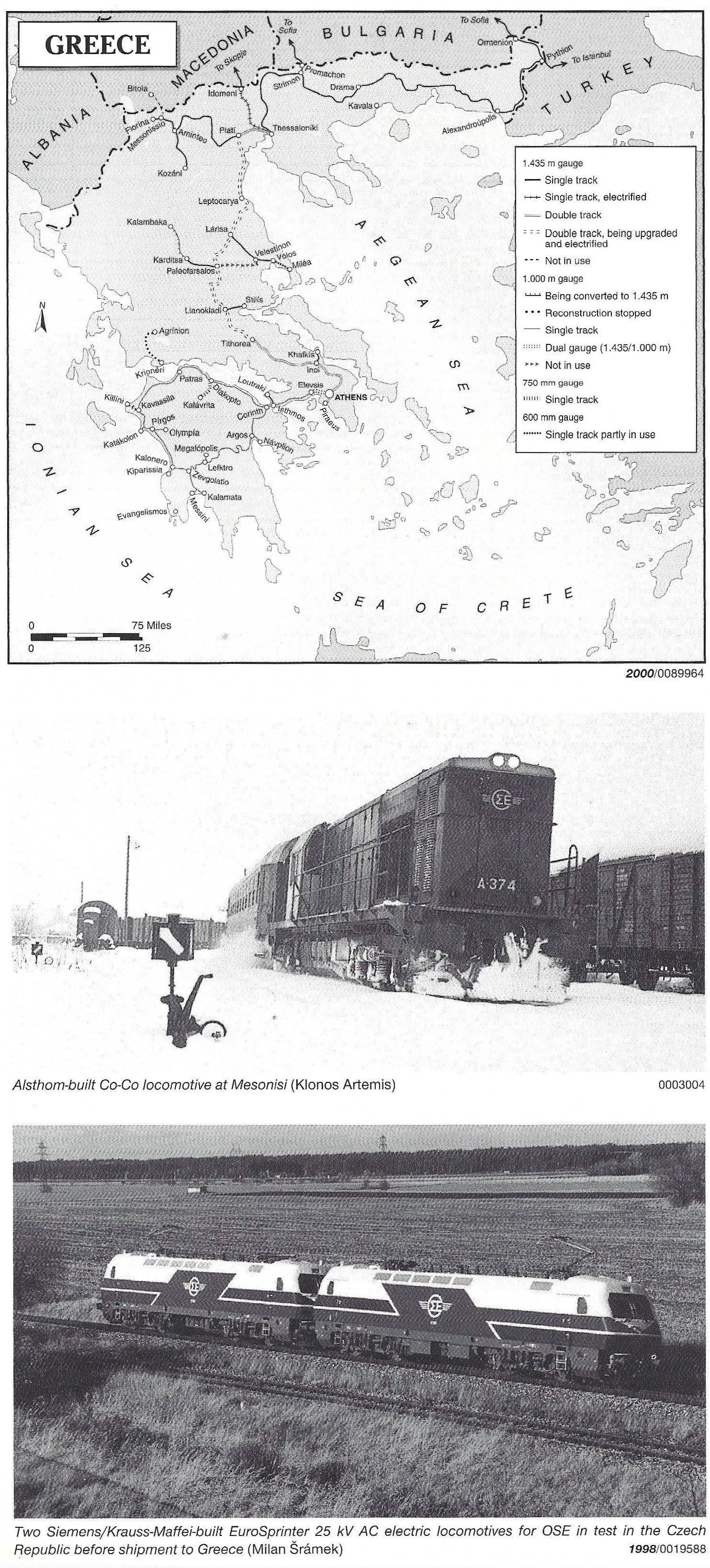
OSE operates passenger services on two main lines from the capital, Athens. To the north, a standard-gauge line runs to Thessaloniki, with services beyond to Alexandroupolis and the former Yugoslavia; to the south, a metre-gauge line runs to the Peloponnese, serving Patras and southern Greece.
Passenger journeys increased by 11 per cent in 1996 to 12.8 million, with passenger-km at 1.751 billion, also up 11 per cent.
Freight operations
OSE carried 2.2 million tonnes of freight in 1996, for 350 million tonne-km. One of the most important lines for freight is that from Thessaloniki to Idomeni, on the border with the former Yugoslavia.
A new freight facilities complex for the Athens region is planned at Thriassio Pedio.
New lines
A new line to serve the port of Kavala is planned. This would link in with the Thesssaloniki-Alexandroupolis line.
Improvements to existing lines
The principal project, in hand since 1978, has been electrification, doubling and realignment of sections of the Athens-Thessaloniki-ldomeni main line, together with track renewal employing UIC54 continuously welded rail on two-block concrete sleepers, with minimum curve radius of 2,000 m. This axis carries more than half the railway’s total traffic.
In December 1996, OSE appointed a 170-strong team to oversee a five-year Dr500 billion EU-backed infrastructure modernisation programme, including both its own personnel and engineering specialists from a consortium of consultants. The Hellas Rail Consult Joint Venture consortium comprises Halcrow Transmark of the UK (30 per cent); Metrotech of Greece (30 per cent); Obermeyer of Germany (25 per cent); and ILF Consulting Engineers of Austria (15 per cent). OSE has established a separate company, ERGOSE, to implement the improvements.
Among other work, the team has been supervising doubling of the track on the difficult mountain section between Evangelismos and Leptocarya (35 km). By 2000, travel time on the 510 km between Athens and Thessaloniki should be reduced from the 6 hours it takes today to 4 hours 20 minutes. Except between Larisa and Plati (134 km), electric signalling will be operative and a modern telecommunications system will cover the whole axis from Athens to Idomeni. There will be electrified double track over the whole route between Athens and Thessaloniki except for Lianokladi-Domokos (65 km) and the project incudes driving two new tunnels through the foothills of Mount Olympus, in northern Greece.
The investment programme also incudes upgrading the line from Thessaloniki to the Bulgarian border to provide an improved alternative link to Central Europe.
A subsidiary project would seethe 80 km metre-gauge Paleofarsalos-Kalambaka line converted to standardgauge. The line connects with the Athens-Thessaloniki route.
Athens-Patras upgrading
Conversion of the 220 km metre-gauge line from Athens to Patras to an electrified 1,435 mm gauge line with modern signalling, engineered for speeds of up to 200 km/h, is a goal of OSE. Work began in late 1990 on some upgrading of the existing metre-gauge track and modernisation of the route’s telecommunications. This would help to achieve accelerated schedules for the new metre-gauge trainsets introduced between Athens and Patras in 1992.
The international team of consultants working on the north-south line will also oversee dual gauging of the eastern section of tlnis route, so that standard-gauge trains will be able to reach Corinth using a new bridge over the Corinth Canal. Funding has also been obtained for the first phase of a new depot at Thiarsion-Pedion.
Traction and rolling stock
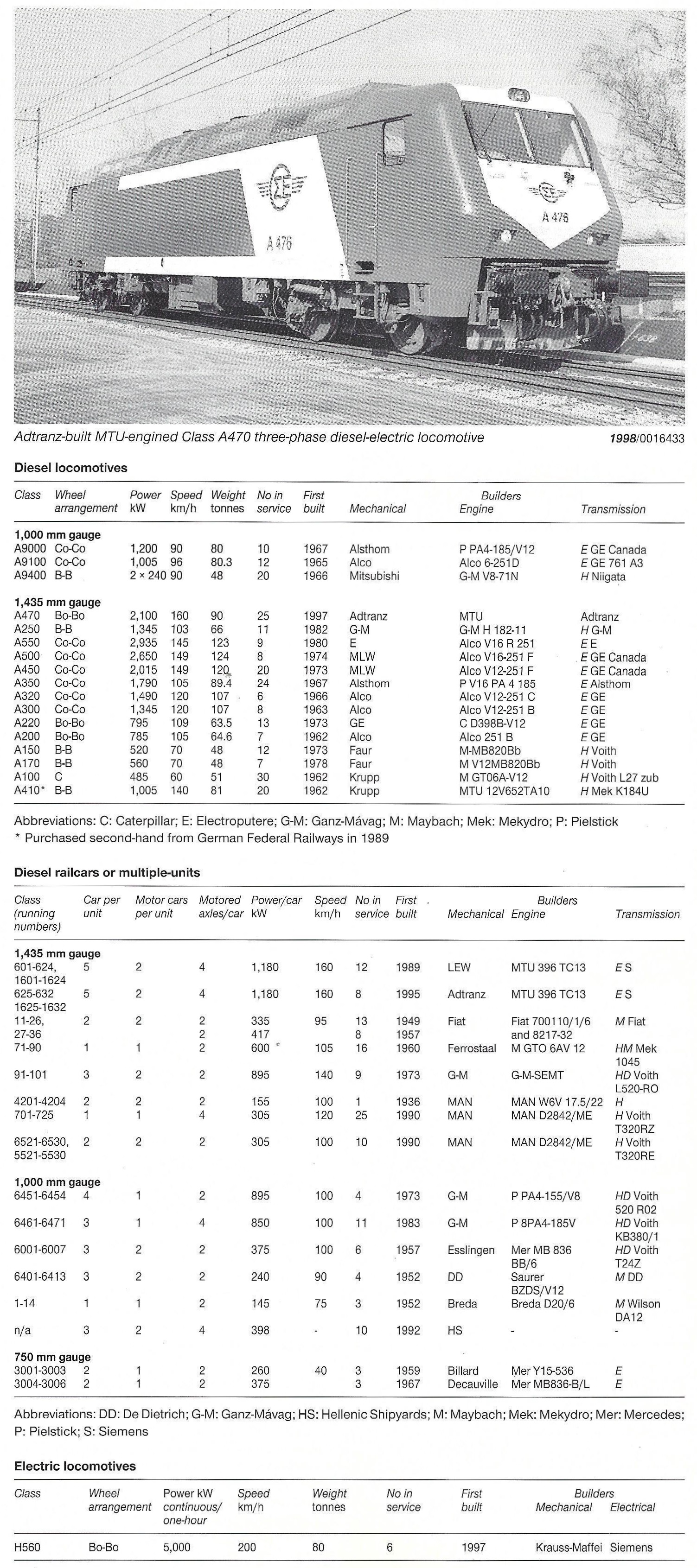
At the beginning of 1997 OSE operated 191 standardgauge and 43 metre-gauge diesel locomotives, 180 dmu vehicles; 400 standard-gauge and 143 metre-gauge coaches; and 6,639 standard-gauge and 1,344 metregauge wagons.
For the Athens-Thessaloniki and Thessalonfki-Alexandroupolis routes, German industry manufactured 12 four-car 160 km/h intercity dmus in 1989. In 1994, a further eight five-car trains were ordered from AEG Bahnsysteme (now Adtranz) for these lines. Assembly took place at the former AEG Hennigsdorf works. In 1995, 12 extra trailer cars were ordered from DWA’s Bautzen factory to make the original units into five-car sets.
Adtranz received a contract to build 25 Class A470 2,100 kW three-phase diesel-electrics for delivery by January 1998. The design of these locomotives allows for eventual conversion to electric traction. In late 1997 Siemens/Krauss-Maffei commenced delivery of six Class H560 EuroSprinter-based 5,000 kW electrics for hauling express passenger and freight trains over the newly electrified section from Thessaloniki to the Macedonian border. In March 1998 a further 24 of these locomotives were ordered from Siemens/Krauss-Maffei for delivery from 2000.
OSE’s first emus were also ordered in March 1998, with a contract for 20 five-car units for the Athens-Thessaloniki main line to be supplied by Adtranz and Siemens Transportation Systems in co-operation with Hellenic Shipyards. The 160 km/h aluminium-bodied articulated vehicles will be based on DB’s Class VT 642 units. Deliveries are due to start in December 1999.
For the metre-gauge system, a total of 10 air conditioned three-car trainsets for intercity operation have been built by Hellenic Shipyards. Two of the cars in each unit have each bogie powered by a 398 kW 2,100 rpm engine. They entered service in 1992.
In 1998 Siemens received a contract to supply 106 coaches, a mixture of first- and second-class vehicles and restaurant cars.
[топ]Electrification
Two electrification projects are planned. Priority is being given to the 25 kV 50 Hz AC electrification of the 587 km Athens-Thessalonfki-ldomeni main line, which has the backing of the European Union. First section to be tackled is the 76 km of single line from Thessaloniki to the former Yugoslav border at Idomeni, where track is being renewed and curvature eased. This route carries three times the freight of the Athens-Thessaloniki line. Wiring is in place; commissioning was scheduled to take place in
1997. In 1996 a consortium led by ABB and including Adtranz won a US$145 million contract to electrify the Athens-Thessaloniki route by 2001.
For the longer term, OSE aspires to convert to standard gauge and electrify the metre-gauge line to Patras (see ‘Improvements to existing lines’ section).
Coupler in standard use: 1,435 mm gauge, UIC 520-521
Brake in standard use: Air, mostly Knorr
Rail: 1,435 mm gauge, UIC 50, 54; narrow-gauge, 31.6 kg/m
Sleepers: 1,435 mm gauge, reinforced concrete twin
block (Vagneaux type) 680 * 290 mm; steel 2,550 x 260 mm; timber 2,600 x 250 mm. Narrow-gauge, steel and timber
Fastenings: 1,435 mm gauge, RNand Nabla for concrete sleepers; К direct fastenings for wood or steel
Min curve radius: 1,435 mm gauge, 300 m; narrowgauge, 110 m
Max gradient: 1,435 mm gauge, 2.8%; narrow-gauge, 2.5%
Max permissible axleload: 1,435 mm gauge, 20 tonnes; narrow-gauge, 14 tonnes
Max permissible speed: 90-100 km/h; 120 km/h parts of Athens-Thessaloniki main line









 Почта
Почта


 Greece railways