Zurich Rail Capacity Increase, Switzerland


|
Zurich is Switzerland's largest city, and also has one of Europe's greatest concentration of rail infrastructure. As well as a comprehensive tramway system, it is the focal point for local, national and international railway traffic. Current projects such as the Glattalbahn (VBG) and Tram Zurich West light rail schemes were partly aimed at dispersing demand by creating more interchanges around the metropolitan area. Handling growing demand at the main station, Zurich Hauptbahnhof (HB) – nearing 3,000 trains daily – remains a great challenge. Switzerland's largest and busiest station by some margin, HB is mainly a surface terminus in the city centre. 
Situated lengthways between the rivers Sihl and Limmat, it is fronted by busy tram stop, and its four-platform sub-surface station for S-Bahn trains (local/regional trains primarily for the Zurich canton) was turned into a through route in 1991. However, even with the adoption of multiple units and push-pull formations which save the need for locomotive changes at surface-level platforms, reversal is still a time waster, and is inefficient use of platform and track space. The project Durchmesserlinie (the Diameter Line) Altstetten-Zurich HB-Oerlikon is the latest project to address the capacity issue. Bahnhof Oerlikon already handles traffic for the north and north east, each main rail arteries and including services routed via Zurich Airport. Many reverse at Zurich HB for destinations in a wide arc from Basel around to the Gotthard line and Chur, with other passengers needing to change trains for onward travel. By allowing such services to pass through the HB hub, the Durchmesserlinie project represents a large-scale reshaping of Swiss train services with implications far beyond the confines of Zurich. Moreso than the 1991 tunnel opening, this will however allow for alterations and expansion of the S-Bahn services that account for a large proportion of train movements in the area, eventually adding long-distance trains. The symbolic groundbreaking for the project was in September 2007. Infrastructure Broadly describing an 'S' shape to link the end points yet incorporating Zurich HB, the Durchmesserlinie is 9.8km (6.1 miles) long. The approximately 5km (3.1 miles) Weinberg tunnel for which the tunnel boring machine began work in October 2008 is the core of the project. Leaving the existing intensively used mainline via a reconfigured portal south of Oerlikon station, the twin-track tunnel will pass beneath the Limmat before broadening to a four-platform layout at a new Zurich HB Löwenstrasse station 16m beneath the main platforms, regaining the surface west of HB. "Zurich uses a mix of rolling stock for S-Bahn services, including rebuilt RBe 540 EMUs mainly dating from the 1960s."
Bahnhof Alstetten marks the western limit of the project, a busy suburban interchange that will also then be the western terminus of the new Tram Zurich West development. The Weinberg tunnel passes under the south side of the HB, and like the to the north, under-cover connections will be possible entirely inside the complex which also houses a large shopping centre, RailCity, a development encouraged by trading laws that are less restrictive when within railway premises. As part of the national rail infrastructure, the line will be fitted with 15kV ac electrification. Being met from national and cantonal public funds, the project cost estimate is CHF2.03bn (2005). Rolling stock Zurich uses a mix of rolling stock for S-Bahn services, including rebuilt RBe 540 EMUs mainly dating from the 1960s. Responding to growing traffic and service expansion, double-deck DPZ stock operated in push-pull mode with Re 450 single-ended locomotives was introduced from 1989. In parallel with the Durchmesserlinie, the S-Bahn is being re-equipped, the earlier high-capacity stock being due for upgrading. Entering public service in 2006, 60 Siemens RABe 514 140km/h (88mph) double-deck multiple units have been ordered. A Siemens/Bombardier consortium announced an order in September 2008 to supply 113 low-floor intermediate double-deck coaches to strengthen existing S-Bahn formations. In June 2008, an order was placed with Swiss company Stadler to supply 50 six-car double-deck electric multiple units of a new design, with options for more under the contract. Compatible for operation with existing S-Bahn stock, they will have a capacity for 1,694 passengers (526 seated) and have a top speed of 160km/h (100mph). "S-Bahn services are expected to begin by late 2013, InterCity following within two years."
Signalling and communications Switzerland is a European leader for implementing the European Rail Traffic Management System (ERTMS) project and the new line will be equipped as an integral part of the principal route network. Nine emergency escape and access points are being built on the tunnel section. SBB have been operating an information centre and holding site visits to explain the works and act as public relations for the project. The future S-Bahn services are expected to begin by late 2013, InterCity following within two years. For long-distance internal services such as St Gallen-Geneva, the project should save up to 30 minutes over present schedules. Upon project completion, the temporary 'Sihlpost' surface platforms 51–54 that were added mainly for S-Bahn use at the south side of Zurich HB should be abandoned. |
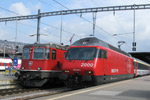  Expand Image Expand ImageZurich HB is at the heart of the Durchmesserlinie project that will have effects on regional and national services. |
 Expand Image Expand ImageApart from the 1991 S-Bahn platforms, all traffic must enter and leave HB from the western end. | |
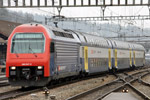 Expand Image Expand ImageThe Re 450/DPZ formations were an early response to growing rail demand around Zurich city and canton. | |
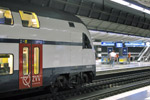 Expand Image Expand ImageA tunnel opened in 1991 gave the initial low-level Zurich HB S-Bahn platforms greater capacity and operating flexibility. | |
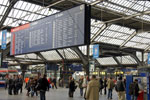 Expand Image Expand ImageZurich HB's destination board illustrates the intensity of S-Bahn services over a short period. | |
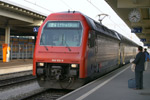 Expand Image Expand ImageZurich HB 'Sihlpost' platforms 51–55 are a temporary measure to add extra capacity pending completion of the Durchmesserlinie project. | |
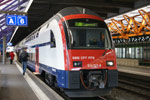 Expand Image Expand ImageEntering service from 2006, the Siemens RABe 514 is the second generation of high capacity Zurich S-Bahn stock. |