Washington Metrorail, Washington, DC, USA


|
Washington Metrorail is a rapid transit system that connects Washington to various neighbouring regions. With six lines, it is the second-busiest rapid transit system in the US, the first one being the New York City Subway. Washington Metropolitan Area Transit Authority (WMATA) operates the entire Metrorail system. The Metrorail system, which has operated since March 1976, incorporates 86 stations and 106.3 miles (171.1km) of track. 
Washington has a residential population of about 591,800. With a population of over one million during the week, Washington faces heavy traffic congestion. The city has the Metrorail and Metrobus serving 3.5 million commuters within 1,500 square miles. The counties that are served by the metro system include Montgomery County and Prince George's County in Maryland and Fairfax County, Arlington County and the City of Alexandria in Virginia. Metrorail project The construction of the Metrorail system began in 1969 and its first phase was opened on 27 March 1976, while the final work of the original 103-mile rail network was completed in 2001. The project's phase 1 construction work took six years and three months to complete. Out of the total length of the metro system, 50.5 miles is subway while the aerial and the surface tracks are 46.31 miles and 9.22 miles long. The subway system of the metro integrates 47 stations, the surface system integrates 33 stations and the aerial system connects six stations. Among the Metroline stations, Forest Glen is the deepest station at a depth of 196ft. The distance between the street and platform can be covered in under 20 seconds in high-speed lifts. The Metrorail project has six metro lines. Blue, Green, Orange, Red and Yellow have already been constructed and Silver is under construction. "With a population of over one million during the week, Washington faces heavy traffic congestion."
The first line, Red, is 31.9 miles (51.3km) long and connects 27 stations in Montgomery County, Maryland. It has been operated since 1976. The Blue line connects 27 stations and traverses through Fairfax County, Alexandria and Arlington in Virginia, the District of Columbia and Prince George's County, Maryland. It has been operated since 1977. WMATA undertook a $177m renovation project for the Red Line in July 2009. The renovation includes improvements to the automatic train controls and tunnel ventilation systems, replacement of tunnel lighting systems and repairing the station walls. The renovation will begin in early 2010. The Orange line is 31.3 miles (50.4km) long and connects 26 stations. The counties served by the Orange line are Fairfax County and Arlington, the District of Columbia and Prince George's County. It has run since 1978. The Yellow line connects 17 stations and traverses through Fairfax County, Alexandria and Arlington, having operated since 1983. Meanwhile, Green Line connects 21 stations in Prince George's County and was opened in May 1991. In 1980, a bill was signed by President Carter to complete the construction of the Metrorail. The Stark-Harris bill passed $1.7bn in federal funds for the project. Infrastructure Red Line connects different places in the northern region. Its structure is in a narrow U shape, with Shady Grove and Glenmont stations at the terminus. Internally, the line has two routes Shady Grove Route and the Glenmont Route, both starting at Metro Center. Red line does not share its stations with any other line. Orange line is an east-west line with Vienna / Fairfax-GMU and New Carrollton stations at the terminals. The line shares half of the track / stations with the Blue line and two thirds of the track will be shared with the under-construction Silver line. Blue line is a south-east line connecting Franconia-Springfield and Largo town centre. A number of stations are shared with the Orange and Yellow lines, with eight stations belonging exclusively to the Blue line. Yellow line is a north-south line with Huntington-Fort Totten station as terminal. Almost the entire Yellow line is shared with the Blue and Green lines. "The operating fleet of the Metrorail system consists of 1,130 railcars manufactured by Rohr, Breda, CAF and Alstom."
Green line is C-shaped with terminals at the north-east and south-east points. The terminals of the line are Branch Ave and Greenbelt stations. The line shares a few stations in Washington with the Yellow line. Silver line is an east-west line with Stadium–Armory and Route 772 as terminals. The line will share its track with a few stations on the Orange and Blue lines. The Metrorail system has 588 escalators and 252 lifts in stations and parking facilities. The longest escalator of the entire system is 230ft and is in the western region at Wheaton Station. The Metrorail system has more escalators and lifts than many other transit systems in North America. The WMATA uses IBM's software to control its entire infrastructure equipment. The software helps WMATA to monitor 267,000 parts of its transportation system, including, trains, stations, bus stops, tracks, buses, railcars, escalators and lifts. A crash-avoidance system is being developed for the Washington Metro by ARINC. The system will monitor tracks and aid in automatic train control to avoid train collisions. Signalling and communications The Metrorail system uses an automatic train control (ATC) system for its fleet. The ATC has three separate subsystems, automatic train protection (ATP), automatic train operation (ATO) and automatic train supervision (ATS). Verizon Wireless is the only communicating medium that works while the Metrorail traverses through the tunnel. The Metrorail system has two-way radios between train operator and the operational control centre (OCC). The system also has hotlines to communicate from OCC to police and fire departments. In addition, the system has various communication and safety systems including an automated electronic fire protection system. Intercoms are also fixed in rail cars, lifts, platforms and landings. The subsystem ATP controls operations including interlocking, train separation and door operations and the ATO controls the operations of the automatically running trains. Rolling stock The operating fleet of the Metrorail system consists of 1,130 railcars manufactured by Rohr, Breda, CAF and Alstom. Metrorail operates six- and eight-car trains, as the system can only handle trains with an even number of cars. There are 290 1000-series railcars, 364 2000/3000-series railcars, 100 4000-series railcars, 192 5000-series railcars and 184 6000-series railcars. The 1000-series cars were manufactured by Rohr while the 2000, 3000 and 4000-series cars were manufactured by Breda. The 5000-series cars were built by CAF and Alstom manufactured the 6000-series railcars. "The Silver line is 23 miles (37km) long and will connect 29 stations."
In April 2009, 20 railcars were added to the fleet by the WMATA. The 20 cars increased the size of the trains on the Red and Green lines. The existing fleet is set to be replaced with 748 7000-series cars and 100 cars of the Breda 4000-series fleet are to be restored. The plan focuses on using optimised procurement methodology and a modern design to produce railcars. The railcars running on the Metrorail system are self propelled, single level and electrically powered. They are a common-design passenger type, with passenger capacity of 175. The length of the railcar is 75ft while the width and height are 10.16ft and 10.83ft respectively. The maximum operating speed of the trains is 59mph while the average, including stops, is 33mph. In February 2010, WMATA awarded a $6m contract to Harsco Corporation's rail unit for the construction of utility vehicle (UTV) prime movers. The construction of UTVs will be carried out at Harsco Rail's track maintenance engineering and production facilities in Columbia, South Carolina. The UTVs will power work trains that are engaged for railway maintenance including snow removal, rail repair and replacement, and supplying power for hydraulic and pneumatic tools. The deliveries are scheduled to begin in January 2011 and run until the second quarter of the year. The future The Silver line is 23 miles (37km) long and will connect 29 stations. It will serve Loudoun, Fairfax and Arlington counties and the District of Columbia. The first phase of this line is scheduled to be opened in 2013. The full line, which is still in the planning stage, is expected to be opened in 2016. An expansion project to extend the Metrorail to the Dulles Corridor in Fairfax and Loudoun Counties is being sponsored by Virginia Department of Rail and Public Transportation. The project work includes the construction of a 23.5-mile transit system that connects Metrorail and Loudoun County. |
  Expand Image Expand ImageWMATA operates the Metrorail system in Washington, DC, with the first section opening in 1976. |
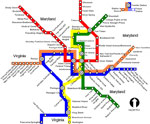 Expand Image Expand ImageWashington Metrorail has six lines, but is expanding with the Silver line, connecting to Loudoun, Fairfax and Arlington counties and the District of Columbia. | |
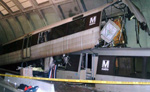 Expand Image Expand ImageThe Metrorail system consists of 1,130 railcars manufactured by Rohr, Breda, CAF and Alstom. The system operates six and eight-car trains only. |