Ankara Metro Light Rail Development, Turkey


|
Ankara, the Turkish capital, first devised a project to build a light rail metro system in 1987, and was able to take advantage of a technical assistance package granted by the Canadian government to help its development. A master plan for light-rail development envisages a 66.4km (42 mile) network split between Metro and Ankaray light rail metro operations by 2015. To date one, 14.6km Metro line, and one light rail Ankaray line, 8.7km long are open and fully operational. 
"The Metro is helping to remove some of the 933,000 private vehicles from Ankara's roads."
The initial 14.6km (9.5 mile) heavy rail route links Kizilay in the city centre with new and expanding residential areas of Batikent in the west, and running along the Ataturk Boulevard, which previously suffered badly from road-vehicle congestion, and so was a prime candidate for a substitute form of transport. The line is fully segregated from the road, however, and the high density rolling stock can accommodate up to 40,000 passengers per hour in each direction, helping to remove some of the 933,000 private vehicles from Ankara's roads. The agreement to build the system was signed in December 1992, and the funding package included credits and loans from the United States, Germany and Great Britain, apart from Canada. The first line, an 8.7km light metro line linking Asti with Dikimevi, was completed in 1996 by a Siemens-led consortium which included Adtranz, and Breda of Italy. It has 11 stations, a Metro interchange at Kizilay and meets suburban trains at Kurtulus. THE ANKARA METRO PROJECT The current Ankara fixed-track public transport system consists of the 14.5km metro line, which opened in 1997. It has 12 stations and consists of 6.5km of underground running, 4.5km on the surface and 3.7km of elevated railway. This line is fully automated, and runs between Kizilay (with a connection to the Ankaray system) and northwest to the rapidly growing suburb of Batikent. "The population of Ankara is expected to grow from 5.1 million to 6.5 million between 2015 and 2025."
However, the first line in the Turkish capital was the 8.7km Ankaray light metro line linking Asti with Dikimevi. It cost DM520 million, and was completed during 1996 by a Siemens-led consortium which also included Adtranz, and Breda (Italy). Now Ankara is looking towards the future of the Ankaray and Metro networks, particularly as the population of Ankara is expected to grow from 5.1 million to 6.5 million between 2015 and 2025, and several extensions are planned. On the automated Metro system, three new lines are under construction to expand the network into a four-line system centred on Kizilay, the heart of Ankara. In addition, Line 1 is being extended by 18km from Batikent to Sincen in the west. The new lines under construction are:
The Ankaray light rail system is also the subject of extensions, although unlike the metro, construction is later. Two further lines are planned between Kurtulas, on the first operational line, to Siteler and from Maltepe to Etlik which will allow further integration of the two systems. INFRASTRUCTURE "The Ankaray system has a capacity of 16,000 passengers per hour, by 2015 this will be 25,000."
The system has a maximum future design capacity of 58,000 passengers/hour/direction. The Batikent-Kizilay heavy metro line is electrified at 750VDC third rail. The first line serves 12 stations, and consists of underground, surface, and elevated track along the 14.5km route. The depot near Macunkoy has 8.5km of storage tracks, plus workshops, and offices. With the current expansion of the network a second depot is to be built at Cayyolu on the southwest extension by 2015. The Ankaray system has a capacity of 16,000 passengers per hour, and by 2015 will be capable of handling 25,000 passengers by increasing train frequency to two-minute intervals. ROLLING STOCK All 108 metro cars, which are based on a design for Toronto, have been delivered by Bombardier Transportation and are formed into 36 three-car trains for testing and trial running. Each three-car set has a motor car at each end, and a trailer in the centre. Six-car trains carrying up to 2,000 passengers each can be operated in peak periods. Eleven trains are used to operate the Ankaray light rail metro system, formed of three vehicles. SIGNALLING/COMMUNICATIONS The system has automatic train control based on Alcatel's Seltrac moving block signalling. "Service frequency is every 3-5 minutes in rush hours, and every 8-9 minutes off-peak."
An inductive loop laid along the guideway provides two-way communication between the train and lineside equipment, and locates the trains. The service frequency is every 3-5 minutes in rush hours, and every 8-9 minutes in the off-peak between 0600 and midnight. Both systems are equipped with CCTV cameras together with transmission, telephone, radio and public address systems and train destination displays. THE FUTURE In addition to the teething problems with the rolling stock, mainly affecting the wheels and brakes, Thorn-EMI, the supplier of the ticketing system, has also been forced to investigate mechanical problems caused by passengers using deformed tickets in the machines in the early period of operation. The metro was designed in 1995 to carry about 35,000 passengers per hour in each direction in the peak but this is now being considerably exceeded to cope with a dramatic rise in population. By 2015, the population of Ankara is expected to reach 6.5 million people, and the current phase of extensions will allow mass transit in the city with less reliance on private vehicle use. Expansions include an extension of the first line (or a second line) south-west from Kizilay to Çayyolu (18km) along Eskisehir Road, Ulus to Keçiören (7.9km) and TBMM to Dikmen (4.8km). |
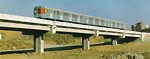  Expand Image Expand ImageThe 36 trainsets were supplied by Bombardier, the trainsets comprise of three cars. |
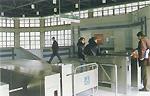 Expand Image Expand ImageThe ticketing system performs with multi-ride magnetic cars. | |
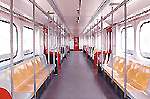 Expand Image Expand ImageThe interior of the new metro passenger vehicles. | |
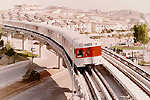 Expand Image Expand ImageA heavy-metro trainset running across one of the many elevated sections of the new Ankara heavy metro. | |
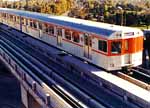 Expand Image Expand ImageElevated sections of the new heavy metro line are essential to allow the smooth running of the city's existing road traffic. | |
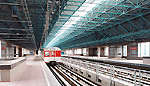 Expand Image Expand ImageNew stations are considerably larger, lighter and more spacious than previously. | |
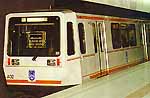 Expand Image Expand ImageAn Ankara light-metro train, supplied by Breda of Italy. | |
 Expand Image Expand ImageThis map shows the extensions that are under construction in 2006, together with the extensions to the Ankaray network that are planned. | |
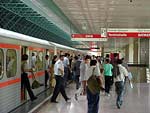 Expand Image Expand ImageThe Ankara Metro has proved popular, and is efficient through the use of automatic trains. | |
 Expand Image Expand ImageThe Ankaray light rail system is independent of the Metro system, with trains built by Italian firm AnsaldoBreda. |