Tunis Light Rail Development, Tunisia


|
The most northerly African country, the Tunisian Republic (Tunisia) has a population of around 10 million. This is mainly concentrated around the coastline in the north and east, with well over 10% in the metropolitan area of the capital, Tunis. A French territory for over 70 years that gained full independence in 1956, Tunisia has one of the most diversified and successful economies in Africa. THE PROJECT 
Public transport is overseen by Tunisia's Ministry of Transport, with constituent bodies operating the various modes. The Société Nationale des Chemins de Fer Tunisiens (SNCFT) has continued development of the heavy rail standard and metre gauge routes, initiated under French control, with the 1,435mm operation centred on Tunis. "By 1992 there were five light rail lines in operation, representing one of Africa's most comprehensive urban rail networks."
An 18.7km electrified double-track suburban line with origins in 1872, the Tunis-Goulette-Marsa (TGM) links the city via a causeway across the Lac de Tunis with its north-eastern suburbs, including resorts and the historic Carthage area. Tunis is just inland and set on low-lying land around several lakes. The heart of the city, the Medina, has a street pattern that long predates the industrial era or motorised transport. In 2003, the city's own road and rail public transport modes came together under the jurisdiction of the Société des Transports de Tunis, operating under the Transtu name. Accounting for almost three quarters of revenue (2006), the company operates 217 bus routes over 6,882km with a fleet of 1,114 vehicles. As with most other large cities, road congestion is a feature of Tunis, although the challenge for public transport is as much about increasing capacity on their already well-used services as it is about stemming the rise in car use. INFRASTRUCTURE With the city set for continuing population growth, preliminary studies for light rail, the Métro Léger, began in 1974. A Siemens-led consortium won the contract to create the 1,435mm, overhead supply surface network. Line 1, Tunis Marine (also city terminus for the TGM) to Ben Arous in the south, opened in 1985. By 1992 there were five lines in operation, representing one of Africa's most comprehensive urban rail networks. The routes mainly have reserved alignments, with many road crossings. There is interchange with the SNCFT terminus at Place Barcelone, part of the largest concentration of Métro lines from where the network displays a broadly radial pattern. ROLLING STOCK Following the lead of German sourcing when the TGM was re-equipped with Düwag -MAN units, the Siemens-led consortium supplied proven technology in the form of 134 bi-directional Düwag 30m units delivered in three batches, in 1985–1998. Running singly or in pairs, these vehicles operate throughout the network. Following a tender of January 2003, in June 2004 an order was placed with Alstom for 30 Citadis type 302 five-unit low-floor sets, the first entering revenue service in September 2007. Supplementing rather than replacing the Düwag units, the initial Citadis fleet assembled at La Rochelle will provide an overall 5% capacity increase on the Métro. Unusually for Citadis, it will operate over a 'legacy' infrastructure rather than being introduced as part of a new integrated project. The uni-directional units will run coupled 'back-to-back' to create ten-unit formations with a capacity of 668. The vehicles are modified for local conditions with added dust protection, more heat-resistant roof panels and special window coatings. A welcome addition for passengers over the original Düwag fleet is the incorporation of air conditioning. "Accounting for almost three quarters of revenue (2006), Transtu operates 217 bus routes over 6,882km with a fleet of 1,114 vehicles."
SIGNALLING AND COMMUNICATION In terms of service information, facilities at tram stops are rudimentary compared with European standards, although high service frequency and straightforward routings offset potential problems. Onboard information systems of the Citadis reflect their modernity in contrast with the other Transtu vehicles alongside which they will operate. Information is provided in the official language, Arabic, and the widely spoken French. THE FUTURE Scheduled for batch completion in March 2008, the first Citadis trams will be followed by nine ordered in February 2007. Delivery and local certification has met the original targets. It is likely that the Alstom-sourced vehicles will see service beyond the initial allocation to Line 1. Transtu intends to issues tenders for a further 16 comparable vehicles for 2008/9. A project for infrastructure improvements valued at €15m is in hand, with a further €16m allocated to a broad programme for increasing system capacity. Some line modifications are required to accommodate Citadis operation. Planned extensions include an extra 5km of Line 4 to reach the Mannouba University campus (cost: €32m) and a 6.8km branch from the present Line 1 to d'El Mourouj (cost: €43m). |
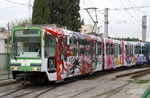  Expand Image Expand ImagePart of the light rail project's inception, the 134 Düwag units are the mainstay of Tunis Métro services. |
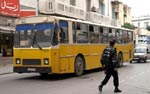 Expand Image Expand ImageTranstu's bus routes carry many more passengers than their rail services. Line extensions will increase the number of mode interchanges. | |
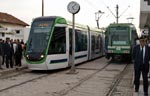 Expand Image Expand ImageLine 1 to Ben Arous (pictured) saw the introduction of Citadis units to revenue service in September 2007. | |
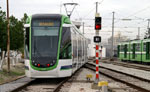 Expand Image Expand ImageThe two vehicle types on Tunis Métro operate side-by-side on the network. Some line modifications are required for Citadis operation. | |
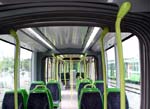 Expand Image Expand ImageModifications for local conditions include heat-resistant roof panels, window coatings, added dust protection and livery in the operator's colours. | |
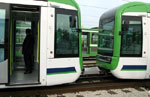 Expand Image Expand ImageThe uni-directional Citadis units operate as pairs with a combined capacity of 668. | |
 Expand Image Expand ImageSeen at Tunis Marine depot, Citadis units like M410 mark a new era of passenger accommodation on the Métro network. |