Speedrail High-Speed Rail Link, Australia


|
Australia cannot decide whether to enter the high speed rail revolution. Despite the 12 December 2000 decision to formally abandon its plans for a Speedrail network between Sydney, the capital of New South Wales, and Canberra, the nation's administrative capital, it is still talking to potential developers. In August 1998, the country's national government had announced proposals for a line that would be entirely designed, financed, built and operated by a privately-owned consortium. The Speedrail Group was chosen as preferred operator, a partnership of Alstom - on whose TGV technology the high-speed trains would be closely based - and civil engineering company Leighton Pty, one of Australia's largest engineering companies. The projected opening date was 2005/06. 
THE PROJECT The Commonwealth, New South Wales and Combined Territories governments signed an agreement with Speedrail in March 1999 for a 'proving-up' process. Meanwhile, studies confirmed the soundness of the patronage, revenue forecasts and technical aspects of the proposals. The new route would start at the existing Sydney Central main terminus, serve stations at the city's domestic and international airport terminals, then Campbelltown, the Southern Highlands, Goulburn and Canberra Airport. Some services would start back at Parramatta rather than Sydney Central. Despite the attraction of a Sydney-Canberra journey time of just 81 minutes, the government withdrew interest when it was suggested that the original A$5 billion cost for the taxpayer might end up as an A$50 billion. Alstom's principal contribution to the scheme was to suggest modifying the French TGV high speed train into a 320km/h version similar to those employed on the Seoul-Pusan high-speed line in Korea. Although conventional multiple aspect signalling would be retained, trains would also have an in-cab signalling system, as also used on the Europe's Eurostar and TGV trains. THE FUTURE The Department of Transport and Regional Services commissioned a scoping study into a broader Melbourne-Canberra-Sydney-Brisbane high speed service, but even went cool on this in March 2002. Associated with the decision was the rejection of a second international airport for Sydney. In the very long term, Australia still has a vision of a much larger 1,300km (800 mile) high speed line linking Melbourne, Canberra, Sydney, the Gold Coast and Brisbane. |
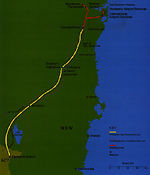  Expand Image Expand ImageSpeedrail map. |
 Expand Image Expand ImageA computer montage of a Speedrail trainset at Sydney Central station. | |
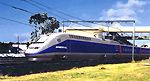 Expand Image Expand ImageAn artist's impression of the Speedrail trainset at speed. | |
 Expand Image Expand ImageNine trains, each comprising eight vehicles, will use their 320km/h capability on the new purpose-built sections of the route. | |
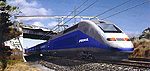 Expand Image Expand ImageAlstom's involvement includes the design and construction of the trains. | |
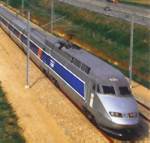 Expand Image Expand ImageFrench TGV Reseau technology was at the heart of the Speedrail project. |