San Juan Tren Urbano Light Rail System, Puerto Rico


|
In 1989, Puerto Rico's Department of Transportation and Public Works (DTPW) proposed to build a mass-transit system called Tren Urbano. This is Puerto Rico's first mass transit project. Phase one of Tren Urbano is designed to bring a new mode of transportation to the most congested sections of the San Juan Metropolitan area. It will transport passengers in San Juan, capital of Puerto Rico, and the surrounding urban areas. The initial phase of Tren Urbano will serve three central municipalities of the SJMA, Bayamóón, Guaynabo, and San Juan. In 1996 the scheme was projected to cost an estimated $1.25 billion, by 2002 the cost had risen to $2.036 billion. The Tren Urbano funding will come from three main sources. These are: FTA Capital Programmes Funds, Flexible USDOT formula funds and Bonds. Phase one of the Tren Urbano project has total capital costs of about $1.55 billion. 
The project has been prompted by the need to find a lasting solution to the continually rising traffic levels in the conurbation. The Puerto Rico administration decided to go ahead with a rail link in 1994. The design of the first phase of the project began in 1996. The first phase will be put into operation in 2002/3. Siemens Transit Team will operate the system for the first five years after completion according to a design-build-operate contract. Siemens will have an option to extend this operating phase by five years if it wishes. INFRASTRUCTUREThe complete mass transit system is being built as a turnkey project. The contract award has gone to Siemens. Siemens has involved the following smaller companies as partners: Alternate Concepts, Inc. and Juan R. Requena & Associates. The 17.2km (10.7-mile) long connection includes 16 stations running from Bayamón to Santurce. There is a centrally located storage and maintenance yard where the operations centre will also be located. Though trains will have operators aboard, the system will be completely automated with a double-track railway that will serve an estimated 115,000 passengers per day. Six major stations including Bayamón, Deportivo, Jardines, Torrimar, MartÃnez Nadel and San Fransisco will have park and ride facilities for long-term parking. Other stations will be served by connecting buses. Much of the system is elevated and runs on the level but there is also one long gradient. The section in the Rio Piedras area is underground. Under the terms of the contract, Siemens provides 74 vehicles, the traction power system, the train control system, an operating control centre, the communication system, elevators and escalators, fare collection systems, 16 stations, as well as track construction, workshops, depots and equipment. The German company will have to supply 9.3km (5.8 miles) of aerial structures, the heavy rail line itself and a 1.4km (0.8-mile) tunnel. ROLLING STOCKAll the 74 vehicles are being built by Siemens and are assembled at its plant in Sacramento, California, USA. The first two-car pre-production vehicle was assembled in November 1999. It was delivered to San Juan in March 2000 for testing, which took place from August that year on a short section of demonstration track. The vehicles are all two-cars and powered by third rail, using a semi-suspended inverted collector rail. Seating is 2+2 with wide centre aisles and doorway standbacks with grab poles. The units will run at a maximum of 88km/h (55mph). SIGNALLING/COMMUNICATIONSThe entire system is fully automated, but can be over-ridden. Phase one will operate 20 hours a day, with trains running every four minutes during peak hours in the morning and afternoon. All signalling will be fully insulated and the units’ drivers will be in contact with the central operating/control centre. THE FUTUREThe DTPW is already planning future phases of Tren Urbano. The first will be Phase 1a, which will extend the initial line from the edge of Santurce to its heart at the Minillas Government Centre. Phase two branches the system from RÃo Piedras east to a major park and ride facility at a terminus in Carolina. In addition, the DTPW has agreed TU Conexión, a medium capacity transit system going into service along Roosevelt Avenue by 2002/03, linking the De Diego, Domenech and Hato Rey Centro stations of Tren Urbano with the Plaza Las Américas shopping mall. Additionally, in the future Tren Urbano lines will extend the Tren Urbano system to the airport in Isla Verde, the city of Caguas, and eventually to Old San Juan, thus providing access to all major activity centres of the metropolitan region. When the system is operational it is expected to reduce traffic levels to the same level as in 1990. By 2010 it will absorb 45% of the increase of all private cars projected for that year. |
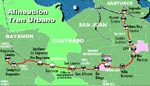  Expand Image Expand ImageMap of the Tren Urbano route. |
 Expand Image Expand ImageThe vehicles are built at Siemens’ Californian plant. | |
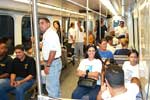 Expand Image Expand ImageThe interior of one of the Siemens built vechiles. | |
 Expand Image Expand ImageThe driving position with all controls in easy reach. | |
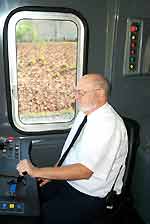 Expand Image Expand ImageThe driving position allows full forward and side views. |