Randstadrail, Netherlands


|
The Randstad is the name given to the densely populated western rim of the Netherlands, a conurbation that accommodates around two-thirds of the Dutch population. Randstadrail emerged from a long-envisaged scheme to connect the transport system of the country’s second city, Rotterdam, with that of Den Haag (The Hague), the seat of national government. This major project was to involve building new routes and taking over under-used former heavy rail lines, to develop a system that served the commuter population of surrounding satellite towns. However, the large number of authorities and interest groups meant that decision making was protracted, similarly with the limited compatibility of the infrastructure to be assimilated under the RandstadRail banner. 
THE PROJECT"Through modernisation and increased frequency, the objective is to greatly increase passenger numbers over levels experienced by the lines in pre-Randstadrail days."
Two NS (Nederlandse Spoorwegen – national rail operator) heavy rail lines were taken over for redevelopment as the principal RandstadRail routes. One connected the expanding new town of Zoetermeer with Den Haag, lightly used due to service frequency and inconvenient access for more recently developed areas. Zoetermeer itself also gained a new light rail line that encompassed more residential areas, creating a total 36km (22.5 mile) for the northern part of Randstadrail. The other route, the 32km (20 mile) Hofpleinlijn linked Den Haag and Rotterdam, joined by the Zoetermeer line for the entry into Den Haag. Through modernisation and increased frequency, the objective is to greatly increase passenger numbers over levels experienced by the lines in pre-Randstadrail days, four-fold for Zoetermeer and double for Den Haag-Rotterdam. Both routes have been equipped with a 750V d.c. overhead supply, although RandstadRail services also use 600V dc tram lines within Den Haag, so new vehicles are dual voltage. As with the nearby RijnGouwelijn light rail project, RandstadRail development has not been smooth, and more serious problems emerged with the start of passenger operations. Derailments on new infrastructure of Regio Citadis and HTM trams, some leading to injuries, in late 2006 attracted widespread coverage and criticism. Rover, a pressure group for the rights of Dutch public transport passengers, threatened legal action and called for the infrastructure to be transferred to national heavy rail operator Prorail. INFRASTRUCTUREDen Haag has undergone highly visible changes to accommodate Randstadrail and the city’s extensive tram service, notably at Centraal Station where a viaduct adjoining the bus interchange carries light rail tracks across the main terminus concourse. Linking directly with commercial properties and car parks, the Souterrain tram tunnel completed in 2004 takes R3, R4 and tram services south west under the city centre. In the opposite direction, the Netkous (net stocking) space-frame tubular viaduct through the business district includes the station at Beatrixlaan. Designed by Zwarts and Jansma, it provides a vital link in the system by taking lines onto the new high level at Centraal and a junction with tram routes at Ternoot. A Den Haag CS-Rotterdam Hofplein Randstadrail service began in 2006 with re-branded RET (Rotterdamse Elektrische Tram) metro stock. Passengers will enjoy better interchange with other transport modes in Rotterdam from 2008 upon completion of the 2.4 km (1.5 mile) twin-bore Statenweg tunnel linking the Hofpleinlijn and the Metro at Rotterdam Centraal. "Services on RandstadRail Lines 3 and 4 were restored in stages in September-October 2007."
The current Metro station is being modernised and gaining a third platform to accommodate the service extension. Once the link is operational, abandoned sections of the Hofpleinlijn are to be redeveloped for non-transport uses. To cope with the different types of rolling stock that will be used on the RandstadRail, some stations will be built with platforms to serve both low-floor and high-floor levels of entry. ROLLING STOCKTwo sizeable orders for new rolling stock were placed with two of the world’s manufacturing giants, Bombardier and Alstom. Although with common branding, the two main elements of RandstadRail will feature different stock, sharing only a small proportion of the system’s length. RET’s €83m Bombardier order is for 21 Flexity Swifts for use on the Rotterdam-Den Haag line, scheduled for delivery during 2008. For Den Haag-Zoetermeer services, HTM placed a €150m order with Alstom to supply 50 Regio Citadis three-car low-floor tram-trains for service from 2006. The air-conditioned vehicles have cabs at each end, capacity for up to 220 passengers, five doors each side and a passenger information system. As with the Flexity Swifts, they have a maximum speed of 80km/h (50mph). Within their own type, two units can be coupled for peak demand. Multi-purpose areas in all vehicles will help service the high level of cycle usage in the area. SIGNALLING AND COMMUNICATIONSTo avoid delays, several road intersections that cross the RandstadRail line have been closed to all traffic. A central traffic control centre oversees the operation of the entire system. Displays at all stops alert drivers as to the exact time trams should depart. All trams will stop at all stations, and uniform waiting times will be introduced. THE FUTUREFollowing investigations and test operations in the wake of the operational problems over the previous year, services on RandstadRail Lines 3 and 4 were restored in stages in September-October 2007. The Boortunnel was completed in February 2008 and is due to start services later in the year. Through services to Slinge metro station in southern Rotterdam, which features a park and ride site, are expected to start during 2009. The success of the concept may determine whether RandstadRail branding will expand or remain to serve only the south west part of the Randstad area. |
  Expand Image Expand ImageElevated platforms carry RandstadtRail and HTM tram services over the Den Haag Centraal concourse. |
 Expand Image Expand ImageNetkoos viaduct carries RandstadRail lines 3 and 4 through Den Haag’s business district. | |
 Expand Image Expand ImageA map of the RandstadRail system as it will be in 2008. | |
 Expand Image Expand ImageRandstadRail Den Haag-Zoetermeer public services were reinstated in autumn 2007. | |
 Expand Image Expand ImageTrack sharing: RandstadRail Line 3 service to Loosduinen terminus ahead of an HTM tram in central Den Haag. | |
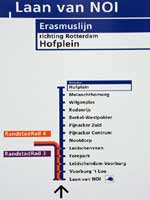 Expand Image Expand ImageThe former Hofpleinlijn now has RandstadRail Erasmuslijn branding in advance of incorporation with Rotterdam Metro's line of that name. | |
 Expand Image Expand ImageOn RandstadRail lines 3 and 4, Beatrixkwartier station is built into the Netkoos viaduct. | |
 Expand Image Expand ImageCompleted in 2008, the Boortunnel will connect RandstadRail with Rotterdam Metro. | |
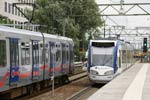 Expand Image Expand ImageWith low and high-floor vehicles in use, the shared section of Randstadrail has stations with twin-height platforms, as here at Laan van NOI. |