Nice Tramway, France


|
Set by the Mediterranean near the Italian border in south-east France, Nice is an ancient settlement that found international fame in the 19th century as a pioneering sunshine destination. Prior to the onset of modern mass tourism, a multi-line tramway system had ceased operation by the 1950s. The densely packed site sloping north towards the Maritime Alps has grown to become the country's fifth biggest city, the terminus for TGV rail services and location of the country's busiest airport outside Paris. 
THE PROJECT Following consideration of a light metro system and after substantial delays and controversy, and given the scale of the city's road traffic problems, Nice's modern tramway came relatively late in the resurgence of French light rail. Opening as Line 1 of a projected three in November 2007, the system's distinguishing technical feature is the use of batteries aboard the trams to avoid the necessity of erecting overhead line equipment (OHLE) on two sections of the route. This was felt necessary to protect the character of the distinctive Italianate architecture and also because of restrictions such structures would put in the way of Nice's carnival processions, both relevant to the area's substantial tourism industry. "The system's distinguishing technical feature is the use of batteries aboard the trams to avoid the necessity of erecting overhead line equipment."
With relatively short distances, a battery option was felt more appropriate than the alternative Alstom OHLE-free system, APS. As used in Bordeaux and due for future systems in Angers, Reims, Orléans and the Al Safooh tramway in Dubai, the more elaborate Alimentation Par le Sol/APS (ground-supply) format requires specialised equipment aboard the vehicles and also in the permanent way. There are sections of grassed tracks away from the city centre, and overall the Nice tramway project embodies a high degree of reworked space and road traffic exclusion, with large areas restricted to tram and pedestrian access. The European Investment Bank made a €150m loan for the project which had a total cost of approximately €560m, of which just over 70% related to creating the tramway. Areas of expenditure indicative of the demands of the setting included storm water drainage works (€25m), rebuilding of Place Massena (€13m), public lighting (€4m) and tree planting (€1m). INFRASTRUCTURE The 8.7km double-track 1,435mm gauge line, with two brief sections where tracks diverge through narrow streets, forms a 'U' configuration, the two arms largely serving demand in residential areas and institutions. The base is near the southern end of the main thoroughfare Avenue Jean Médecin and the two open spaces near the Old Town, Place Masséna and Place Garibaldi, respectively 440m and 470m sections without OHLE. These 'gaps' are joined by a 320m section with OHLE between Opéra-Vieille-Ville (pictured) and Cathédrale-Vieille-Ville stops where trams run conventionally. With the capacity for over twice the present fleet, the system's depot is at the Las Planas terminus on the line's westerly arm. Built on sloping ground, the complex makes use of the restricted site by a line spiralling over the entry tracks beyond the Las Planas stop to give access to the depot proper and a short test track. Located close to the A8 autoroute, Las Planas also incorporates a park-and-ride facility. ROLLING STOCK Resulting from a €57m order from authority Communauté de l'Agglomération de Nice Côte d'Azur (CANCA), the fleet is 20 Alstom Citadis type 302. The fully air-conditioned, 100% low-floor, modular five-unit double-ended trams could be extended in response to the high take-up of the service. Roof-mounted Ni-MH (nickel-metal hydride) traction batteries with an operational life of at least five years were supplied by Saft under a €2m contract. Giving trams a range of up to 1km at a maximum speed of 30km/h with air-conditioning in operation, the switching of power being either from the overhead line or the batteries is activated by the driver, with the pantograph fully lowered when running without OHLE. Each tram's driver console features visual and audio indications of the need to operate the power changeover sequence. The batteries recharge from the overhead supply while in conventional operation. There is no additional external infrastructure needed to operate the trams under battery power over the OHLE-free track. SIGNALLING AND COMMUNICATIONS Covered by a common ticketing system and operated by Veolia Transport, tram Line 1 is a constituent part of the primarily bus network, Ligne d'Azur. The approximate Line 1 end-to-end journey time is 30min. Tram stops have the usual features of Alstom systems such as ticketing and information equipment, with 'signature' aspects including tall metal 'T' markers at each stop and the use of stylised script. The control centre is at the depot, linked with trams and to the extensive network of video monitoring of the system. Benefiting from road traffic exclusions and priority at crossings, in this totally urban setting, trams can attain an average 18km/h, as opposed to 11km/h for buses. "The project aim is for over 60% of those resident in the metropolitan area and 150,000 jobs to be within 500m of a tram line."
THE FUTURE For completions projected between 2013 and 2020, the system's future is covered in Le Plan de Déplacements Urbains (PDU), CANCA's statement covering traffic management. Line 1 should be extended 4.5km north from the Pont Michel terminus to La Trinidad. Split into two parts, Line 2A will run from the Port de Nice, east of the Old Town, westwards to serve the Arénas business district and Nice Côte d'Azur Airport and generally an area in great need of improved public transport. Beyond there, 2B would continue along the coast to Cagnes sur Mer. Also to the west of the city and connecting with the future Line 2, Line 3 would head inland. The total system would approximate to 36km (22 miles). The project aim is for over 60% of those resident in the metropolitan area and 150,000 jobs (80% of the total) to be within 500m of a tram line. |
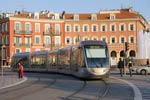  Expand Image Expand ImageThe Nice project is notable for the use of on-board battery power for operation without an external power supply: Place Masséna. |
 Expand Image Expand ImageAfter crossing Place Garibaldi, trams raise the pantograph at Cathédrale-Vieille-Ville for traction current and to re-charge batteries. | |
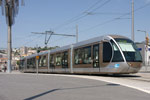 Expand Image Expand ImageLike most modern French tramways, Nice opted for the Alstom Citadis. | |
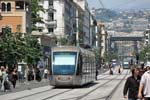 Expand Image Expand ImageWith landscaping and traffic restrictions, Avenue Jean Médecin is a main thoroughfare transformed by the tram project. | |
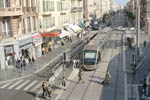 Expand Image Expand ImageA few hundred metres separate Nice-Ville SNCF station from the nearest tram stop, Gare Thiers. | |
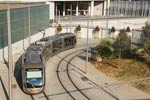 Expand Image Expand ImageCombining the Las Planas terminus and a park and ride, the depot complex uses a spiral track layout on a very restricted hillside site. | |
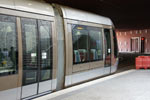 Expand Image Expand ImageAt Las Planas, trams continue towards the depot before setting back for the next southbound service. | |
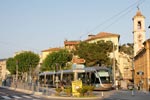 Expand Image Expand ImageThe line's eastern arm skirts the Old Town: trams join a brief overhead supply between Opéra-Vieille-Ville (pictured) and Cathédrale-Vieille-Ville. | |
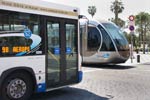 Expand Image Expand ImageThe projected line along the western sea front would greatly improve public transport to Nice Côte d'Azur Airport and the business district. |