N700 Shinkansen, Japan


|
Japan was the first user of high-speed railway lines, when it introduced Bullet Trains on the Tokaido Shinkansen line in 1964. Four decades later, the country has an exemplary network of standard gauge high-speed lines, and is now ready to introduce a new generation of trains to accelerate services. Initially, the new N700 Shinkansen will be used on the Tokaido Shinkansen – the very first high-speed line in Japan – increasing the maximum speed from 270km/h (168.5mph) to 300km/h (186mph) and thus reducing end-to-end journey times. Around 300 high-speed trains currently operate every day, carrying 130 million passengers. 
"The train has been designed with tilting mechanisms and advance aerodynamic features."
THE PROJECTThe N700 project was launched in 2002 when the Komaki research centre opened. It combines the best practise from previous high-speed trains and the latest technology to deliver a highly sophisticated train. The first pre-production N700 series train was ordered in July 2003 by JR Central and completed for a public launch in March 2005. The train has been designed with tilting mechanisms and advance aerodynamic features to increase its energy efficiency and maximum speeds whilst reducing journey times on the Tokaido Shinkansen. Following completion of a full testing programme, the aim is to commence commercial operation in 2007. INFRASTRUCTUREThe infrastructure of the Shinkansen routes already allows for a maximum speed of 270km/h (168.5mph) following upgrading from a 210km/h (131 mph) route. However, the 2,500m curves spread along the route still have speed restrictions of 250km/h (156mph), which reflects the limit of the infrastructure. In order to increase speeds still further, new technology has been designed and built into the first pre-production N700 tilting train for the Tokaido Shinkansen. New tilting mechanisms allow the new trains to pass through 2,500m radius curves at 270km/h and run at a maximum speed of 300km/h on selected routes. ROLLING STOCKThe 16 car N700 is the combination of experience in high-speed rail travel and the latest technology. Primarily based on the earlier 700 series trains, the greatest advance is in the body tilting system. It uses air springs in con-junction with a new form of Automatic Train Control (ATC) to allow trains to pass through 2,500m radius curves at 270km/h – 20km/h faster than permitted with conventional high-speed trains. Acceleration has been improved too. The N700 benefits from a 30% increase in acceleration performance and now meets the acceleration standards of commuter trains – at 2.6km/h/s – reducing the amount of time needed to reach maximum speed. In service the trains will be permitted to travel at a maximum speed of 270km/h on the Tokaido Shinkansen and 300km/h on the Sanyo Shinkansen. "The amount of noise created by the N700 has also been reduced for both passengers and the surroundings."
Improvements in ride quality have also been achieved, firstly by installing a new high-performance semi-active suspension system, as well as continuing the use of non-linear air springs and dampers between cars. The amount of noise created by the N700 has also been reduced for both passengers and the surroundings. To do this, the double skin structure has been enlarged and a new type of hood that covers the entire space between cars has been added to reduce external noise. Flooring materials too have been selected to suppress sound, together with low noise electrical and drive systems. Outside, as well as the hoods between cars, the bogies have been covered by skirts and a new design of low noise pantograph has been fitted. The design of the N700 front has been specially considered to produce the most aerodynamic shape. Known as the ‘Aero Double Wing’ it has been developed using airplane technology for the first time in a railway application, for optimum aerodynamic performance at 300km/h. SIGNALLING AND COMMUNICATIONSSignalling is largely fixed block, although with such high line speeds, sections are much longer than is standard elsewhere. A regular clock-face departure pattern for most services helps maintain a high level of reliability, but in the event of emergencies, train crews are in constant contact with their nearest control centre. Information systems on newer variants of Shinkansen trains are proving far more reliable than previously, thanks to their use of much shorter cable lengths. The new N700 trains include additional ATC systems to operate the body tilting mechanism. THE FUTUREThe N700 represents a significant development in high speed rail travel. Their reduced energy consumption, greater acceleration, improved aerodynamics and state-of-the-art body tilting mechanism make this the most advance rail product to be built in Japan. Following completion of testing revenue earning services with the N700 series, trains are expected to start in 2007, with full operation in 2009. |
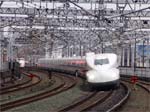  Expand Image Expand ImageThe N700 is the latest development in Japanese high-speed trains. |
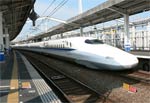 Expand Image Expand ImageThe front of the N700 has been designed using airplane technology to produce a dynamic and highly aerodynamic nose. | |
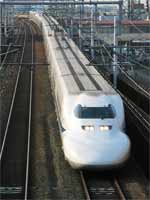 Expand Image Expand ImageThe N700 is based on the earlier 700 series trains. The main differences are the nose design, bogie skirts and lighting position. | |
 Expand Image Expand ImageOlder ‘Bullet Trains’ are where the grass roots of the N700 lie. |