Mumbai Metro, India


|
Overstretched rail and road networks have created an urgent need for a suitable high-capacity transport system within the Indian city of Mumbai, formerly known as Bombay. The existing suburban railway network, which is not designed for mass transit, has to cope with those travelling into the city every day. In the 1950s, Mumbai enjoyed an extensive public transport system, with trams, rail and bus services adequately coping with demand. 
In recent times, however, commuter transport has become hazardous with severe overcrowding and the greater resort to road use. Even with the need for a rethink, around 80% of journeys in Mumbai are made using public transport, mainly by train and bus, and the closure of the tramway in the 1960s is now seen as a major planning error. There are 26 cities in India proposing to build high-capacity metro systems, and Mumbai is the latest to reach the construction stage. The project The Mumbai Metropolitan Region Development Authority (MMRDA) planned the Mumbai Metro to be a 146.5km rail-based mass rapid transit system. The project's master plan execution has been planned in three phases. Phase I covers a total length of 62.68km. It includes the 11.07km Versova-Andheri-Ghatkopar route, the 38.24km Colaba-Bandra-Charkop route and the 13.37km Bandra-Kurla-Mankhurd route. "Around 80% of journeys in Mumbai are made using public transport, mainly by train and bus."
Phase II has been planned to cover the 7.5km Charkop-Dahisar route and the 12.4km Ghatkopar-Mulund route. Phase II will be executed in 2011-2016. Phase III will include the development of the 19.5km BKC-Kanjur Marg via Airport route, the 18km Andheri East-Dahisar East route, the 21.8km Hutatma Chowk-Ghatkopar route and the 3.5km Sewri–Prabhadevi route. Phase III will be executed in 2016–2021. In June 2006, Prime Minister Dr Manmohan Singh laid the first stone for the first phase of of the Mumbai Metro, which comprises a three line high-capacity metro system spanning 63km. When it opens, the new system will slash journey times on the 11km east-west corridor from 90 minutes to just 21, crossing densely populated areas and major industrial locations. The first line (Phase I) connecting the regions Versova, Andheri and Ghatkopar (VAG) is under construction. Reliance Industrial Infrastructure Limited (RIIL), formerly Reliance Energy (REL), as part of a consortium involving European rail operator Connex, the Mumbai Metropolitan Regional Development Authority, Hong Kong's MTR and France's Veolia Transport, won the build-own-operate-transfer contract for this route at a fee of Rs23.6bn ($524m). This will see the consortium manage the first three metro lines for 35 years before transfer to a new operator. The Indian Government is funding INR6,500m in viability gap funding. A special purpose vehicle, Mumbai Metro One Pvt Ltd, was created by RIIL for implementing Phase I. Phase II, which will connect Charkop, Bandra and Mankhurd, has been awarded to the consortium made up of RIIL, SNC Lavolin Inc, Canada and Reliance Communication. The contract, in which the consortium was the only bidder, was awarded in August 2009, at a fee of INR110bn (approximately $2.3bn). RIIL expects the Phase II route to be operational by 2015, although the execution plan indicates project completion for 2016. The third metro line (Phase III) is still underway and consists of two elevated and 14 underground stations. In February 2009, plans were made to construct shopping complexes, and the MMRDA called for investment for these plans. Infrastructure The first 11km route of the Mumbai metro will run east-west through the city between Versova and Ghatkoper, with 12 stations, and entirely on an elevated formation. With such freedom and the capacity to handle 60,000 passengers per hour, it will cut journey times through the densely populated areas. "When it opens, the new system will slash journey times on the 11km east-west corridor from 90 minutes to just 21."
Construction of Line 1 was due to start in late 2006, but financial issues surrounding the granting of viability gap funding delayed the progress from November 2006. Construction finally began in February 2008. In June 2009, a construction control room was set up for the VAG corridor. RIIL aims to complete the construction in three years, and expects to open the line in 2011. However, the first route is far from the end of the plans. A second phase will aim for two further lines reaching a total of 63km, but the ultimate plan is for a network spanning 146.5km. This could cost Rs195bn, and include 114km of elevated running plus 32.5km of underground operation. In line with the Railway Ministry's standards, the Mumbai Metro will be built using the standard broad gauge of Indian Railways – 1,676mm gauge – throughout. The system will have a major effect on the prosperity of Mumbai. Even though major ground works have not commenced yet, there is already speculation that property prices along the metro routes will rise significantly over the coming years. Rolling stock RIIL consulted major rolling stock builders to provide the new train fleet for Mumbai Metro. CSR Nanjing China was chosen as the supplier of rolling stock. Kawasaki (Japan), Alstom (France), Siemens (Germany) and Bombardier were all on the list of potential train builders, having produced vehicles for metro systems around the world. For passenger comfort, the trains will feature air-conditioning, and the aim is to develop trains capable of carrying up to 1,500 passengers in a four-car unit. With the input of the Delhi Metro Corporation and Hong Kong MRT, the new trains are likely to follow similar standards to those already in operation in those cities. A fleet of 18 locomotives from CSR Nanjing Puzhen Rolling Stock will be delivered in 2010. The trains will be supplied as part of a $100m contract signed by CSR in May 2008. These will be the first domestically produced Chinese trains delivered to India. Signalling and communications Mumbai Metro will feature the latest signalling technology, including automatic train protection (ATP) and automated signalling to control the high-volume of train movements on the 11km route. A four-minute interval service is anticipated on the route. Siemens will supply the signalling systems required for the project, while Thales will supply the required communication systems. "Ambitious plans are in place to establish the system into a nine-line network by 2021."
Environment The project is focusing on the development of an environmentally friendly system to become Asia's first Green Metro right from the construction stage. A detailed environmental impact assessment and feasibility study to certify the project for LEED have been undertaken. The future Even though work is only just starting on the first line of the Mumbai Metro, ambitious plans are in place to establish the system into a nine-line network by 2021. Three phases of development are expected, with the first line opening in 2011, further routes in 2016, and completion coming five years later. |
  Expand Image Expand ImageHigh-frequency rapid transport is coming to Mumbai. A 146.5km network of metro lines is planned. |
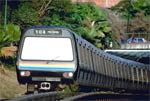 Expand Image Expand ImageRolling stock builders from around the globe may tender to build the new metro trains. This is an Alstom product. | |
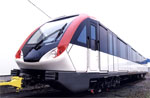 Expand Image Expand ImageMumbai is one of 26 Indian cities currently proposing to build metro railway networks following the experiences of Delhi. |

Related links
Mumbai Metro to Receive Chinese Trains