Marmaray Railway Engineering Project, Istanbul, Turkey


|
Modern civic life is the aim of one of Turkey's greatest railway engineering projects ever undertaken. The city of Istanbul, like so many others, is being crippled by heavy road traffic, pollution and limited high-capacity transport systems. The Marmaray Project will help resolve many of the city's issues by providing a rail link beneath the Istanbul Strait. It is primarily aimed at bringing great benefits to the major city, both in terms of cutting pollution – by reducing the need to use private cars – and also relying on its own electrical power generation resources rather than imported fuels. 
It is anticipated that the Marmaray Project will generally aid the development of the railway system in Turkey, a country which is completing its first high-speed railway line linking the capital city Ankara with Istanbul – ultimately reducing journey times by more than three hours between these two major population centres. Construction work of the project was scheduled to be completed in April 2009, but this was revised to 2010. The Marmaray Rail Tube Tunnel and Commuter Rail Mass Transit System will be opened in October 2011. The projectAround 12 million people travel into and through the city of Istanbul everyday and the Marmaray Project will provide mass transit for the city's population. A 76.3km (48 mile) high-capacity metro style railway will connect Europe and Asia by crossing the Istanbul Strait. The project includes upgrading 63km (40 miles) of suburban railway, and purchasing new rolling stock to provide the service. "It is anticipated that the Marmaray Project will generally aid the development of the railway system in Turkey."
Following more than a decade of studies, a funding agreement was struck in 1999 between the Republic of Turkey and the Japanese Bank for International Cooperation. This brought together 35% of the total project funding and allowed the underwater tunnel to be constructed. The total project cost was estimated at $4.1bn. There are four main components of the Marmaray Project: the underwater railway tunnel, improvement of the Gebze-Haydarpasa and Sirkeci-Halkali suburban railway lines, electrical and mechanical works, and the procurement of new rolling stock. The entire project is supervised by State Railroads, while the Ports and Airports Administration is overseeing the project. The construction contract has been assigned to a Japanese-Turkish consortium led by Taisei. The firms in the consortium include Kumagai Gumi of Japan, Gama Endustri Tesisleri Imalat ve Montaj and Nurol Construction and Trade of Turkey. The project is being financed by the Japan Bank for International Cooperation (JBIC) and the European Investment Bank (EIB). JBIC has lent $950m under a long-term low-cost loan while EIB provided a €650bn soft loan. InfrastructureThe Marmaray Project requires the construction of a tunnel under the Istanbul Strait. The idea was first mooted in 1860 but the depth of the water negated using traditional seabed, or below, tunnelling methods. The tunnel will be the deepest immersed structure in the world, 55m below sea level. Its length is 13.6km (8.5 miles) long with 9.8km of bored tunnel, 2.4km built using cut-and-cover methods and the remaining 1.4km as a tube tunnel. The tube tunnel will carry two running lines separated by a dividing wall, pre-cast in lengths of around 100m before being towed into place across the sea and dropped into place for joining together and dewatering. This process causes the water pressure at the other end of the section to compress a rubber sealing gasket, making the joint water tight. Foundations are below each section once they are lowered into place, replacing temporary foundations. The immersed tunnel is connected to the shore by tunnels bored using tunnel boring machines (TBMs) to produce separate bores for each running line, with connections at frequent intervals for emergency use. The scheme also requires the upgrading of 63km of existing suburban railway lines, rebuilding 37 stations and building three new ones. Platforms are 225m long, the equivalent of 10 carriage lengths. The stations will be based on metro style operations but will also be served by heavy rail trains capable of travelling at 100km/h (60mph) with an average speed between stations of 45km/h (28mph). On completion, the Marmaray Project will provide an east-west transport corridor with a connection at Yenkapi to the north-south metro line, also currently under construction. Rolling stockThe Ministry of Railways is planning to invest in rolling stock to meet the increased demands – 280 vehicles for the commencement of operations, followed by a further 40 in 2010 and 120 in 2011. "Forecasts estimate that by 2015 1.5 million trips per day will be made on the new route."
The new trains will have a maximum design speed of 100km/h (60mph) – the design speed of the railway – and are aimed at meeting an average speed between stations of 45km/h. Signalling and communicationsSignalling and communications will form an important part of the new route to meet the demands of safely transporting 75,000 passengers per hour in the future with intensive operations. The futureThe Ministry of Railways has a target of 2009 for the first revenue trains to use the tunnel. Forecasts estimate that by 2015 1.5 million trips per day will be made on the new route, rising to 1.7 million by 2025. Travel times will also be greatly reduced for the people of Istanbul. In the opening year, travel time savings are expected to be 13 million hours and by 2015 that will increase to a saving of 25 million. Istanbul's railway network currently caters for just 3.6% of all journeys in the city. It is aimed that following opening of the new rail link the city will come into line with other major cities with railway transport, accommodating 28% of all passenger journeys – similar to London and New York. |
  Expand Image Expand ImageThe Marmaray Project includes the world's deepest immersed tube tunnel. This is a section of tunnel being floated into position for the Oresund link in Denmark – similar processes are being used in Istanbul. |
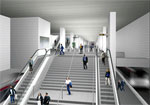 Expand Image Expand ImageThe high-capacity commuter route will have 37 rebuilt stations, all with a modern feel. | |
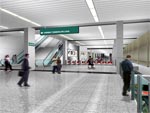 Expand Image Expand ImageStations are being rebuilt in metro style to meet the needs of a high-capacity transit system. | |
 Expand Image Expand ImageThree new stations are being built as part of the project. | |
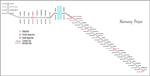 Expand Image Expand ImageThe route of the new east-west corridor, showing the Istanbul Strait which will be crossed by a new 13.6km tunnel. |

Related links
Istanbul Marmaray Tunnel to Open in 2011