Madrid Light Rail System, Spain


|
Most major European cities, particularly those in France, have been active in building light rail systems. However, Madrid has lagged behind, concentrating instead on extending its metro network to reach a large part of its population. Madrid has now embraced the concept by constructing its own three-line light rail system, copying the style of other Spanish cities such as Barcelona. The tramcar is far from an original idea in Madrid – the first line was built in 1898, but by 1967 the entire system had been dismantled to make way for road traffic and expansion of the metro. 
New developments on the edge of Madrid have been a secondary catalyst in pushing the need for light rail transport in the sprawling city. There are now high ambitions for the system, which is expected to convey 50% of residents from the new areas into the city. "There are now high ambitions for the system, which is expected to convey 50% of residents from the new areas into the city."
THE PROJECTThe Madrid LRT system will initially consist of three routes – T1-T3. These have been chosen in preference to introducing new bus services, as there is a feeling that a high quality public transport system is needed in order to appeal to the residents who will use it. Construction began on the 5.4km T1 – the Sanchinarro Line – from Pinar de Charmartin metro station in northern Madrid to Las Tablas in 2004, with a planned opening in April 2007. The other two lines are being marketed jointly as Metro West. They are the 8.7km T2 (Pozuelo de Alarcon Line) and 13.7km T3 (Boadilla del Monte Line). Together, the two lines will serve 90,000 people and are being operated on a 30-year concession to a consortium of companies including OHL and Transdev. This second pair of lines has the same opening date as T1. INFRASTRUCTUREThe first phase of T1 has 3.7km running underground, to allow trams to run at higher speeds than on ground level routes segregated from road traffic. The maximum gradient is 6%, and the minimum curve radius is 35m. Tunnels have been built using the cut-and-cover method to keep costs down, and also to provide greater flexibility in station locations. The total cost for T1, €262.25m, includes the provision of new Alstom-built rolling stock. Line T1 has nine stations, five underground – including the terminus at Pinar de Charmartin – and four at ground level. T2 is by far the cheapest of the three routes being constructed, at a total of just €151m. When open it will serve 60,000 people at 13 stations. About 30% of the route is being built in tunnels. T3 is the longest route with 14 stations. It runs on the surface for 90% of its route, through new housing developments that are sprouting in Madrid. The total cost of T3 is €210m. ROLLING STOCKA fleet of 70 Alstom Citadis light rail vehicles (LRVs) has been ordered for the Madrid system at a cost of €144.6m, all to arrive by June 2007. The units are formed of five sections and are low-floor throughout. They have a maximum speed of 70km/h, use three phase traction motors, and have both regenerative and rheostatic brakes to bring them to a safe halt. GPS equipment is fitted to enable a central control centre to monitor progress and also maintain headways. LRVs on Line T1 will be equipped with Automatic Train Protection. For passenger comfort, they will be air-conditioned. SIGNALLING AND COMMUNICATIONSAs well as being chosen to supply rolling stock for Madrid's light rail network, Alstom won the €56m contract to install signalling equipment and maintain it for three years. The agreement covers all three lines of the system. T1 will have ATP on the underground section, but the rest of the network will operate on line-of-sight, with a traffic officer monitoring headways from the control centre. "By the end of 2007 three light rail routes will be operational."
To aid monitoring of the LRVs, all vehicles will be fitted with GPS, and there will be trackside receivers communicating with the control centre to determine the exact position of any vehicle at any given time. Priority will be given to trams at road junctions. Passengers will have information displays and indicators to ensure they know which side to alight at each stop. CCTV cameras will also be installed for safety and monitoring. THE FUTUREThe short-term future of Madrid's light rail system is clear. By the end of 2007 three light rail routes will be operational, providing connections between the end of the extensive metro network and the developing satellite towns that are being built on the edge of the Spanish city. If developments continue, it is likely that the system will also benefit from growth. However, the key is to provide an attractive passenger experience that will make future expansion easier to develop. |
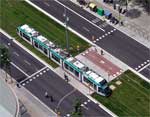  Expand Image Expand ImageMadrid is now following the example of other European cities by building a new light rail system. |
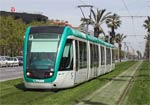 Expand Image Expand ImageMadrid will use five-section Alstom Citadis cars, similar to these in use in Barcelona. | |
 Expand Image Expand ImageA large part of T1 of the Madrid LRT will be underground, but the rest of the system will be at grade segregated from road traffic. | |
 Expand Image Expand ImageTo make sure everything works first time, a five month trial period is planned on the three-line system. |