Lyon Light Rail System, France


|
Ranging from hired bicycles to a rack-assisted metro and shortly to add a tram-train operation, the city of Lyon has an abnormally wide mix of public transport modes. The second-largest French city in terms of area, it underwent marked population increases in the late 20th century, now home to 470,000, with around a million more in the metropolitan area. 
It is served by transport body Le SYTRAL (Syndicat Mixte des Transports pour le Rhône et l'Agglomération Lyonnaise), the services operated by Keolis under the title Transports en Commun Lyonnais (TCL). THE PROJECT One of the early systems in the modern French tramway revival, Lyon opened its first two lines (T1 and T2) opened in early 2001, the last of the previous tram network having closed in 1956. By the start of the new century, Lyon's size and shape as a community had changed significantly, notably with the Part Dieu redevelopment scheme around the new SNCF station, retail and business area, effectively creating another city centre. This was sufficiently distant from older focal points (the left bank of the Rhône; the Presqu'île peninsular which includes Perrache, the original principal SNCF station; and immediately west of the Saône) for public transport to be reconsidered for its coverage and capacity. Although SNCF Part Dieu and Perrache had connecting services, these could not meet local travel needs. In a bold move based upon prevailing demands and expected long-term population increases, a mainly rubber-tyred metro system opened in 1978 that has since grown to four lines, incorporating a pre-existing rack section on Line C. The light rail project was in part a response to population rises not being as extreme as earlier thought. Expanding the increasingly costly metro seemed a less appealing option than surface-running trams, by then again becoming re-established nationally as a modern and effective mode. INFRASTRUCTURE T1 and T2 were largely new alignments through the streets with mainly reserved tracks, with T1 specifically filling the role of linking Part Dieu with more established parts of the city. Opened in 2006 and terminating at Part Dieu (but separate from T1), T3 largely used a former heavy rail route, retaining protected road crossings and with track on ballasted sleepers. "The entire fleet is made up of five-module Alstom Citadis 302 100% bi-directional low-floor units. Their distinctive nose ends are unique to Lyon."
Two depots handle maintenance; near Porte des Alpes for T1/T2 and at Meyzieu for T3. There are 17 TCL total park and ride sites, of which nine are at tram stops. All lines are 1,435mm double track, with low platform access. As with the stock, Alstom was principal supplier of infrastructure. But for the T1/T2 section to the SNCF Perrache interchange and the southern end of T1, the light rail network is all east of the Rhône, with the west and the historic centre largely served by buses, trolley buses and three metro lines. As has become the norm on French systems, lines are configured to serve major traffic generators such as universities, industrial zones, heavy rail stations and hospitals. ROLLING STOCK The entire fleet is made up of five-module Alstom Citadis 302 100% bi-directional low-floor units. Delivered in several batches and with more on order, with the exception of two commemorative liveried sets, they are finished in all-over white with simple graphics based upon features of the city skyline. Their distinctive nose ends are unique to Lyon, setting a pattern for other operators who sought to have their vehicles styled specific to their setting. It was a small supplementary order by Lyon (already the world's largest Citadis operator) in 2007 that pushed the order total for the type past the 1,000 mark. In addition to metro and light rail, Lyon public transport features 113 bus routes, seven trolley bus lines, two funiculars, some SNCF local services and a cycle hire system operating from 250 points. SIGNALLING/COMMUNICATIONS Installed as an integrated part of the Alstom infrastructure, tram signalling interlocks with road signals. Passenger information is provided on-board vehicles and on real-time indicators at stops. "Track sharing by the two vehicle types on different schedules will be made possible by passing loops."
THE FUTURE A short extension opened in October 2007 on metro Line A, prefacing the 2009 start of services under the LESLYS express tram project. An 8.5km extension between the T3 terminus at Meyzieu Z.I. and Lyon Saint Exupéry Airport will create a 23km line to Part Dieu on which the Rhônexpress consortium will use six new 100km/h part low-floor Stadler Tango tram-trains. Track sharing by the two vehicle types on different schedules will be made possible by passing loops, including at the only two intermediates stops for Rhônexpress, Vaulx-en-Velin La Soie (the Line A metro connection) and Meyzieu Z.I. The first 10km section of the new T4 line is under construction and due to open in April 2009, from T2 south from Jet d'eau MendГЁs France along Boulevard des États-Unis. Taking in Gare de Vénissieux on metro line D, T4's projected southern terminus will be Cliniques Feyzin. A northern extension may be added that will join the line to the system's hub at Part-Dieu and to the metro/T2 interchange at Charpennes. |
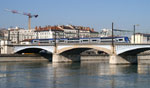  Expand Image Expand ImageA focal point of SNCF operations, limited local services could not match Lyon's growing demands for local transport. |
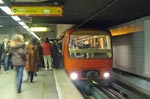 Expand Image Expand ImageLyon's metro predated the light rail network: the automatic Line D at Bellecour. | |
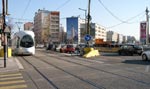
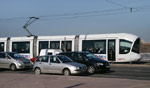 Expand Image Expand ImageTo avoid delays in Lyon's notorious traffic, much of the network has reserved running. | |
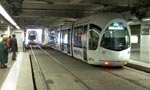 Expand Image Expand ImageT1 linked SNCF's new main station, Part Dieu, with the earlier one at Perrache (pictured), also a metro terminus. | |
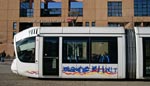 Expand Image Expand ImageAs well as for T3, Part Dieu will become the terminus for the Rhô nexpress tram-train service to the airport. | |
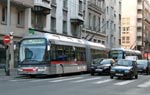 Expand Image Expand ImageOf intermediate capacity between buses and light rail, Lyon's trolley buses are prone to going off-schedule in traffic jams. | |
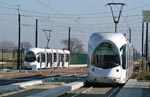 Expand Image Expand ImageCentral tracks at some stops will allow Rhô nexpress services to pass T3 trams on the shared line. | |
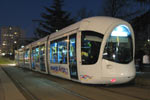 Expand Image Expand ImageGrange Blanche is one of several large mode interchanges outside of the city centre. | |
 Expand Image Expand ImageWork in progress at Jet d'eau on the new T4 line (to right) due to open in 2009. |