Karachi Circular Railway Revival, Pakistan


|
The Karachi Circular Railway revival project includes the transformation of the old Karachi Circular Railway (KCR) into a mass transit system. The total length of the railway line is expected to be 50km and will cost about $1.58bn. Opened in 1964, the route of the old KCR started from Drigh Road and ended in Karachi. The railway ceased operations in 1999 after it suffered huge losses. In 2005, however, revival plans for the railway were initiated to fulfil the growing transportation needs of Karachi. 
Karachi is among the biggest cities in the world with a steadily growing population. It is estimated that the city's population will increase from 18 million in 2009 to 27.5 million in 2020. The projected population growth generates the need for an efficient mass transportation system. In May 2008, a semi-autonomous entity, the Karachi Urban Transport Corporation (KUTC), was incorporated to execute the project. Work on the project is scheduled to start in 2010 and will be completed by 2014. Following revival, the KCR will serve about 700,000 passengers per day. "The total length of the railway line is expected to be 50km and will cost about $1.58bn."
The execution of the project, however, is facing a few hurdles in land acquisition. Several households have been illegally living along the right of way of the proposed KCR. A resettlement action plan study was proposed to identify and provide land for the people affected by the project. Following completion of the study, the land needed for the project was to be transferred to the KUTC. The resettlement study, however, has not been completed, and therefore, the project can not yet begin. Karachi circular railway (KCR) revival project A feasibility study for the revival of the KCR was conducted by Japan External Trade Organisation (JETRO) in 2006. UK-based Scott Wilson Railways was appointed to validate the report prepared by JETRO. Japan International Co-operation Agency (JICA), which is funding the project, sponsored a final study prepared by Special Assistance for Project Formulation (SAPROF). US-based consultants Louis Berger validated the final report. "Karachi is among the biggest cities in the world with a steadily growing population."
The study prepared by JETRO recommended that the project should be executed in two phases. Phase I of the project will include a 28.3km circular section from Karachi Cantt to a proposed station at Gulistan-e-Johar. About 9km of this section will be elevated. Phase II will consist of the 14.8km circular section from Gulistan-e-Johar to the proposed station at Liaquatabad. This section will have two dedicated tracks along the main line. Phase II also includes a 5.9km airport line from Drigh Road to Jinnah Airport. This extension will either have an elevated or underground track. Other bridges, culverts and underpasses, wherever necessary, will be constructed for the project. Japan International Co-operation Agency (JICA) is providing the entire funding for the project through a soft loan. The loan is payable in 40 years by the stakeholders of the City District Government Karachi, Pakistan Railways and Government of Sindh (KUTC). The KUTC is planning an international tendering process for the project, which will be awarded on a turnkey basis. The winning contractors will operate it for the first two years of operation. KCR line routes The modernised KCR will follow a circular path, covering Karachi Cantt, Karachi city, Wazir mansion, Liaquatabad, Depot Hill, Drigh Road and Departure Yard. The extension towards the airport will start from Drigh Road and follow the path of the Pakistan Railways towards the airport. KCR infrastructure "About 23 stations are planned for the project."
The project will include the construction of 19 underpasses and three overhead bridges. About 23 stations are planned for the project. The stations will feature computerised ticketing and vending machines, automated ticket gates and elevators. The existing KCR has about 22 level crossings. Since the railway line passes through the major commercial areas of the city, these level crossings need to be removed to ensure that trains can operate at the proposed 6min headway. The level crossings are expected to be removed and replaced by underpasses or overpasses. Rolling stock The new KCR will be served by electric multiple units (EMU) with a capacity to carry 1,400 passengers. The maximum speed of the EMUs will be 100km/h. About 290 trains are expected to operate daily at a six-minute headway. KCR signalling and communications The project will feature modern signalling and telecommunication system. An automatic train control (ATC) system will also be set up for the railway. |
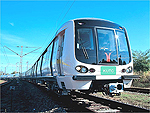  Expand Image Expand ImageA model of the train to be used for the KCR. |
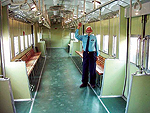 Expand Image Expand ImageThe old KCR operated until the late 1990s. | |
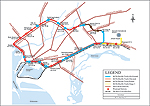 Expand Image Expand ImageThe route map of the KCR. | |
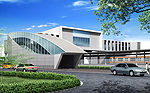 Expand Image Expand ImageA proposed station at Shaheed-e-Millat. | |
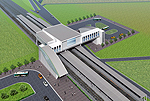 Expand Image Expand ImageAll the proposed stations of the KCR will have a design similar to the Shaheed-e-Millat station, with modifications depending on the elevation of the station. |