Hudson Rail Tunnels – New Jersey/New York, USA


|
For almost a century, one two-track rail route has provided a connection for local and long-distance trains across the Hudson River, which lies between New York City and New Jersey. Having reached maximum capacity, it has become a major problem for the region which includes the nation's prime financial centre. Completed in 1909, the now Amtrak-owned twin-bore North River Tunnels are used by both Amtrak and New Jersey Transit, carrying up to 45,000 passengers during each peak with a 2–3 minute headway. The need for more capacity on the entire commuter rail system from west of the Hudson River and midtown Manhattan comes from a sharp rise in traffic: between 1994 and 2004, peak time trains increased from 88 to 186. 
According to the New York Times (28/01/07), "the need for the tunnel is enormous" and cites the reliance of city enterprises upon commuters from west of the Hudson as growing year-on-year. In spite of expanding capacity with higher capacity stock and more services, the ceiling imposed by present infrastructure seems to have been reached. The solution identified is a second tunnel to double capacity and end the all-or-nothing reliance on just the one tunnel beneath the Hudson. The projectThe third-largest US public transport provider by passenger numbers, New Jersey Transit (NJ Transit) is at the centre of the Trans-Hudson Express (THE) tunnel project, as it is running out of station and tunnel capacity to reach New York Penn Station. This location has reached its peak capacity with 42,500 passengers passing through during the morning peak period. Indicative of success but further squeezing capacity, in the 2007 financial year, NJ Transit reported a 6.1% increase in rail ridership across the network, reaching 78.5 million passenger trips. Employment is expected to grow from the current 2.7 million to 3 million in the centre of Manhattan, while in the wider area surrounding the Hudson employment is estimated to grow from 9.6 million to almost 11 million by 2025. The first funding for a second tunnel under the Hudson River was announced in 2006, and the total cost of the project has been estimated at $7.2bn. The proposed tunnel would more than double the number of trains reaching Manhattan during the morning rush hour, while also reducing journey times and pollution. "Upon completion of THE, the new tunnel is expected to meet the demands placed on NJ Transit for at least the next 20 years."
The NJ Transit-led project received financial backing worth $2bn from the Port Authority of New York and New Jersey, which will be provided in two instalments. New Jersey Transportation Trust Fund has also committed $5m towards the initial engineering phases of THE. Complementing the new twin-bore that will take a curving alignment south of the North River Tunnels into Manhattan, a new interchange will also be built at 34th Street in Manhattan to relieve pressure on New York City's Penn Station, which is failing to meet passenger expectations. Running from North Bergen, under Union City and Hoboken to reach 34th Street, the tunnel is expected to be about 15km (9.4 miles) long. NJ Transit's 1,435mm gauge network is a combination of non-electrified and overhead supply routes. The project extends beyond building the tunnel and station. Additional capacity will be provided on Amtrak's Northeast corridor and there will be connections to rail lines serving Rockland, Orange, Bergen and Passaic amongst other counties to provide greater continuity in journeys. Upon completion of THE, the new tunnel is expected to meet the demands placed on NJ Transit for at least the next 20 years. Rolling stockNJ Transit operates 11 heavy rail commuter routes in the New Jersey, New York and Philadelphia region. To accommodate the second river crossing, an order for new rolling stock is expected when the project passes the preliminary engineering and public hearing stages. In August 2008 Bombardier Transportation announced that a contract valued at around €178m ($262m) had been signed for 26 dual-supply locomotives to NJ Transit. "Double-deck stock was introduced on the Northeast Corridor in December 2006."
Fitted with a diesel engine, thereby able to work over electrified and non-electrified parts of the system, the type will allow through working on the system into Manhattan. The order contains an option for an additional 63 locomotives. A development of the Adtranz DB Class 101-based ALP-46 electric locomotive that has been in service with NJ Transit since 2002, the new type is also on order with AMT of Montreal. Artist impressions indicate a single-ended design. Manufacture will be at Bombardier plants in Germany and Poland, with deliveries due from 2011. Bombardier is also a supplier of passenger coaching stock to NJ Transit. Double-deck stock was introduced on the Northeast Corridor in December 2006; deliveries continued until 2009. Signalling and communicationsSignalling will follow a similar pattern to that already in use in the area, using multiple aspect signals to control train movements from a control centre. The specification is awaited as to what safety systems will be present in the tunnel. The future"Cost estimates for the project had reached $7.6bn by 2008."
THE, now also known as Access to the Region's Core (ARC), is acknowledged as the country's biggest public transport infrastructure project. Cost estimates for the project had reached $7.6bn by 2008. Construction of all the new work and issue of new contract bids of the rail tunnel have been halted by the state of New Jersey, as the project went over budget in September 2010. The work in progress includes a track subway in North Bergen, and a tunnel section beneath the Palisades will be permitted to proceed even during the suspension. Completion of the project is now expected in late 2018. |
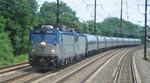  Expand Image Expand ImageThe new Hudson River rail tunnel will be used by both NJ Transit commuter trains and Amtrak services off the Northeast Corridor. |
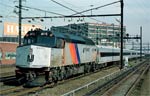 Expand Image Expand ImageA mixture of diesel and electric powered services are currently in service. New dual-power trains are expected to enter service when the new tunnel opens in 2018. | |
 Expand Image Expand ImageNew York Penn Station has reached capacity. As part of the project a new station will be built next to it at 34th Street in Manhattan. | |
 Expand Image Expand ImageCommuters form the bulk of the passengers using NJ Transit services to cross the Hudson River to reach their place of work. The new tunnel will shorten their journeys and reduce overcrowding. | |
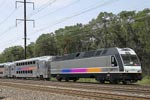 Expand Image Expand ImageArtist's impression of the new Bombardier diesel-electric hybrid loco as ordered by NJ Transit in August 2008. |