Hamburg S-Bahn, Germany


|
Germany's second-largest city, the city-state of Hamburg (Freie und Hansestadt Hamburg) is the country's leading port and a commercial, manufacturing and media centre. About 100km (62 miles) from the open sea, the Hamburg conurbation spreads along, and extends north and south of, both sides of the Elbe. Hamburg has a residential population of about 1.7 million. 
For much of the second half of the 20th century in close proximity to the border with East Germany, the city has gradually restored its eastern hinterland and transport links following reunification in 1990. The Hamburg S-Bahn railway network covers 147km in Hamburg and surrounding regions. It has six lines and 68 stations in the region. The network transports 200 million passengers a year. The network is being operated by S-Bahn Hamburg (DB Regio). "Hamburg has gradually restored its eastern hinterland and transport links following reunification in 1990."
The project In spite of its size, and unlike the country's other major cities, Hamburg no longer has a tramway or light rail system. The Greater Hamburg area spills into the neighbouring lände (states) of Niedersachsen and Schleswig-Holstein, 18,000km² accommodating over four million people. Supplemented by an extensive bus network and passenger ferries along the Elbe, there are three forms of rail passenger transport. DB and other main-line rail operators, notably Metronom and AKN, serve several stations in the urban area in addition to the main interchange, Hamburg Hauptbahnhof. The three-line 101km (62-mile) U-Bahn, operated by Hochbahn, weaves around the centre on mainly elevated or underground alignments, also extending at ground level into the suburbs. As an electrified urban railway, Hamburg S-Bahn dates back to 1907 and has undergone several technical changes, as well as route length increases. Like other institutions in the area, public transport in Hamburg required massive reconstruction post World War II. The Hamburg S-Bahn has expanded in stages, notable extensions being to Pinneburg (1969), Altona (1979) and across the Elbe to Harburg Rathaus (1983) and Hamburg-Neugraben (1984). The tariff union, Hamburger Verkehrsverbund (HVV), runs the common ticketing system for the various public transport modes. The renovation work on the retaining walls of the S-Bahn tracks in Hamburg-Sternschanze was started in February 2009 and was completed in October. Infrastructure Unlike most German S-Bahns, but in common with Berlin, Hamburg's system is, until the Stade extension opens, completely independent of the main DB tracks, although many alignments are shared. Also like Berlin, power supply is by a third rail outside of the running rails, although unlike the former's 750V, the Hamburg standard is 1,200VDC. Excluding the airport project, there is approximately 10km of tunnel, mainly the tracks under the city centre and the S3 section under Harburg on the left bank of the Elbe. By a quirk of alignment and confusing identification, at the busy Landungsbrücken station that serves Elbe ferries and tour boats, S-Bahn tracks are underground, with the U-Bahn high on a prominent viaduct. "As an electrified urban railway, Hamburg S-Bahn dates back to 1907."
With space at a premium due to intensive long-distance and regional services in a restricted cutting location, Hamburg Hauptbahnhof has the two city outbound S-Bahn tracks inside the train shed, the inbound tracks being in tunnel just to the east. Maintenance facilities are at Ohlsdorf depot. Of the entire S-Bahn network, 113.2km of the network is separated from other rail services while 32km is operated along with regional and cargo traffic. The S-Bahn system operates six lines, four of which are main lines. The four main lines of the system are S1, S21, S3 and S31, while the other two lines are S11, S2. The lines S1, S2 and S3 pass through the inner-city tunnel via Jungfernstieg. S1 connects Hamburg Airport to Wedel. The airport was brought onto the rail network with a ten-minute interval service. From a new junction north of Ohlsdorf station on route S1, a 3.1km (1.9-mile) two-bore tunnel leads to an underground station serving the airport's terminals. The S-Bahn station at Ohlsdorf was renovated and developed during 2008. S2 connects the stations Altona and Bergedorf, and S3 has Pinneberg and Stade as the terminals. S11 connects the stations Blankenese and Ohlsdorf, S21 has the stations Elbgaustraße and Aumühle as the terminals, while S31 networks Altona, Harburg Rathausa and Berliner Tor. Rolling stock The fleet size of the S-Bahn is 217 locomotives, which are driven by direct current supplied via third rail. Of the total fleet, 112 are electrical multiple units (EMU) of 474 class while 62 are EMU of 472 class. The fleet also includes 42 Zweistromfahrzeuge trains and one Museum train of Class 471. With the withdrawal of earlier stock by 2002, 472 and 474 now operate all services. Both types are formed of three non-gangwayed cars and now in standard DB traffic red (verkehrsrot) following the demise of Hamburg's own livery. Capable of operation only on the Hamburg system, both classes have been joint developments by various equipment suppliers and builders. Within their own class, trains may be formed by one, two or three units. The later 474.3 series is a product of Alstom and Bombardier. This series was delivered with overhead current collection equipment, with 33 earlier 474 vehicles being retro-fitted for dual-system operation. Dating from 1974, the Class 472 fleet is subject to a modernisation programme. Signalling and communications S-Bahn units carry external route and station indicators, with on-board display and announced stations in German and English. Station platforms have real-time indicators of incoming services. The system uses several signalling centres which are likely to be phased out with more centralisation. A new signalling centre is due to open in 2008 at Ohlsdorf. The central control at Altona dates from 2001, from where information on train identification, locations and delays can be fed to station displays for passengers. "From 1 January 2010, S-Bahn Hamburg will supply its network with CO2-free electrical energy."
A modern passenger information system was installed in all the locomotives in 2009. It provides the passengers with details of next stop and transfer possibilities or interchanges through advertisements and bilingual announcements. The fleet is also equipped with a passenger compartment video monitoring system, for the security of passengers, and a direct voice communication system to provide a direct voice link to the driver. Future projects Modernisation work on the S-Bahn station Othmarschen started in June 2009. Barrier-free access will be built with a lift and a tunnel from the entrance to the bus station / Jeppweg, by 2010. The infrastructure of 112 S-Bahn trains of 474 class will be developed by the end of 2010. In addition, a prototype of the ET 474 Plus, that is being developed by InnoTrans, is planned to be completed by autumn 2010. From 1 January 2010, S-Bahn Hamburg will supply its network with CO2-free electrical energy generated by German hydroelectric power plants. The other project, less high-profile but a much longer extension, may prove to be a model for longer-term network expansions. Route S3 will be extended north-west to Stade in Niedersachsen. Rather than continuing the Hamburg S-Bahn practice of dedicated tracks that would need time-consuming and costly new construction, or adding a third rail to existing tracks on this lengthy stretch, pantograph-fitted Class 474 units will use existing tracks with 15kV overhead power supply. The power switch-over will be in a 135m dead section outside of Hamburg-Neugraben station. Adopting the same approach with the enlarged fleet of two-system vehicles, more S-Bahn expansion projects may be realised. |
  Expand Image Expand ImageHVV represent all forms of rail service in the Hamburg area. |
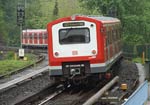 Expand Image Expand ImageThe distinctive Class 472 is now the oldest Hamburg S-Bahn rolling stock. | |
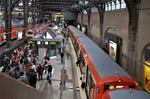 Expand Image Expand ImageHamburg Hbf has two of its four S-Bahn tracks inside the train shed. | |
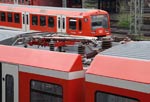 Expand Image Expand ImageClass 474 overhead current collection is encouraging system expansion. | |
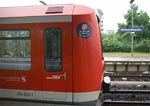 Expand Image Expand ImageHamburg-Neugraben to Stade is the longest single S-Bahn extension. | |
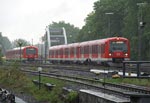 Expand Image Expand ImageThe new junction north of Ohlsdorf will take the S-Bahn to Hamburg Airport. | |
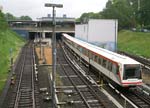 Expand Image Expand ImageU-Bahn routes complement the S-Bahn as Hamburg's urban rail service. |