Grenoble Light Rail System, France


|
Grenoble in the Isère département on the western edge of the French Alps had a tram service until 1952. Like many French systems, it went out of existence due to the high cost for required renewals compared to bus replacements and being perceived as an outmoded form of transport. When asked in 1983 whether they would like a modern tramway, the voters were only narrowly in its favour. Grenoble opened its first tramway in 1987 with the 8.8km (5.5 miles) between Fontaine La Poya and Grand Place. With the opening of Line D in October 2007, the system had grown to four lines with a combined length of 34.2km (21.4 miles). 
The Grenoble network is widely seen as an excellent example of marrying modern technology with sympathetic urban renewal. It has won particular praise for providing far greater access and independent travel for those with impaired mobility through the pioneering use of level access to low floor vehicles. The projectAlong with Nantes, Grenoble was in the first wave of modern French tramways. The network was intended to play an integral part in redevelopment of the whole city, which also included ridding large parts of the central area of most road vehicles, creating pedestrian-only zones, buildings renovation and landscaping. Contrary to opposition in some quarters claiming that banning the private car would damage retail business, shops and leisure facilities in the central area experienced resurgence, circumstances that have helped ease the adoption of new tramways in many other cities. The branding for public transport in the metropolitan area is TAG (from Transports de l'Agglomération Grenobloise). Like several French tramways, the Grenoble system is operated by Transdev, which is also a partner in the area’s mixed sector SEMITAG authority. Despite being situated in a famously mountainous area, Grenoble itself is relatively flat. A regional centre for Rhône-Alpes and with a large student population, the city attracts many visitors. InfrastructureTrack gauge is 1,435mm and the overhead power supply is rated at 750V DC. Completion of the initial section of Route A was followed by Line B on which work began in October 1990. Sharing the first section of the network between the main SNCF railway station and city centre with Route A, it branches east and runs 5.8km (3.5 miles) to serve a major hospital complex and the university campus, which engendered the name 'le tramway des etudiants' (the students' tramway). Lines linking such types of civic institution have become a characteristic of modern French systems, with these major population concentrations generating sufficient traffic to fill the trams to capacity at peak periods. Further extensions were added to Line A – a total of 3.8km – taking the route to Echirolles and Denis Papin between 1996 and 1998. "Line D linking Les Taillées Universités to Saint-Martin-d'Hères opened in October 2007."
The contract was let in early 2001 for a 13.5km (8.4-mile) Line C linking Seyssins, Seysinnet, St Martin d'Hères and the SNCF's station at Gieres, the site of a planned stop on the future Lyon-Turin high-speed rail line. The line was completed in March 2006, with 26 stations serving 60,000 residents and 30,000 jobs. A short extension of Line B opened in March 2006. With a short section shared with Line C, Line D linking Les Taillées Universités to Saint-Martin-d'Hères opened in October 2007. The network is characterised by a high level of park and ride places dispersed around the network to encourage tram use around the central area. Rolling stockGrenoble had at the outset the only entirely low-floor fleet in use in France, all units being part low-floor Tramway Français Standard (TFS) built by GEC Alsthom. Unlike the previous TFS-1 as operated in Nantes, Grenoble’s TFS-2 had all doorways giving access to a low-floor section. There were 39 TFS vehicles with a 186 passenger capacity in the original batch and a further 14 were introduced between 1995 and 1997. These featured a revised interior and are powered by GEC-Alsthom's Onix traction package which is more compact and designed for reduced maintenance and power consumption. In spite of the implication in its full name, the TFS proved to be short-lived and additions to the fleet have been from the highly successful Alstom Citadis modular range. Like the TFS-2 which remains the numerically dominant type in Grenoble, the Citadis variant is bi-directional. At 43.7m, almost 15m longer than the TFS, the 100% low-floor Citadis type 402 specified for Grenoble has a capacity for 274 passengers. (82 seated). The vehicles resulting from an order placed in 2003 entered service in 2006. Signalling and communicationsGrenoble ordered video surveillance to increase safety and security for both passengers and operational staff. New York-based Verint Systems was chosen to supply the Networked Video, which assists organisations in preventing incidents and allows improvements to be made to response times. On-board and tram stop information systems are fitted. "Projects for several extensions of existing lines exist for completion up to 2013."
As with other french tramway systems, trams in Grenoble receive priority at road junctions to assist in maintaining timetables. In addition to ticketing for all TAG, joint tickets are available that also cover SNCF's TER regional trains or the Transisère bus network. The futureThe growth of the Grenoble tramway and the resurgence of the city as a destination are indicative of the system's success. In November 2007 TAG placed an order for a further 15 Citadis 402 trams. In 2009 a Line B extension will open from Cité Internationale to Polygone Scientifique. Projects for several extensions of existing lines exist for completion up to 2013. A new line E would extend the system to Meylan in the north east. A long-term plan is to reduce reliance upon travel through the city centre lines with a southern extension of Line D to connect with Line C in the south west. The muted tram-train service in the Grenoble area has yet to gain substance. |
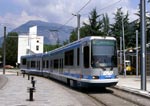  Expand Image Expand ImageA short-lived but important design, the TFS is the numerically dominant type in the TAG fleet. |
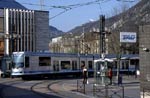 Expand Image Expand ImageA TFS near Grenoble's SNCF station in the early years of the tramway's operation. | |
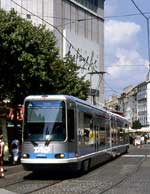 Expand Image Expand ImageContrary to views expressed by tramway opponents, removing cars has brought more activity back to the city centre. | |
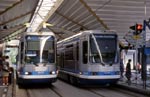 Expand Image Expand ImageThis elaborate Line A structure also incorporated a bus interchange and serviced demand from an adjacent suburban shopping centre. | |
 Expand Image Expand ImageTAG's latest fleet additions are 100% low-floor Alstom Citadis vehicles. | |
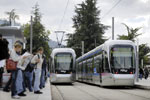 Expand Image Expand ImageRouting the tramway past the SNCF station, shopping centres, large hospitals and universities ensures a high take-up of services. | |
 Expand Image Expand ImageThe second batch of Alstom Citadis 402 trams ordered by Grenoble under construction in La Rochelle in 2008. |