Glattalbahn Light Rail (VBG), Zurich, Switzerland


|
The urban Glatt valley district (Glattal) adjoins the northern edge of Zurich, Switzerland's largest city. Even in the context of Zurich's expansion of population and job creation, the middle Glattal is undergoing intensive development, as exemplified by the green field development of Glattpark, Opfikon. Planning restrictions apply in Switzerland to commercial and residential developments in respect of the availability and capacity of nearby public transport. The middle Glattal also falls between Zurich's airport – a major employment centre – at Kloten and the city. 
Local transport authority Verkehrsbetriebe Glattal (VBG) is building a light rail system in association with the Zurich local transport authority (VBZ) and the tariff union of Zurich canton, ZVV. February 2003 saw the people of Zurich canton vote by two to one in favour of allocating CHF555m to the project. "Passenger forecasts estimated that between 3,000 and 5,000 people per hour would be able to use the system."
As the region became increasingly built up, the Glattalbahn (also 'Stadtbahn Glattal') was judged to be the most effective solution for reducing congestion and creating more orbitally based journey opportunities that would avoid Zurich city centre. It would also be fully compatible with the existing Zurich tram system. Passenger forecasts estimated that between 3,000 and 5,000 people per hour would be able to use the system, with an initial service frequency of a tram every 7.5min, stepping up to every 3–4min when fully operational. The initial project has three phases. Operating as an extension of VBZ route 11, the first phase used a connection with the VBZ tram system at Oerlikon Bahnhof, a busy S-Bahn station. Running from a former terminus, Messe/Hallenstadion, through the modern Thurgauerstrasse business district and past the Glattpark development to Auzelg, the line opened in December 2006. The second phase extends from a triangular junction with Phase 1 near the Glattpark stop to Zurich Airport (terminus Fracht, the airfreight terminal) and is due for a late 2008 opening. Although the airport has excellent long-distance and S-Bahn services at its sub-surface station beneath the main terminal building, this is not always useful for more local travel, especially relevant for the workforce. Phase 3 will extend from the current Auzelg terminus (which will remain so for Line 11) to Bahnhof Stettbach, a VBZ tram terminus and also on the S-Bahn. INFRASTRUCTURE Following conception of the light rail option for the area in the early 1990s, construction began in 2004. The 12.7km (7.9 mile) system resulting from phases 1–3 will be a mixture of street running and reserved way. Major works will include the tunnel near Bahnhof Glattbrugg, bridges over railways and roads, also the viaduct to raise the line above roads south from the airport. As per the Zurich network, turning circles will be installed for use by single-ended vehicles. A total of 21 stations will be built, many of which will be interchanges with Zurich S-Bahn stations and bus or tram routes of VBG and VBZ. Landscaping work includes grassed track as on Thurgauerstrasse and tree plantings, with easy access for pedestrians and cyclists. VBG hopes that passenger revenue will cover 65% of running costs when the system is operational. ROLLING STOCK The first phase in use for VBZ Line 11 has used Tram 2000 and Cobra classes. Although early design studies for the project implied a new form of streamlined vehicles would work Glattalbahn services, the 100% low-floor Cobra, a joint product of lead contractor Bombardier and Alstom, will become the system's rolling stock. The first of the batch specifically for VBG is expected to be delivered in 2008, with the dedicated fleet to carry its own livery, yet using the traditional Zurich colours of blue and white to give visual continuity with Glattalbahn services working into the city. "VBG hopes that passenger revenue will cover 65% of running costs when the system is operational."
SIGNALLING AND COMMUNICATIONS The Glattalbahn will follow standard light rail practice of 'line of sight' signalling with trams able to run at short headways and mix with existing road traffic and junctions. The stops have a consistency of design, providing shelter, ticketing machines and electronic real-time service displays. As with other modes throughout the canton, Glattalbahn services will be a constituent part of the ZVV's common ticketing system. THE FUTURE Phase 2 to the airport is scheduled to open in late 2008. Construction of Phase 3 is likely to start in summer 2008, giving a 2010 target for the initial network to be fully operational. Service numbers and routes will be modified as the system is commissioned, with the airport having two routes, 10 and 12, onwards to Zurich. Subject to approval is the longer-term plan for the Ringbahn Hardwald to the north and east which would complete a circuit for the Glattalbahn. |
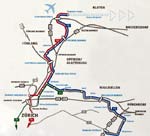  Expand Image Expand ImagePhases 1–3 of the Glattalbahn. |
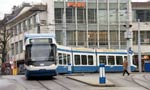 Expand Image Expand ImageThe Glattalbahn connects with the Zürich tram network at Oerlikon. | |
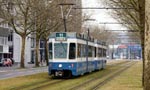 Expand Image Expand ImageA Tram 2000 on the landscaped alignment along Thurgauerstrasse, part of Phase 1. | |
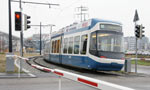 Expand Image Expand ImageGlattalbahn's light rail characteristics contrast with Zurich's more traditional tram alignments. | |
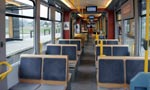 Expand Image Expand ImageThe interior of a Cobra tram, the type to be the rolling stock of the Glattalbahn. | |
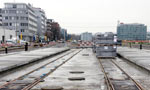 Expand Image Expand ImageDevelopments like the Kraft Food offices (right) require availability of high-capacity public transport: Phase 2 construction towards Lindbergh-Platz: April 2008. | |
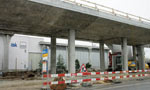 Expand Image Expand ImageViaducts will keep Phase 2 clear of road traffic around the intensively developed airport area. | |
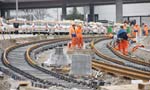 Expand Image Expand ImageConstruction between the airport passenger terminal and the Phase 2 terminus in the freight area: April 2008. | |
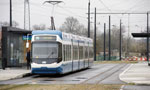 Expand Image Expand ImagePhase 3 will extend beyond the present Auzelg terminus from a point behind this Cobra tram. |

Related links
Zurich Tramway Developments