Fehmarnbelt Link, Denmark


|
Denmark and Sweden have been historically reliant upon ferry connections with countries to the south. This situation has been improved through the creation of fixed road and rail linksm, such as the bridge-tunnel crossings of the Great Belt within western Denmark (opened in 1998) and the Øresund bridge between Malmo, Sweden and Copenhagen, Denmark (opened in 2000). The latest project to be approved – after spending more than 20 years under consideration –is the Fehmarnbelt Link, which will cross the 19km (11.8 miles) Baltic channel of the same name separating Germany and Denmark. 
The project The Fehmarnbelt Link will connect Puttgarden on Fehmarn Island (Germany) with Rødby on the Danish island of Lolland. The construction of the project was ratified by Denmark's parliament in March 2009, and Germany's in June 2010. Each island is already connected to their respective national rail systems. With a ferry link, these are traversed by the Vogelfluglinie ("bird flight line", an allusion to migration by the direct route), a DSB/DB jointly operated passenger service between Hamburg and Copenhagen Central stations. Project execution is largely in Danish hands, as is the funding. Wholly owned by the Danish government under Sund & Bælt Holding A/S, and modelled on operations for the Øresund and Great Belt projects, Femern Bælt AS is initially charged with preliminary arrangements. The German contribution relates only to connecting lines and roads. For rail these will mainly be improvements over the 89km (55 miles) between Lübeck and Puttgarden. "Project execution is largely in
Danish hands, as is the funding." The Hamburg-Lübeck section is already subject to an upgrading and electrification project. Femern Bælt A/S has signed contracts with two technical consultancy groups: a Danish-German joint venture consisting of Cowi A/S and Obermeyer for the construction of the bridge, and the Danish-UK-Dutch joint venture consisting of Rambøll, Arup and TEC for the construction of tunnel. An infocenter was opened at Rødbyhavn in 2010, providing information on the project details and its impact on Denmark and Germany. It is expected that the rail link will strengthen local towns and cities through investments and localisation. Infrastructure A cable-stayed bridge has been selected as the preferred Fehmarnbelt crossing, as this would allow for four motorway lanes and a twin-track railway. "A cable-stayed bridge is the preferred Fehmarnbelt crossing, as this would allow for four motorway lanes and a twin-track railway."
An immersed tunnel is also being considered, the eventual means chosen being subject to criteria that includes cost, implications for shipping in this vital sea channel and the environment, particularly relevant to the sparsely populated areas and natural habitats at either end of the crossing. The main line west from Copenhagen carries traffic to Aarhus and Odense, Denmark's second and third largest cities, and to Germany via the Great Belt and Padborg border crossing. The route is notoriously restricted by limited main line infrastructure, the parallel Copenhagen suburban S-tog as far as Høje Taastrup being a free-standing system. Existing planning for increasing capacity here will need revision to take account of the Fehmarnbelt project. This will also bring 25kV electrification from the junction at Ringsted onwards to Rødby. Rolling stock Between Rødby and Puttgarden harbour terminals, Vogelfluglinie trains travel aboard Scandlines train ferries with passengers disembarking and embarking aboard for the 45min crossing. For many years Hamburg-Copenhagen was solely operated by Danish IC3 multiple units, supplemented from late 2007 by German ICE Class 605. Even with completion of the Hamburg-Lübeck electrification, ship access and unpowered sections on both systems require the continued use of diesel units. With the completion of the Fehmarnbelt project, connecting lines will be electrified, albeit with different systems. Germany uses 15kV AC, whereas currently limited to Helsingør-Copenhagen-Padborg, the Danish have installed 25kV AC. "Dual-voltage locomotives for freight and passengers will be required."
Dual-voltage locomotives for freight and passenger stock will therefore be required, comparable to conditions created by the Øresund link where dual-voltage Bombardier Contessa units automatically switch between Danish and Swedish power and signalling systems. Signalling and communications In 2006, the Danish government committed to a complete signalling systems renewal on the national network controlled by Banedanmark, who are seeking resources for a 2018 completion target. It is probable that European ERTMS Level 2 will be adopted for the Fehmarnbelt project. The future Construction is expected to start in 2011, and commercial services are due to begin in 2018. The Fehmarnbelt fixed link should cut Hamburg-Copenhagen journey times by one-third. However, the availability of an electrified and faster line means services are likely to be recast to provide longer distance through-running that is not constrained by the Vogelfluglinie end-points. Much of the rail freight currently using the continuous but longer land route via Padborg is likely to take the Fehmarnbelt crossing. The Fehmarnbelt scheme's adoption appears to have ended f a rival project for a Rostock-Gedser crossing for the foreseeable future. Twice as long, and with differing engineering challenges and implications for connecting infrastructure, this scheme was argued to be more suited to linking Scandinavia with growing markets in central and eastern Europe. Aside from forecast general rises in traffic levels, and based upon the Øresund and Great Belt examples, it seems certain that the increased capacity, shorter transit times and reduced costs will see the Fehmarnbelt Link greatly increase the region's volume of road and rail journeys. |
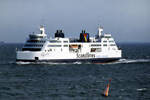  Expand Image Expand ImageThe Fehmarnbelt section of the Copenhagen-Hamburg rail service is currently provided by Scandlines train ferries. |
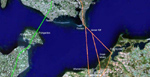 Expand Image Expand ImageThe Fehmarnbelt fixed link (in green) has won official support rather than the competing easterly Rostock-Gedser schemes. | |
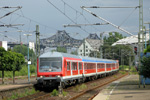 Expand Image Expand ImageMade possible by the Great Belt crossing, the present Germany-Denmark continuous rail connection is via the Jutland peninsular (Rendsburg). | |
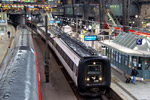 Expand Image Expand ImageRequiring diesel power, the service between Copenhagen-Hamburg (pictured) was for many years been provided solely by Danish IC3 units. | |
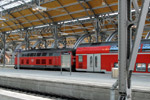 Expand Image Expand ImageWith Hamburg-Lübeck (pictured) electrified, it leaves the section northwards to Puttgarden to be upgraded for the Fehmarnbelt project. | |
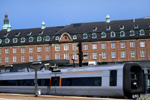 Expand Image Expand ImageIndicative of that project's success, more Bombardier dual system Contessa units were ordered for the Øresund fixed link in 2008 (Copenhagen). | |
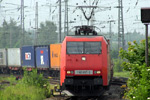 Expand Image Expand ImageThe Fehmarnbelt fixed link seems likely to become the main rail freight route between Scandinavia and the rest of Europe. | |
 Expand Image Expand ImageA cable-stayed bridge is the favoured but not yet certain means of crossing the Fehmarnbelt. |

Related links
Danish-German High-Speed Rail Link Contract Announced