Edinburgh Tramway, United Kingdom


|
Edinburgh, Scotland's capital city and administrative centre, is to open the first section of its new tramway network in 2011. It will be less ambitious than hoped, because the rejection of congestion charging by a public referendum has removed one of the principal sources of funding. The light rail scheme passed its final legal hurdles in the Scottish Parliament at the end of 2007, having been within a hair's breadth of cancellation when political control was gained by the minority Scottish National Party, its members believing that the tramway money could be better spent on road improvement schemes across the country. Its concerns that the project would overrun on costs were however not supported by an independent audit, and other political groups finally forced the project through Parliament by a narrow vote. 
Edinburgh Tram is managed by the city council's arms-length company Transport Initiatives Edinburgh (TIE), and the operator will be Transdev. The primary funders are a consortium of the Scottish Executive, Edinburgh City Council and developers, including Forth Ports. THE PROJECT Phase 1 of Edinburgh Tram concentrates on running from the airport in the west to Newhaven in the heart of the Leith Docks commercial and leisure development area, running via the city centre and calling at Haymarket and Waverley national rail stations. "It is proposed that an initial frequency of six trams per hour will run across the first phase."
The total cost of the project (for the first two routes) is £545m, and it is hoped that this will come in under budget, allowing the savings to be used for a Phase 1b from the Haymarket to Granton, and running close to Western General Hospital. Later phases will include the completion of an outer circle via a short connecting line between Granton Square and Newhaven, and also a branch from Ingliston Park and Ride to Newbridge North. As both trams and Lothian Buses will be owned by the City of Edinburgh Council, fares will be the same for equivalent journeys. New ticket machines were installed at key city centre bus stops in 2007 so passengers can experience using them. It is proposed that an initial frequency of six trams per hour will run across the first phase. This will climb to 12 an hour from St Andrew Square to the foot of Leith Walk. INFRASTRUCTURE Preliminary ground works started in the autumn of 2007, and in a pioneering move for the UK, advance agreement was reached with gas, water and electricity companies to move all utility pipes and cables in one contract to minimise disruption and also allow easy access in the future. Standard gauge track (1,435mm) will be used in the project, and conventional tram stop platforms and shelters with ticket machines, lighting and CCTV together installed. The network is also being designed for disabled access throughout. New bridges will be required to cross the railway network at Edinburgh Park and Stenhouse, and Murrayfield Viaduct will require attention for trams to pass beneath it. Existing bridges at Balgreen, Roseburn, Coltbridge and Craigleith will be widened. The principal rolling stock and maintenance depot is at Gogar, close to the airport, which has required extensive ground excavation to provide sound insulation in a sensitive area. ROLLING STOCK Spanish builder CAF beat Alstom to win the contract to supply 27 trams under a 30-year build-and-maintain arrangement. The trams will use conventional welded steel bodyshells, intended for a long life and ease of repair damage. They will be 42m long, with seven modules resting on four bogies. The French team responsible for the internal design also worked on the Nottingham Express Transit trams for Bombardier, and TIE has specified step-free access and internal movement, and large luggage areas for airport passengers. A unique feature is the ability screen off part of the tram for night services, giving on-tram staff great control for small number of passengers SIGNALLING AND COMMUNICATIONS "It is finance and fear of overspending that is stifling the expansion of Edinburgh Tram."
The preferred bidder for the £220m infrastructure contract was named at the end of 2007 as the Siemens/Bilfinger Berger consortium. It will also be responsible for supervising the delivery of the CAF trams. The signalling will follow tramway conventions, with vehicles manually driven on 'line of sight' procedures, but with the benefit of computerised management on non-segregated track sections and automatic maintenance data collection. All waiting shelters and trams will be equipped with CCTV and emergency call points, with additional real-time information displays inside the trams. A public address system will also be available to the driver. THE FUTURE It is finance and fear of overspending that is stifling the expansion of Edinburgh Tram. After the Leith circle is completed, there is the desire to build an extension from the Ingliston Park and Ride stop to Newbridge North on the western outskirts of the city. In the much longer term, lines to Edinburgh Royal Infirmary, Newcraighall, Livingston, Dalkeith, Musselburgh and Queensferry are possible. |
  Expand Image Expand ImageA fleet of 27 seven-module trams have been ordered from CAF in Spain. |
 Expand Image Expand ImageThe busy thoroughfare of Leith Walk will be less dominated by motor cars when trams start running in 2011. | |
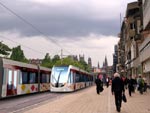 Expand Image Expand ImageNewhaven will be the short-term northern limit of tram operation when the first phase is complete. | |
 Expand Image Expand ImagePrinces Street at the heart of the city centre will be provided with a frequent-interval service to both Edinburgh Airport and the Leith business and retail area. | |
 Expand Image Expand ImageThe most recent UK order for CAF products has been the 23 trains for Northern Ireland Railways from 2004. The Class C3K trains run in three-car formations. | |
 Expand Image Expand ImageMap displaying the route of the new tramway in Edinburgh. |

Related links
Siemens - High Speed and Suburban Trains