Al Safooh Light Rail, Dubai, United Arab Emirates


|
Dubai is part of the United Arab Emirates (UAE), a grouping of seven states formed in 1971, each ruled by their own emir and with a high level of autonomy. Dubai, the largest UAE city, and neighbouring Abu Dhabi are developing the area as a regional centre with particular reference to transport, trade and tourism. Part of the transformation of the UAE since the discovery of oil in the 1950s has been the application of fuel revenues to diversify the economy with a view to long-term prosperity and stability. 
A spate of building projects triggered a workforce demand, leading to rapid population increase. Growing by 292,000 during 2006, the population reached 1.42 million by the year's end, with around 75% of residents being expatriates. Such growth in a very short time has caused extreme traffic-related problems such as long journey times, a high level of accidents and pollution. In 2007 a government official identified congestion costs as approximating to 3.15% of the worth of the Gross Domestic Product. If vehicle growth goes unchecked, the trend will lead to over five million cars registered by 2020, their effect mainly concentrated on the urban area. THE PROJECT Dubai's Roads and Transport Authority (RTA) is addressing the issue through renewal and expansion of the bus fleet, also with low-emission vehicles for their taxi operations. Introducing rail transport to Dubai, the RTA Metro system is due to begin revenue services in late 2009. More recent is the Al Safooh tram project, the first modern application of trams in the Gulf region. Al Safooh (spellings vary) is a district adjoining the western Dubai seafront. It accommodates some free economic zones, several retail centres and is associated with the city's booming tourist trade, notably the Palm Jumeirah development. MVA consultancy and its Systra parent have been involved with Dubai's public transport planning since 2004, the principal rail outcome being the Metro project. The tram mode was recommended to match the district's need for closely spaced stops to service commuter and tourism demand. It also will make RTA's coverage more comprehensive for wholly public transport journeys. First announced in April 2008, RTA signed a contract in June valued at over €550m with the ABS consortium for delivery of Al Safooh project Phase 1. The composition of ABS is Alstom of France (with around €300m of the total), Belgian construction company Besix and UK-based multi-sector operator Serco. INFRASTRUCTURE Al Safooh features a world first for an open tramway of all stops equipped with platform screen doors, this allowing for full air conditioning of the system. Giving consistency with other RTA modes, including bus shelters, air conditioning adds to customer appeal in regular temperatures around 40°C. Another innovation is the use throughout of Alstom's catenary-free APS (Alimentation Par le Sol) system for electricity ground supply to trams whilst overhead. Although APS has been in use on sections of the Bordeaux tramway since 2003 and is specified for other French cities Angers, Reims and Orléans, this is the first total system application. As with third-rail pick-up being specified for Dubai Metro, the authorities wished to avoid what is considered as visually intrusive overhead line equipment. The full scheme is for 14km (8.7) mainly following Al Safooh Road, linking Madinat Jumeirah and the Mall of the Emirates with Dubai Marina and the Jumeirah Beach Residence. Phase 1 will create a twin-track 10km (6.2 mile) line with 13 stops, with a standard platform length of 44m. Mainly at surface level, there will be some elevated track near the Marina. To encourage overall public transport use, interchange with the Metro Red Line will be provided at three points. "Al Safooh features a world first for an open tramway of all stops equipped with platform screen doors."
ROLLING STOCK Alstom will supply 11 APS-fitted 100% low-floor Citadis 402 trams under Phase 1. This seven-module 44m variant is in service with APS equipment in Bordeaux and also with overhead supply in Grenoble, Strasbourg and on Paris T3 where it is configured to carry just over 300 passengers. Capacity in each direction for the Al Safooh project is put in excess of 5,000 per hour. SIGNALLING AND COMMUNICATIONS The signalling and ticketing system is to be Alstom-supplied, as is the control centre which as per norm on such modern schemes will probably be incorporated in the depot. THE FUTURE Phase 1 of the project should start commercial services during 2011. Phase 2, on which the ABS consortium has an option, would add another 14 trams and 4km (2.5 miles) with six stops. The system will connect with the 5.4km (3.35 mile) monorail for the Palm Jumeirah complex. |
  Expand Image Expand ImageOne of the world's fastest growing cities, Dubai is associated with high-profile developments. |
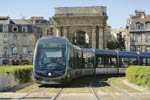 Expand Image Expand ImageAlstom's proprietary APS ground supply system is being fitted throughout on the Al Safooh system. | |
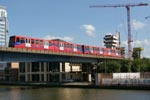 Expand Image Expand ImageConsortium member Serco is service operator on the successful London Docklands Light Railway. | |
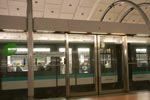 Expand Image Expand ImageWidely fitted on metro systems, platform screen doors will be used on a surface tramway for the first time in Dubai. | |
 Expand Image Expand ImageA high-capacity vehicle, the seven-module Citadis 402 can accommodate over 300 people. |

Related links
Bahrain to Conduct Feasibility Study for Rail Project