Dallas DART Light Rail Expansion, USA


|
The light rail system of Dallas Area Rapid Transit (DART) is to be doubled in size over the next decade following agreement on a $2.4bn investment programme. The year 2006 marked the tenth anniversary of the opening of the first 17.6km (11 mile) line with 14 stations, since grown to 77km (48 miles) with 39 stations. Rail, light rail and bus operator DART was formed in 1983. DART light rail was instigated in the mid-1990s, as a forward-thinking project associated with a major redevelopment of Dallas. It is reaping the rewards of its major investment, having grown from carrying 1.4 million passengers in 1996 to 17.5 million in 2005. DART has become one of the largest light rail systems in the USA, after Los Angeles, Newark, New Jersey, San Diego and Portland MAX. 
Expansion has nevertheless been stifled by a lack of revenue, but July 2006 saw DART receive a $700m grant from the United States Federal Transport Administration towards the total project cost. Construction has encouraged developments along the route, and there are now plans for $3bn in private activity alongside the routes. A 1% sales tax approved by residents of the 13 cities benefiting from DART services helps to fund the operation. The area continues to suffer from massive traffic congestion issues and rising pollution, and it is hoped that the planned new lines will significantly reduce the number of car journeys. The project Dallas was a centre for electric railways in the early 20th century, when it was served by the extensive network of the Texas Electric Railway. Suburban areas were served by an additional network of city lines, run by the Dallas Railway and Terminal Company, but this declined in the late 1950s, hastened by the introduction of the Interstate highway programme in 1956. However, by the mid-1970s, thanks to increased traffic congestion and growing fears of pollution, attempts to improve public transport were back on the agenda. In 1996 the first DART line opened. "A series of new lines and extensions are scheduled to open between 2009 and 2018."
A series of new lines and extensions are scheduled to open between 2009 and 2018, one of the main projects being the 44km (27.7 mile) Green Line, running from the northwest to the southeast. The estimated investment in the line is $1.8bn. Phase 1 of the line, which runs between Pearl station and MLK, Jr station (2.7 miles) opened in September 2009. The second phase of the line from MLK, Jr station to Buckner station (7.4 miles) is scheduled to open in December 2010. The second line will be the 14-mile long Orange Line, which will serve six station between Bachman and Dallas Fort Worth airport. The line is divided into three sections: a 5.4-mile section from Bachman station to Irving Convention Center station; a 3.9-mile section from Irving Convention Center station to Belt Line Road station; and the 4.7-mile section from Belt Line Road station to Dallas Fort Worth Airport. The first section is scheduled to be completed by December 2011 and the second by December 2012. In June 2010, the 4.7-mile third section from Belt Line Road to Dallas Fort Worth Airport was put on hold due to a shortfall in sales tax revenue. In August 2010, however, DART announced that it will go ahead with construction of the third section. The section will serve Dallas Fort Worth International, the world’s sixth busiest airport by passenger numbers. The third project will be an extension of the Blue Line, which will serve two stations, Rowlett and Lake Highlands. Construction of the Lake Highlands station is expected to be completed by the end of 2010. Construction of the line commenced in December 2009 and is scheduled to be completed by December 2012. The project is estimated to cost $275m. In total, the planned extensions will nearly double the network's length from 77km (48 miles) to 144km (90 miles). Lines and routes The first phase was greatly scaled down from initial objectives, comprising just two light rail routes forming a 32km (20 mile) starter railway. The first was 17.6km (11 miles) in June 1996. This was followed in 1997 by a 9.6km (6 mile) extension of the Red/Blue line and a 4.8km (3 mile) extension of Blue Line to South Oak. In September 2001, a 5km (3.1 mile) line north east on Blue Line opened, followed in May 2002 by a further 3.5km extension of the Blue Line. Subsequent work in 2002 added 12.5km to the network, and the latest opened in 2004. New funding released by the United States Federal Transportation Administration will allow the doubling of the network by 2014, including a 44km (27.7 mile) Green Line with 20 stations. It will serve regional destinations including Deep Ellum, Baylor University Medical Center, Fair Park, Victory Park and Dallas Market Center. "The planned extensions will nearly double the network's length from 77km (48 miles) to 144km (90 miles)."
A second branch will extend from the Green Line to Carrollton, to become the Orange Line. Design and planning consultation for the Green and Orange lines is done by Sasaki Associates of Boston and San Francisco. The company has been involved in several high profile projects in the Dallas area including the Addison Circle Park which is served by light rail. The Blue Line extension will provide services from Garland to Rowlett by 2012, giving an additional 60,000 passenger trips each weekday, doubling the current ridership. Austin Bridge & Road are the main contractors of the Blue Line extension. They were awarded a contract worth $188m. Rolling stock After visiting San Francisco Bay Area Rapid Transit (BART) system in 1987, the executive director of the Dallas project recommended the purchase of 210 cars, each with a 75ft (23m) rigid body, 10ft 10in (3.3m) wide, and mounted on two two-axle bogies, at a cost of $1.1m each. "In June 2010, the third section of the Orange Line was put on hold due to a shortfall in sales tax revenue."
However, realisation by DART staff that articulated cars, each 2ft narrower, could seat the same number of passengers resulted in this specification being adopted. The initial tranche of 40 vehicles was completed by Japanese manufacturer Kinki Sharyo of Osaka in 1995. All vehicles are serviced and maintained at a three-storey purpose-built facility in the Fair Park district of Dallas, reached by a spur off the lines between Cedars and 8th and Corinth. The first section of the Green Line uses 56 LRVs. Thirty eight of the present fleet have been retro-fitted with a low-floor section and the 18 Super LRV on order from Kinki Sharyo also include such a section. Another 19 Super LRV will be supplied for the Orange Line. Signalling and communications The most complex section is the Central Business District (CBD) stretch. This street-level section contains 13 crossings at grade, the remainder of the network has 42 level crossings. Intersections in the CBD are equipped with train signals linked to traffic lights. Additionally, several intersections have special traffic lights to restrict specific vehicle movements while trains are passing. Outside the CBD, signals are the traditional three-colour (red, amber, green) type, with level crossings protected by flashing red lights and gates. Cab signalling integrated with emergency braking is to be introduced on DART LRVs. |
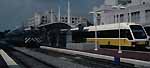  Expand Image Expand ImageLight and heavy rail commuter trains pull into station. |
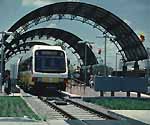 Expand Image Expand ImageWestmoreland station showing the roof design that protects passengers from the strong Texan sun. | |
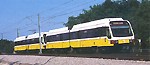 Expand Image Expand ImageSections of the former main line have been upgraded to allow the Dallas light rail vehicles to operate at speed. | |
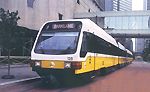 Expand Image Expand ImageLight rail vehicles move through a traffic-free transit mall. | |
 Expand Image Expand ImageThe Dallas light rail system has received funding to start expanding its network. | |
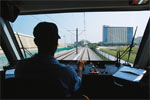 Expand Image Expand ImageThe driver of a DART LRT approaches a stop on the system. Soon there will be new route miles to learn. | |
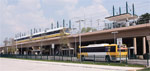 Expand Image Expand ImageInterchanges between transport modes are an important part of DART’s flexibility. | |
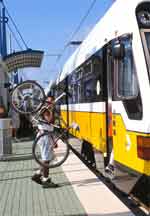 Expand Image Expand ImagePassengers with bicycles can also be accommodated on DART light rail network trains. | |
 Expand Image Expand ImageMap detailing the expansion of the network. |

Related links
North America Drives the Light Rail Boom