Valenciennes Tram System, France


|
One of the most notable things about the tram service in Valenciennes is its setting. Most contemporary light rail developments in France are based in major cities, but this one serves a dispersed cluster of communities - home to around 390,000 people. The population of Valenciennes itself is only 42,900. Valenciennes is part of the Nord département administrative area, adjoining the Belgian border. The region suffered from the extreme decline in the local industrial staples of mining, steel and textiles. It had an extensive tram network in the first half of the 20th century, but it closed in 1966. 
Revival has in part been through the automotive industry, with major employers PSA Peugeot Citroën and Toyota both having manufacturing plants locally. The latter was a relative newcomer to region, only beginning production in 2001, but became an active supporter of the tram project. Bombardier Transportation and Alstom also have rail vehicle manufacturing operations in the area. The European Railway Agency is also headquartered in Valenciennes. Its mandate is to create a competitive European railway area through increased cross-border compatibility. The project As is common in mining areas, Valenciennes features a number of closely spaced but self-contained settlements that evolved before the motor vehicle era. Consequently, it lacks a coherent road network, and the post-industrial infrastructure did little to encourage redevelopment. At grass roots level, a public survey of almost 1,250 people found 83% believed a tramway was "an interesting proposal", and more than two-thirds of those questioned said they would be likely to use the services. "An 8.8km extension of Line 1, from Dutemple to Denain, was carried out in phase 2."
The light rail scheme was sponsored by Syndicat Intercommunal des Transports Urbains de la Région de Valenciennes (SITURV); its supporters included local, regional and industry interests. Phase I of the project was given the go-ahead in 2000, despite the efforts of a powerful anti-tram lobby. An Alstom-led consortium was award the contract to build the system; it opened in July 2006. This phase cost €242.8m, and the European Investment Bank was an important source of these funds. The system is operated by French transport specialist company Transdev, under the name of Transvilles. Prior to January 2006, it operated under the name of Semurval. An 8.8km extension of Line 1, from Dutemple to Denain, was carried out in phase 2 of the project. The extension connected eight stations, and opened to the public in August 2007. Infrastructure The first phase of Line 1, a 9.5km double-track route, passes through residential, retail and industrial areas, variously using reserved tracks parallel to roads, dedicated alignments and streets restricted to tram and pedestrian use only. Although it includes central Valenciennes, it does not enter the impressive city square (which is open to road traffic). The closest it gets is the Hôtel de Ville tram stop a block away. "Five tram stops have adjoining park and ride sites to discourage car use within urban areas."
Like much of the evolving Valenciennes system, both original terminals, Dutemple and Université, are in semi-rural locations. As part of the reorganisation of road space – and in common with many other modern French tramways – the dedicated alignments make extensive use of grassed areas between and around the tracks. There are several bus interchanges along a route, including a stop at the busy SNCF railway station where passengers can connect to regional and long-distance services. The system's purpose-built depot and control centre is near the Saint Waast stop. Five tram stops have adjoining park and ride sites to discourage car use within urban areas. The first substantial addition to the system, almost doubling the length, extends south-west from the Line 1 terminus at Dutemple to the area's next largest community, Denain. The extension uses 6.5km of pre-existing but disused mining railway; as such, speeds of up to 70km/h are possible, with slowing for road crossings. In practice, overall operating speed for the extension is more than 10km/h faster than the original urban section's 20.8km/h. Two new stations have since been added to the line: Solange Tonini in 2008 and La Plaine in July 2009. One existing station, Allende, was renamed to Jean Dulieu in September 2008. Trams run between 5.30am and 10pm. Rolling stock Valenciennes opted for a fleet of 21 Alstom Citadis type 302 trams, the type used in the majority of French tram systems that have opened since 2000. This model has five-sections, low-floors, double doors and plenty of rails, allowing passengers to rapidly get on and off even at busy stops. There is also potential for units to be augmented with intermediate modules to meet any increased demand. Driver cabs are air conditioned. "The signalling and control systems are completely integrated, minimising the possibility of isolated problems bringing the entire network to a halt."
Signalling and communications Tickets can be bought from machines at each stop, with inspectors present on the route for revenue protection. Tram stops have real-time indicators displaying service information, and visual and audio announcements of stops are made onboard. The trams are also equipped with internal video surveillance cameras for added passenger protection. The trams have a cab signalling system, although they run on entirely reserved tracks, with warning signals at the many road intersections marked to indicate the absolute priority of trams. The signalling and control systems are completely integrated, helping keep down overall costs and minimising the possibility of isolated problems bringing the entire network to a halt. The future Projected extensions may see the system extended by 40km, consistent with the original objective of creating a network to unify the many communities in the Valenciennes area. The next likely developments will form part of Line 2, the first section of which is a 14km route from Croix d'Anzin on Line 1 to Vieux-Condé. Construction is scheduled to begin 2010, for a 2012 opening. Another Line 2 section would travel to Quiévrechain and across the Belgian border to nearby Quiévrain. A third project, less ambitious in terms of distance, could see a short link contructed between Saint Waast and Valenciennes' main hospital. |
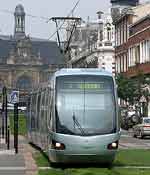  Expand Image Expand ImageClemenceau tram stop. Extensive use is made of grassed track alignments to control noise and soften the visual impact. |
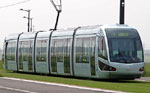 Expand Image Expand ImageBoth of the original terminals in semi-rural surroundings. | |
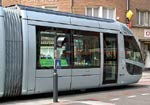 Expand Image Expand ImageThe system's many road crossings are signalled for priority to trams. | |
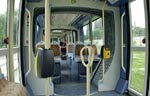 Expand Image Expand ImageLow floors and easy access makes the Citadis 302 ideal for frequent stops. | |
 Expand Image Expand ImageTrams serve the busy and impressive Valenciennes railway station. | |
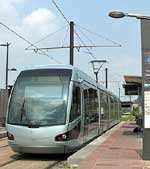 Expand Image Expand ImageThe stops include a shelter, information points and real-time indicators. | |
 Expand Image Expand ImageTwo Citadis trams pass on the new Dutemple to Denain extension, a former mineral railway alignment. | |
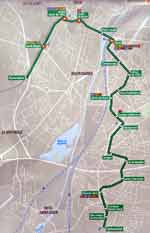 Expand Image Expand ImageA map of the modern tram network. |