Central Corridor, Minnesota, USA


|
The Central Corridor is a light rail transit system being developed in Minnesota, the US. It is the second light rail transit (LRT) in Minnesota – the first one being the Hiawatha line – and is the third rail line planned for Minneapolis. The transit system will connect Minneapolis and Saint Paul in Minnesota. The project was planned in order to reduce regular congestion in the region and to provide better access to automobile traffic. Minnesota's capital city Saint Paul and the region's largest city Minneapolis are together known as twin cities. The twin cities have united to form the 13th largest metropolitan area in the US, with a population of 3.5 million. 
The public transit systems in the metropolitan area include LRT systems and bus services. The rail transit system in Minneapolis has two lines, the Hiawatha line and the Northstar commuter rail. The Hiawatha line, also known as the yellow line, connects Minneapolis to Bloomington, while the Northstar commuter rail, or blue line, connects Big Lake with a station at Target Field. The Metro Transit, which operates the LRT systems and bus services in the region, will be the operator of the Central Corridor. Construction work is expected to begin in summer 2010 and is scheduled for completion by 2013. It will start its commercial operations in 2014. Central Corridor LRT project The initial planning for the project dates back to 1981. The Alternatives Analysis and Environmental Impact Statement (EIS) of the project, prepared by Ramsey County Regional Railroad Authority (RCRRA), were released in April 2006. "The Central Corridor is the second light rail transit in Minnesota."
In June 2006, the project was transmitted to the Metropolitan Council (MC), who supported it along with the Central Corridor coordinating committee. The MC submitted a "New Starts" application to the Federal Transit Administration (FTA) as well as a request to start preliminary engineering work. The FTA was involved in the evaluation of the LRT and in guiding the project to meet federal requirements. The preliminary engineering work, which is being carried out by the MC, was approved by the FTA in December 2006. Along with the other main bodies involved in the project, the MC finalised the station number and locations in December 2006, as well as the cost of the project and management plans. The local funding sources were also identified in December 2006. The project's scope was approved by the MC in February 2008. The Central Corridor will comprise a transit-pedestrian mall on Washington Avenue on University of Minnesota's (UoM) East Bank campus, a vehicle maintenance facility on Ramsey County, 18 stations along the line, and will also include the development of the infrastructure for three future stations. "St Paul and Minneapolis have united to form the 13th largest metropolitan area in the US."
The project's final EIS, Record of Decision and Letter of No Prejudice were approved by the FTA in August 2009. Following the approvals, the project applied for permission to enter the final design. The MC approved the execution of the advance utility contract in the same year. The transfer of the public utility began in September 2009, prior to the start of the LRT's construction. The project will be fully funded and start its construction after completion of the final design. Central Corridor line route The 18km Central Corridor – or red line – is an east-westbound line that connects the two major cities of Minnesota. The highly commuted regions of downtown Minneapolis and downtown St. Paul will be connected through the UoM along University Avenue. The Target Field station is planned to be the eastern terminal of the corridor, with the western terminal planned to be the Saint Paul Union Depot. The line will share stations with the already existing Hiawatha line and Downtown East / Metrodome station. Central Corridor finance The project is to receive funds from the US federal and Minnesota government. Out of the total funds, 50% will be awarded by the FTA and the remaining 50% will be awarded through state and county funds. "The Central Corridor LRT is scheduled for completion by 2013 and will start its commercial operations in 2014."
The state and county funds will include 30% funds from the new Counties Transit Improvement Board (CTIB), 10% funds from the state government, 7% from Ramsey and 3% from Hennepin County. The funds that will be awarded by CTIB will be generated through the metro county transit sales tax. According to the initial plan in 2006, the project was estimated to cost $941m. The plan included building 15 new stations as part of the project. In January 2010, it was announced that three more stations were to be added to the LRT. The stations will be on University Avenue at Western, Victoria and Hamline avenues, and will cost $15.6m, half of which will be funded by the federal government. The remaining cost will be funded by a coalition of local foundations known as the Central Corridor Funders Collaborative. The total project cost now stands at $956.6m. Rolling stock The rolling stock will include 31 new light rail vehicles. Each vehicle will have 66 seats and additional space to enable another 70 people to stand comfortably. Light rail transit line future plans The future LRT line, Southwest Corridor (or green line), will connect Minneapolis to the south-western suburb of Eden Prairie. The project, which is underway, is the fourth rail line planned for Minneapolis. Construction is anticipated to be completed by 2015. |
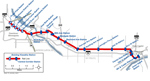  Expand Image Expand ImageMap of the Central Corridor line. |
 Expand Image Expand ImageWork in progress to connect the Hiawatha LRT line to a shared station with the Northstar commuter rail line in downtown Minneapolis. | |
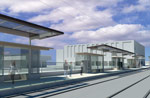 Expand Image Expand ImageThe LRT will have a total of 20 stations. |